
Publisher: HeavyPartsSource
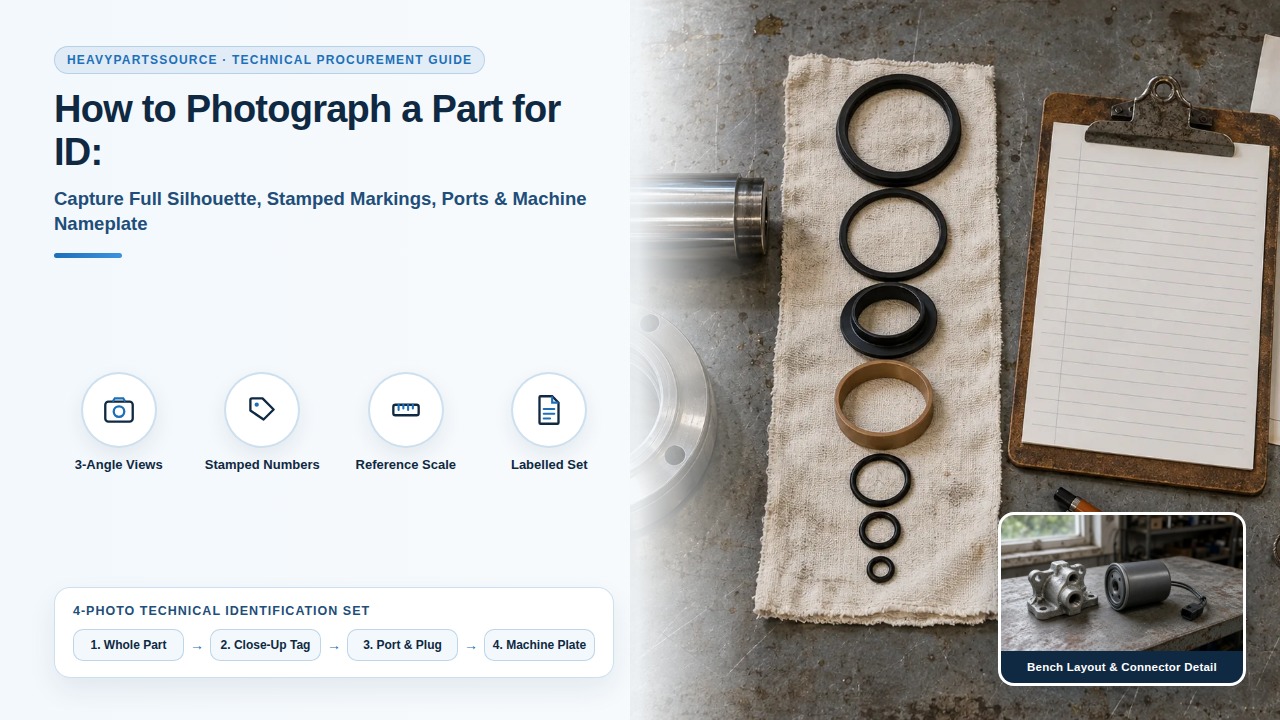
Submitting a single angled smartphone snapshot of a grease-covered heavy-equipment component—or laying a tape measure on the workbench 40–60 mm behind a raised hydraulic flange—causes perspective parallax measurement errors, illegible serial-tag glare, wrong-part international air-freight returns, and multi-day excavator bay downtime. Capture a structured, line-numbered 5-photo identification set that locks the machine's 17-character Product Identification Number (PIN), the sub-vendor component nameplate under oblique raking light, orthogonal 4-side housing views, and locked digital-caliper interface measurements before releasing a purchase order.
To photograph a heavy-equipment part for accurate technical identification and quotation verification, capture five standardized views for each request line (line-01, line-02): (1) the 17-character machine Product Identification Number (PIN) plate (ISO 10261:2021, >= 4 mm cab-plate characters or >= 6 mm / >= 0.2 mm deep right-hand frame stamping), (2) the sub-vendor component nameplate photographed straight on (90 deg) with camera flash OFF and a 10–25 deg oblique raking light to expose all three identification fields (Danfoss H1P Service Parts Manual AX152986481244en-001004, March 2026, page 5: assembly Ident number, model code string, and serial number), (3) four orthogonal whole-part silhouettes (front, back, left, right at 90 deg intervals) showing mounted regulators, pilot valves, and orientation, (4) locked vernier or digital caliper jaw-on-feature photos across ISO 6162-1 / ISO 6162-2 four-bolt split-flange centers (L_long x L_short within <= 1.0 mm), SAE J514 (37 deg JIC) vs. SAE J1453 (ORFS flat-face) thread seats, and paint-marked DIN 5480 involute spline teeth (z, d_a1, W_k), and (5) straight-on macro views of SAE J2030 Deutsch electrical connector mating faces and failure boundaries.
Scroll horizontally to view all columns.
| Photo view or verification input | Standard baseline or optical specification | Why it governs part identification & fitment |
|---|---|---|
Shot 1: Machine PIN plate & frame stamp (line-01-machine-pin.jpg) | ISO 10261:2021 Clauses 4.1–4.7, 5.2, 6.1, 7 (17-character PIN; >= 4 mm plate text or >= 6 mm / >= 0.2 mm deep frame stamp) | Filters OEM electronic parts catalogs (SIS, CSS, PartsPro, PROSIS, GSP) across mid-series production serial breaks |
Shot 2: Sub-vendor component nameplate (line-01-component-tag.jpg) | 90 deg orthogonal macro with flash OFF and 10–25 deg oblique raking LED light (Danfoss AX152986481244en-001004, March 2026, p. 5) | Separates complete assembly Ident number, internal configuration model code, and component serial number without flash whiteout |
Shot 3: Orthogonal 4-side whole-part context (line-01-overall-front.jpg) | Four perpendicular 90 deg elevations (L_cam >= 400 mm, 2x optical zoom / 50–70 mm equivalent) on a clean bench | Confirms attached sub-assemblies (regulators, auxiliary gear pumps, brackets) and distinguishes LH vs. RH hand orientation |
Shot 4: Locked caliper on flanges & threads (line-01-flange-caliper.jpg) | ISO 6162-1 (Code 61) vs. ISO 6162-2 (Code 62) bolt spacing (<= 1.0 mm); SAE J514 (37 deg JIC) vs. SAE J1453 (ORFS flat face) | Eliminates perspective parallax error (Delta z -> 0) and separates ports that share identical nominal bores and AS568 O-rings |
Shot 5: Spline shaft & harness pinout macro (line-01-spline-connector.jpg) | DIN 5480 / ISO 4156 (30 deg spline z, d_a1, W_k with paint dots) & SAE J2030 Deutsch DT04/DT06 keyway (Key A/B/C/D) | Prevents +-1 spline tooth miscounts and cross-mated solenoid/sensor harness connectors (orange vs. green wedge locks) |
Raw foundry casting marks (line-01-casting-mark.jpg) | Raised or embossed characters (>= 0.5 mm positive relief) cast into raw iron or aluminum housings | Logged strictly as secondary mold evidence; never used as a standalone orderable part number |
| File integrity & naming convention | Uncropped original .jpg / .png (>= 12 MP), zero AI super-resolution, named by request line (line-01-*) | Preserves micro-stamped digits and maps every image unambiguously to one quotation line item |
| Dominant failure mode & prevention | Perspective parallax (+15% to +25% ruler error) and flash glare causing mis-shipped heavy assemblies | Prevented by coplanar scale / locked caliper jaws on metal features and 10–25 deg oblique raking illumination |
How does the 5-shot heavy-equipment part photography protocol prevent fitment errors?
When a hydraulic pump, travel motor, main control valve, cylinder seal kit, or engine electronic control module (ECM) is requested without a verified OEM part number, photographs become the primary engineering evidence used to cross-reference candidate assemblies. A single oblique snapshot of a component sitting in a dark machine bay fails because it hides the opposite mounting face, distorts port center distances, and cannot prove whether auxiliary valves or sensors are included in the supply scope.
Under HeavyPartsSource's technical verification workflow, every unidentified or partially tagged component line requires a connected 5-shot photographic set where each view answers a distinct mechanical or catalog question:
Scroll horizontally to view all columns.
| Protocol shot & standard file name | Target subject & required camera geometry | Specific engineering features that must be visible in frame | Subsystem scope & catalog cross-check | Dominant failure mode & prevention |
|---|---|---|---|---|
Shot 1: Machine PIN & engine data plate (line-01-machine-pin.jpg) | Straight-on (90 deg) view of cab PIN plate (>= 4 mm text) or right-hand boom-foot frame stamping (>= 6 mm text, >= 0.2 mm depth per ISO 10261:2021) | All 17 characters of the machine PIN (WMC positions 1–3, MDS 4–8, Check Letter 9, MIS 10–17 prefix and sequential build number) | Locks the exact OEM serial break (S/N 50001 and up) in Caterpillar SIS, Komatsu CSS, Hitachi PartsPro, Volvo PROSIS, or SANY GSP | Failure mode: Photographing only the painted boom decal (320D, PC200-8, SY215C), missing mid-series pump or harness revisions. Prevention: Clean and photograph the 17-character ISO 10261 PIN plate and engine tag before component photos. |
Shot 2: Sub-vendor component nameplate (line-01-component-tag.jpg) | Macro (90 deg optical axis) with camera flash OFF and handheld LED light at 10–25 deg raking angle across the metal tag | All three sub-vendor fields (Danfoss AX152986481244en-001004, p. 5): Complete Assembly Ident No., Model Code string, and Component Serial No., plus separate shot of raised casting marks | Identifies exact internal rotating group, displacement regulator, shaft code, and service-bulletin break (SB-2020-013) | Failure mode: Direct on-camera flash creating a specular whiteout blob over stamped digits, or confusing a >= 0.5 mm raised casting number with the tag P/N. Prevention: Use 10–25 deg side raking light and label foundry marks strictly as line-01-casting-mark.jpg. |
Shot 3: Orthogonal 4-side whole-part views (line-01-overall-front.jpg, -back, -left, -right) | Four perpendicular elevations (0 deg, 90 deg, 180 deg, 270 deg) plus top view at L_cam >= 400 mm using 2x optical telephoto lens | Complete silhouette, mounting flange orientation, attached regulator/pilot valves, auxiliary tandem pump pad, and LH/RH machine installation side | Confirms assembly supply scope (complete unit vs. bare housing per Parker Cylinder Manual, p. 41) and port clock orientation | Failure mode: Wide-angle close-up hiding a rear auxiliary gear pump or reversing left-hand versus right-hand travel-motor porting. Prevention: Shoot all four orthogonal sides on a well-lit workbench before disassembly. |
Shot 4: Locked caliper on flanges & ports (line-01-flange-caliper.jpg) | Digital or vernier caliper jaws clamped directly on bolt holes or thread OD, with the caliper readout crisp in the same frame | ISO 6162-1 (Code 61) vs. ISO 6162-2 (Code 62) 4-bolt rectangle L_long x L_short (<= 1.0 mm), 'M' metric stamp, and SAE J514 (37 deg cone) vs. SAE J1453 (ORFS flat groove) seat | Separates 350 bar Code 61 from 420 bar Code 62 flanges and 37 deg JIC from ORFS or metric DIN 2353 24 deg cone fittings | Failure mode: Laying a tape measure on the bench behind a raised port face, introducing +15% to +25% perspective parallax magnification. Prevention: Lock caliper jaws directly on the machined metal feature (Delta z = 0 mm) and photograph the readout. |
Shot 5: Spline shaft, harness connector & damage (line-01-spline-connector.jpg) | 90 deg axial end-on macro of spline shaft and electrical plug mating face (polarization key at 12 o'clock), plus failure site | Paint-pen witness dots on DIN 5480 spline teeth (z), caliper span W_k, SAE J2030 Deutsch DT04/DT06 cavity count, wedge-lock color (orange vs. green), and cracked/scored area | Resolves shaft option codes (W 45 x 2 x 21 vs. 22), harness keying (Key A/B/C/D), and companion repair kit requirements | Failure mode: Miscounting spline teeth from an angled side view or shipping a solenoid valve with an incompatible harness keyway. Prevention: Dot every 5th spline tooth for an axial end-on shot and capture the connector mating face straight on. |
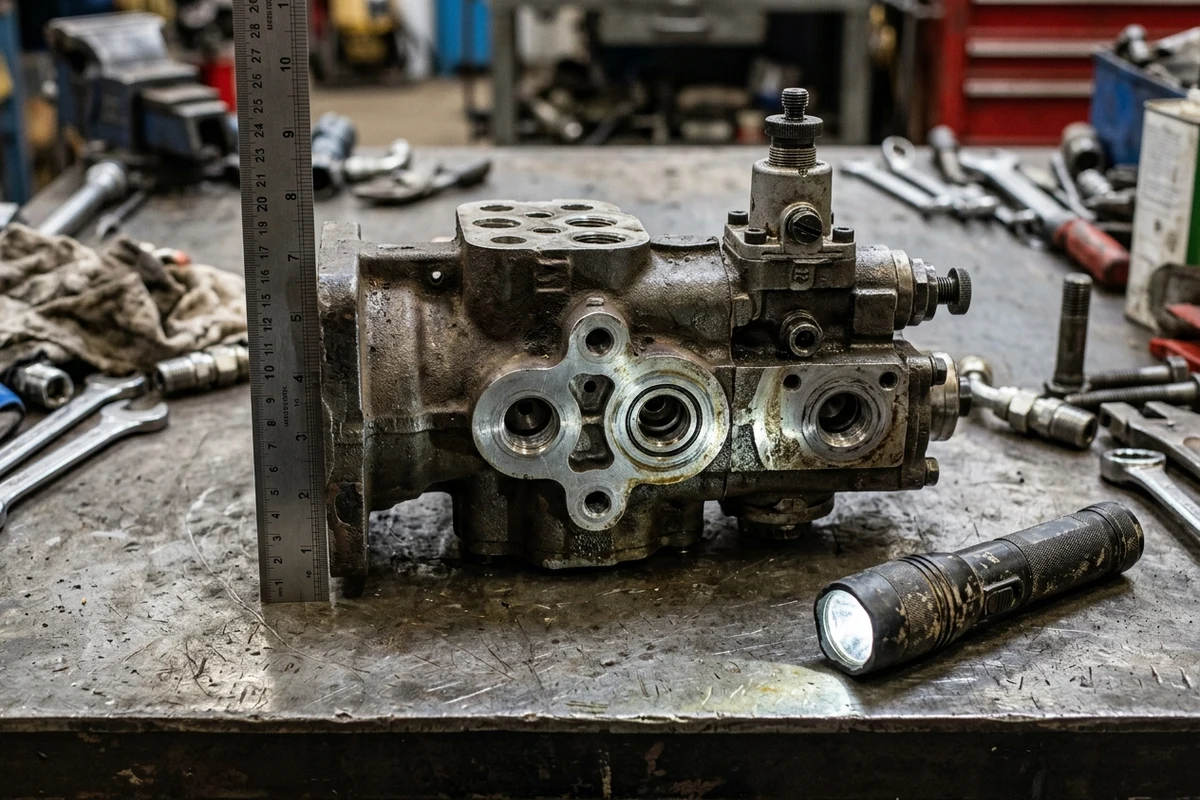
Workbench setup for orthogonal heavy-equipment part photography: clean machined port faces, a rigid stainless-steel machinist scale held flush in the exact measurement plane of the flange face, and angled LED work lighting.
Takeaway: Structure every part identification inquiry around the 5-shot sequence (machine PIN -> raking-light component tag -> 4-side orthogonal context -> locked-caliper port/flange dimensions -> axial spline & connector macro) and name every file with its request line (line-01-*).
Why do out-of-plane rulers and wide-angle smartphone lenses distort part dimensions?
The most common technical failure in field part photography occurs when a mechanic rests a heavy hydraulic pump, final drive cover, or cylinder gland on a workbench, lays a steel tape measure or ruler flat on the benchtop beside the base of the casting, and takes a top-down smartphone photo of a raised flange or shaft boss located Delta z = 30–80 mm above the bench surface. Because a standard smartphone main camera uses a wide-angle lens (24–28 mm full-frame equivalent focal length) held at a short working distance (L_cam = 200–300 mm), any feature closer to the camera lens than the ruler plane projects across a wider visual angle on the image sensor.
Projective Perspective Parallax Magnification & Cosine Tilt Error Equation
In pinhole and rectilinear lens optics, when a camera lens is positioned at perpendicular distance L_cam from the background reference scale plane, and the measured mechanical feature (such as a hydraulic port face, flange bolt circle, or shaft shoulder) lies at an out-of-plane elevation Delta z closer to the lens (Delta z > 0) while tilted by angle theta_tilt relative to the sensor plane, the apparent dimension D_app read against the background ruler and the absolute parallax error Delta D_app obey the exact geometric projection equations:
D_app = D_true * [ L_cam / (L_cam - Delta z) ] * cos(theta_tilt)
Delta D_app = D_app - D_true = D_true * [ Delta z / (L_cam - Delta z) ] ≈ D_true * (Delta z / L_cam) (for theta_tilt = 0 deg)
where D_true is the true mechanical dimension (mm), L_cam is the camera lens-to-scale working distance (mm), Delta z is the depth offset (mm) between the scale plane and the measured feature plane, and theta_tilt is the angular tilt (deg) between the feature surface and the camera sensor plane (cos(15 deg) = 0.9659, cos(25 deg) = 0.9063).
- Worked Example (
1-InchISO 6162-1 Code 61 Flange Photographed Above a Workbench Ruler): Suppose a technician photographs a1-inch(DN 25/-16) ISO 6162-1 Code 61 hydraulic pump port whose true long-axis bolt-hole center spacing isD_true = 52.40 mm. The pump housing rests on a workbench with the port face elevatedDelta z = 40.0 mmabove a steel ruler lying on the benchtop, and the smartphone camera is held parallel (theta_tilt = 0 deg) at a distanceL_cam = 250.0 mmabove the ruler:Delta D_app = 52.40 * [ 40.0 / (250.0 - 40.0) ] = 52.40 * (40.0 / 210.0) = 52.40 * 0.19048 = +9.98 mm
Reading the ruler in the photograph makes theD_app = 52.40 + 9.98 = 62.38 mm (+19.05% apparent magnification error)52.40 mm(1-inchCode 61) bolt pattern appear to be62.38 mm—causing a reviewer to bypass both1-inchCode 62 (57.2 mm) and1-1/4-inchCode 61 (58.7 mm) and misidentify the port as a1-1/4-inch(DN 32) flange.
Scroll horizontally to view all columns.
| Photographic measurement or lighting method | Optical geometry (L_cam, Delta z, theta_light) | Typical dimensional or legibility error | Suitability for heavy-part identification | Dominant failure mode & prevention |
|---|---|---|---|---|
Ruler or tape measure laid on bench beneath raised part (Delta z = 30–60 mm) | Wide-angle lens (24–28 mm eq.) at L_cam = 200–300 mm with out-of-plane offset Delta z > 30 mm | +12% to +25% (+6 to +15 mm) perspective parallax magnification error | Unacceptable for flange bolt circles, shaft diameters, or seal housings | Failure mode: Misclassifying ISO 6162 Code 61 vs. Code 62 flanges or ordering the wrong cylinder seal kit size. Prevention: Never place a scale on a lower background plane; hold the scale coplanar (abs(Delta z) <= 2.0 mm) or clamp calipers on the feature. |
Coplanar rigid machinist steel scale (abs(Delta z) <= 2.0 mm, 2x telephoto) | Scale pressed flush against the measured face; camera at L_cam >= 400 mm (50–70 mm eq.), theta_tilt <= 5 deg | +-0.5 to +-1.0 mm visual interpolation accuracy | Acceptable for overall envelope length, bracket centers, and hose length | Failure mode: Curved flexible tape measure sagging or hiding the zero edge on a chamfered port. Prevention: Use a rigid matte-finish stainless machinist rule aligned with a clear 100 mm index mark. |
Locked digital or vernier caliper clamped on machined feature (Delta z = 0 mm) | Caliper jaws seated directly on bolt holes, shaft OD, or spline span W_k; locking thumbscrew tightened | +-0.02 to +-0.05 mm direct mechanical metrological accuracy | Highest (Gold Standard) for DIN 5480 splines, ISO 6162 flanges, and cylinder rods | Failure mode: Measuring a swollen, cut urethane seal ring (Parker p. 41 / SKF p. 11) instead of the metal rod and gland bore. Prevention: Clamp caliper jaws strictly on clean, rigid machined metal surfaces and photograph both the jaw contact and readout. |
On-axis smartphone flash (theta_light ≈ 90 deg perpendicular to tag) | Coaxial LED flash next to camera lens reflecting off metal plate (theta_incidence = theta_reflection) | 40%–80% character loss due to saturated specular glare whiteout and zero groove shadow | Unacceptable for brushed aluminum nameplates or painted frame stampings | Failure mode: Central whiteout flare obliterating the middle digits of a 17-character ISO 10261 PIN or pump model code. Prevention: Turn on-camera flash OFF before photographing any metal plate or machined surface. |
Oblique raking LED illumination (theta_light = 10–25 deg grazing angle) | Camera perpendicular (90 deg) to plate; external work light held off to the side at 10–25 deg grazing angle | Full recovery of >= 0.2 mm stamped indentations with zero specular bounce into lens | Highest (Gold Standard) for corroded, abraded, or painted-over serial plates | Failure mode: Single-direction raking light missing vertical vs. horizontal stroke wear on heavily pitted steel stamps. Prevention: Take two raking-light macro shots—one lit from the 3 o'clock side and one lit from the 12 o'clock top edge. |
| Smartphone "AI text enhancer" / generative super-resolution zoom | Digital neural-network sharpening (> 5x digital zoom) applied to low-contrast or blurry stamped digits | High risk of hallucinated characters (3 -> 8, 5 -> 6, 0 -> D, 1 -> I) with false sharp edges | Strictly prohibited as sole identification evidence | Failure mode: Ordering an incompatible part number because smartphone AI redrew a scratched 3 as an 8. Prevention: Submit unedited original .jpg files at 1x–2x optical focal length and mark uncertain digits with [?] in text. |
Engineering Rule-of-Thumb (Perspective Parallax & Coplanar Scale / Locked-Caliper Threshold): If the depth offset Delta z between a measured hydraulic port, flange face, or shaft shoulder and a background workbench ruler is >= 5.0 mm (or the camera working distance L_cam is < 350 mm on a wide-angle smartphone lens) under part-dimension photography → clamp a digital or vernier caliper directly onto the machined feature (Delta z = 0 mm) or hold a rigid steel machinist scale coplanar within abs(Delta z) <= 2.0 mm at L_cam >= 400 mm using 2x optical zoom, because projective perspective parallax inflates apparent dimensions by Delta D_app ≈ D_true * (Delta z / L_cam)—enough to shift a 52.4 mm (1-inch Code 61) flange bolt spacing past 57.2 mm (1-inch Code 62) and into the 1-1/4-inch (58.7–66.7 mm) class.
Takeaway: Never photograph a ruler lying on the workbench behind a raised part feature; either lock caliper jaws directly onto the machined metal surface or hold a rigid steel scale flush in the exact same depth plane.
How do you photograph corroded or painted serial plates using oblique raking light?
On field excavators, wheel loaders, and heavy-duty trucks, the two metal plates that govern OEM and sub-vendor catalog lookup—the machine's 17-character ISO 10261:2021 PIN plate and the component's sub-vendor data tag—are routinely abraded by gravel, coated in oxidized hydraulic oil, or sprayed over during fleet repainting. When a technician points a smartphone straight at a metal tag with the built-in flash enabled, the metal surface acts as a mirror (angle of incidence = angle of reflection), bouncing a blinding white hotspot straight back into the lens while leaving shallow stamped grooves completely shadowless.
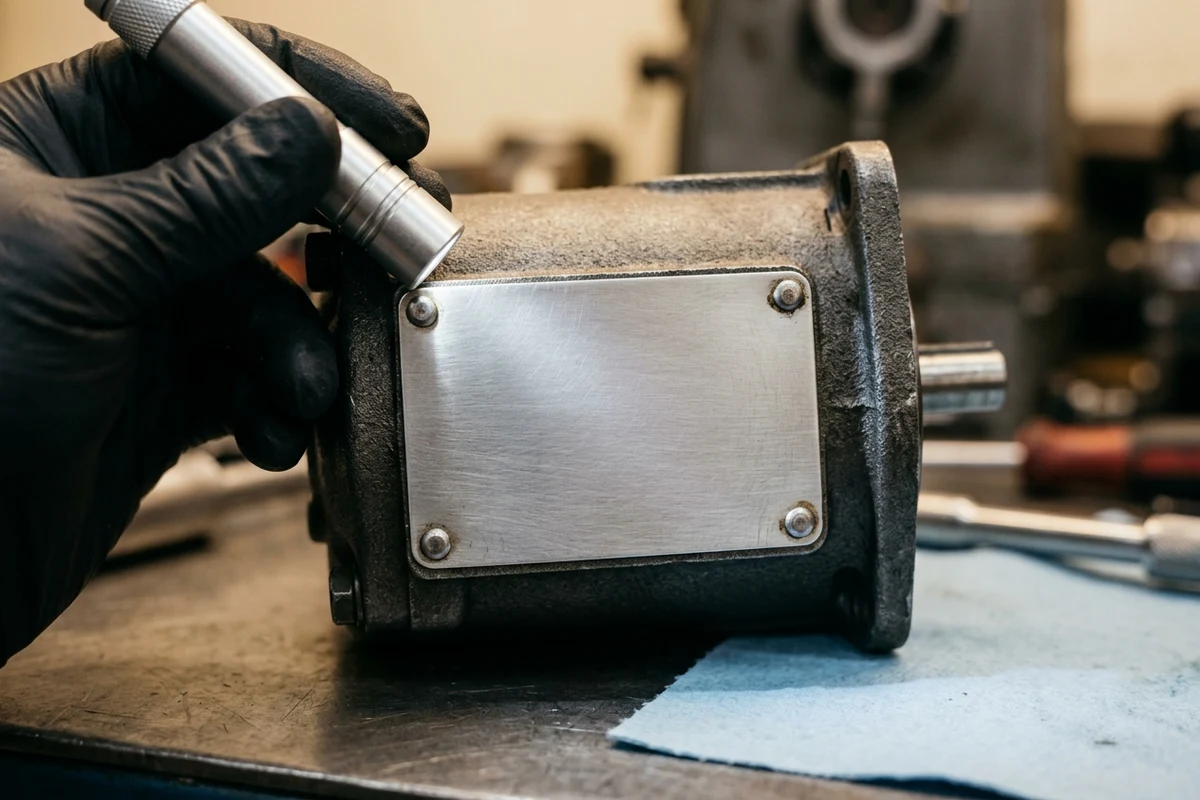
Oblique raking-light technique (10–25 deg grazing illumination with
on-camera flash turned OFF): side lighting casts crisp micro-shadows inside
recessed stamped grooves while routing specular glare away from the lens.
Step-by-Step Raking-Light Protocol for ISO 10261:2021 Frame Stamps & Sub-Vendor Nameplates
- Chemical surface cleaning without abrasive metal removal: Wipe grease, mud, and loose paint from the cab PIN plate (
>= 4 mmcharacter height per ISO 10261:2021 Clause 6.1), the right-hand boom-foot main-frame stamping (>= 6 mmcharacter height and>= 0.2 mmminimum stamping depth per ISO 10261:2021 Clauses 6.2 and 7), and the sub-vendor component tag using solvent and a lint-free shop rag. Never grind a riveted aluminum or laser-etched steel nameplate with a coarse flap disc or wire wheel, which obliterates shallow (0.05–0.20 mm) laser and micro-percussion markings. - Disable on-camera flash and lock orthogonal (
90 deg) framing: Hold the camera lens perpendicular (90 deg +- 5 deg) to the plate surface so all four corners of the plate are in focus and rectangular. Use1xor2xoptical magnification rather than extreme digital zoom. - Apply
10–25 degoblique raking illumination from two axes: Hold a separate LED inspection light nearly parallel to the plate surface—at a10 deg to 25 deggrazing angle from the 3 o'clock side edge, and then repeat from the 12 o'clock top edge (oblique-raking-light-scale-photography.txt). As the low-angle beam skims across the metal, the leading edge of every>= 0.2 mmstamped indentation blocks the beam and casts a dark, high-contrast shadow across the recessed floor of the character, making even painted-over or pitted digits legible without specular glare. - Capture all three sub-vendor nameplate fields (
Danfoss AX152986481244en-001004, March 2026, page 5): Verify before leaving the machine that your macro photo clearly resolves:- Complete Assembly Model / Material (Ident) Number (e.g.,
83038133): required to order a complete replacement pump, motor, or valve assembly. - Full Model Code String (e.g.,
H1P250 R A A A3 C1 N D8 C F8 E2 L 42 L 42 W P 24 PN NNN NNN): required to identify internal displacement controls, shaft spline options (A4–G3), end-cap porting (D6, D8, J1), and relief settings when ordering internal rotating groups or seal kits. - Component Serial Number (plant code + 2-digit year + 2-digit week + 5-digit sequence): required to check mid-series engineering service bulletins (
SB-2020-013,SB-2024-007).
- Complete Assembly Model / Material (Ident) Number (e.g.,
- Isolate raw foundry casting marks (
>= 0.5 mmraised relief) in a separate file: If you also photograph raised numbers cast into the raw iron or aluminum housing, name that fileline-01-casting-mark.jpgand log it strictly in the foundry observation field of our excavator part number verification guide so it is never mistaken for the finished assembly part number.
Engineering Rule-of-Thumb (Oblique Raking-Light vs. On-Axis Flash Glare Threshold): If a riveted component nameplate or right-hand main-frame PIN stamping (>= 0.2 mm groove depth per ISO 10261:2021 Clause 7) is corroded, abraded, or painted over under field inspection → switch the on-camera flash OFF, hold an external LED work light at an oblique grazing angle of 10 deg to 25 deg relative to the plate surface while aiming the camera lens perpendicular (90 deg ± 5 deg), and disable smartphone AI text enhancement, because coaxial flash bounces specular glare straight into the lens (theta_incidence = theta_reflection) while 10–25 deg raking light casts high-contrast shadows inside micro-stamped character walls.
Takeaway: Turn your camera flash off and hold a separate flashlight at a 10–25 deg grazing angle to the side of any stamped metal tag; submit both the unedited macro photo and your character-by-character transcription with [?] marking any uncertain digit.
How do you photograph hydraulic ports, involute splines, and electrical connectors when tags are missing?
When a component nameplate has been sheared off in demolition, quarry, or forestry service, overall context photos cannot distinguish between metric and inch port threads, standard and high-pressure split flanges, 21-tooth and 22-tooth involute splines, or differently keyed waterproof harness plugs. In these cases, your photo set must pair locked-caliper dimensional views with axial macro views of the mechanical and electrical interfaces.
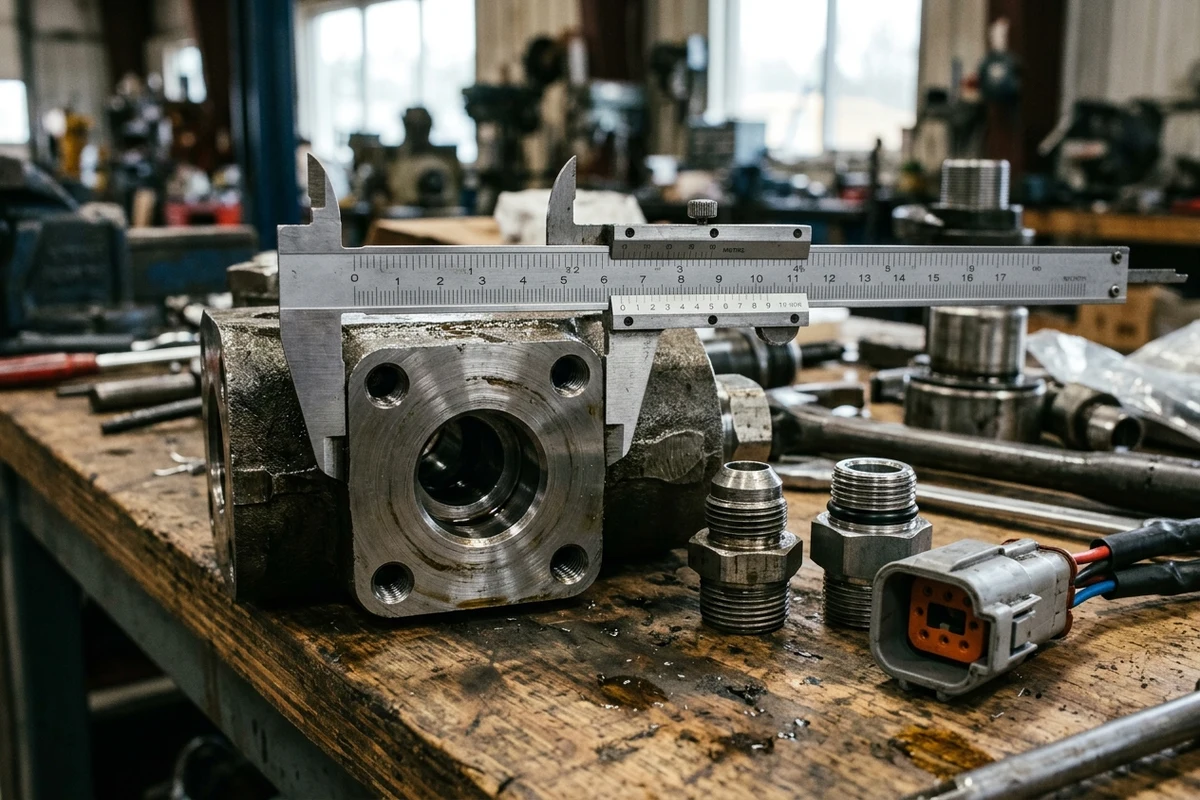
Interface verification bench setup: vernier caliper jaws locked across a 4-bolt split-flange port pattern alongside a 37-degree JIC flare fitting, a flat-face ORFS fitting with captive O-ring, and a keyed heavy-duty electrical connector plug.
1. Hydraulic Flange & Threaded Port Photography (ISO 6162-1/2, SAE J514 JIC, SAE J1453 ORFS)
As detailed in ISO 6162-1 / ISO 6162-2 (SAE J518 Code 61 vs. Code 62) and the SAE J514 / SAE J1453 Thread Identification Guide, visual snapshots of open hydraulic ports fail for two reasons: first, Code 61 (160–350 bar) and Code 62 (420 bar) split flanges of the same nominal dash size (-08 1/2", -12 3/4", -16 1", -20 1-1/4") share the exact same bore and ISO 3601-1 / AS568 O-ring (#210, #214, #219, #222), differing by only 2.4 to 8.0 mm across their 4-bolt rectangle (L_long x L_short); second, straight-thread tube fittings (SAE J514 37 deg JIC flare vs. SAE J1453 flat-face ORFS vs. DIN 2353 24 deg metric cone) look nearly identical from the outside hex nut.
Following SAE J518 metrological practice (Fluid Power World, Robert Mackey), zero your digital caliper on the bolt-hole diameter or measure center-to-center across both L_long and L_short within <= 1.0 mm, lock the caliper thumbscrew, and photograph the caliper seated on the port face alongside a macro view of the thread pitch gauge and internal sealing seat:
Scroll horizontally to view all columns.
| Hydraulic or electrical interface family | Governing standard & pressure / rating baseline | Critical dimensions & visual features to photograph | Example size comparison (Dash -06 / -08 / -12 / -16) | Dominant failure mode & prevention |
|---|---|---|---|---|
4-bolt split-flange port (Code 61 vs. Code 62) | ISO 6162-1 (Code 61, 160–350 bar) vs. ISO 6162-2 (Code 62, 420 bar / 6000 psi); ISO 3601-1 / AS568 3.53 mm O-rings | Locked caliper on L_long and L_short bolt centers (<= 1.0 mm), flange head thickness, bolt hole thread (UNC vs. metric), and 'M' stamp on port face | 3/4" (-12): 47.6 × 22.2 mm (Code 61) vs. 50.8 × 23.8 mm (Code 62, both #214 O-ring); 1" (-16): 52.4 × 26.2 mm (M10) vs. 57.2 × 27.8 mm (M12, both #219 O-ring) | Failure mode: Photographing only the port bore or #219 O-ring, resulting in a Code 61 pump shipped for a 420 bar Code 62 hose assembly. Prevention: Photograph locked calipers across both L_long and L_short and check for the 'M' metric stamp. |
JIC 37 deg flare fitting (SAE J514 / ISO 8434-2) | Straight UN/UNF mechanical threads with metal-to-metal 37 deg flare cone seat (no O-ring on nose) | Caliper jaw on Male Thread OD (or Female Thread ID), thread pitch gauge (TPI), and 45 deg angled macro showing the machined 37 deg cone seat | -06 (3/8"): 9/16"-18 UNF (0.56 in / 14.29 mm OD); -08 (1/2"): 3/4"-16 UNF (0.75 in / 19.05 mm OD); -12 (3/4"): 1-1/16"-12 UN (1.06 in / 26.99 mm OD) | Failure mode: Confusing a 37 deg JIC flare with a 45 deg SAE flare (SAE J512) or 24 deg metric DIN cone from a side photo. Prevention: Place a seat angle gauge (24°/30°/37°/45°) on the cone and photograph the caliper thread OD + TPI gauge. |
O-Ring Face Seal (ORFS) (SAE J1453 / ISO 8434-3) | Straight UN/UNF threads with machined flat face and captive 90-durometer nitrile O-ring groove in male face | Caliper jaw on Male Thread OD, thread pitch gauge (TPI), and axial macro of the flat face showing the captive face O-ring (011N90–029N90) | -06 (3/8"): 11/16"-16 UN (0.69 in / 17.46 mm OD, #012 O-ring); -08 (1/2"): 13/16"-16 UN (0.82 in / 20.64 mm OD, #014 O-ring); -12 (3/4"): 1-3/16"-12 UN (1.19 in / 30.16 mm OD, #018 O-ring) | Failure mode: Ordering a JIC adapter for an ORFS hose end because both use UN/UNF straight threads (12 TPI on -12 and larger). Prevention: Photograph the flat sealing face and caliper thread OD (1-3/16" ORFS vs. 1-1/16" JIC on -12). |
Involute spline drive shaft (DIN 5480 / ISO 4156 / ANSI B92.1) | 30 deg pressure angle involute spline (W d_B x m x z); module m = 1.25–3.0 mm, integer tooth count z | Paint-pen witness dots on Tooth #1 and every 5th tooth in a 90 deg axial end-on photo, plus caliper shots of shaft tip OD d_a1 and span W_k over k teeth | DIN 5480 - W 45 x 2 x 21 (z = 21, d_a1 = 44.00 mm, W_3 = 15.66 mm) vs. W 45 x 2 x 22 (z = 22, W_3 = 15.75 mm) | Failure mode: Counting spline teeth from an unmarked oblique photo and missing 1 tooth due to shaft curvature. Prevention: Mark every 5th tooth with paint, shoot dead-on axially (90 deg), and photograph caliper span W_k to ±0.05 mm. |
Heavy-duty electrical harness connector (SAE J2030 Deutsch DT / DTM) | Environmentally sealed thermoplastic housings (-55°C to +125°C, Size 16 contacts rated 13 A) with secondary terminal wedge locks | Straight-on (90 deg) macro of mating face with polarization key at 12 o'clock showing pin (DT04-*P) vs. socket (DT06-*S), wedge-lock color, housing key color, and rear wire colors | Plug DT06-*S uses orange wedge lock (W2S–W12S); Receptacle DT04-*P uses green wedge lock (W2P–W12P); 8/12-way keys: Key A = Gray, Key B = Black, Key C = Green, Key D = Brown | Failure mode: Photographing only the black wire loom side of a solenoid plug, hiding whether the housing is a 2-pin vs. 3-pin or Key A (Gray) vs. Key B (Black) variant. Prevention: Unplug the connector safely and photograph the mating face straight on plus the rear wire entry grommet. |
Engineering Rule-of-Thumb (Hydraulic Port & Thread Seat Angle Macro Verification Threshold): If a replacement hydraulic pump, control valve, or travel motor carries untagged 4-bolt split flanges or threaded tube adapters where bolt-center spacing differs by <= 4.8 mm (such as 1-inch ISO 6162-1 Code 61 at 52.4 × 26.2 mm vs. ISO 6162-2 Code 62 at 57.2 × 27.8 mm) or where UN/UNF straight threads overlap between 37 deg JIC flare (SAE J514) and flat-face ORFS (SAE J1453) → photograph the locked caliper reading across bolt centers (within <= 1.0 mm) or thread OD alongside an angled macro shot of the internal sealing seat (37 deg cone vs. captive O-ring face groove and 'M' metric port stamp), because outer hose hex nuts and shared AS568 O-rings (#214, #219, #222) look identical in side-profile snapshots.
2. Involute Spline Tooth-Mark & Span Equation (DIN 5480 / ISO 4156)
When photographing an untagged hydraulic pump or motor shaft (see our replacement hydraulic pump checklist and excavator final drive assembly scope guide), wipe all grease from the splines, place a high-contrast white or yellow paint dot on Tooth #1 and every 5th tooth (#5, #10, #15, #20) so any reviewer can verify the integer tooth count z from a single 90 deg axial end-on photograph, and clamp a vernier caliper across the outer tip diameter d_a1 and across k teeth (W_k). Under DIN 5480 (alpha = 30 deg pressure angle, cos(30 deg) = 0.866025, sin(30 deg) = 0.500, inv(30 deg) = tan(30 deg) - pi/6 = 0.053751 rad), the pitch diameter d, base circle diameter d_b, and caliper span W_k follow:
d = m * z, d_b = m * z * cos(alpha), W_k = m * cos(alpha) * [ pi * (k - 0.5) + z * inv(alpha) ] + 2 * x * m * sin(alpha)
- Worked Example (Verifying a 21-Tooth
DIN 5480Pump Spline in a Bench Photo): For a shaft with modulem = 2.0 mm, counted teethz = 21, pressure anglealpha = 30 deg, and profile shiftx * m = +0.10 mm(DIN 5480 - W 45 x 2 x 21), clamping the vernier caliper flat acrossk = 3teeth yields:
Photographing the paint-marked axial end view (d = 2.0 * 21 = 42.00 mm, d_b = 42.00 * 0.866025 = 36.37 mm, W_3 = 2.0 * 0.866025 * [ 3.141593 * 2.5 + 21 * 0.053751 ] + 2 * 0.10 * 0.500 = 15.66 mmz = 21) alongside the locked caliper reading (d_a1 = 44.00 mm,W_3 = 15.66 mm) positively distinguishes the shaft from a 22-tooth variant (W_3 = 15.75 mm).
Engineering Rule-of-Thumb (Involute Spline Paint-Mark & Harness Keyway Orientation Threshold): If an untagged drive shaft carries z >= 13 involute spline teeth (DIN 5480 / ISO 4156, 30 deg pressure angle) or an electrical solenoid/sensor harness uses a multi-pin Deutsch DT/DTM connector (SAE J2030) → mark spline tooth #1 and every 5th tooth with a contrasting paint dot before taking a 90 deg axial end-on photo (paired with caliper tip OD d_a1 and span W_k) and photograph the connector mating face straight on with the polarization keyway at 12 o'clock showing the wedge-lock color (orange W*S plug vs. green W*P receptacle and Key A/B/C/D housing color), because oblique shaft photos obscure 1–2 peripheral teeth and side-angle harness shots hide non-interchangeable pin cavities.
Takeaway: For hydraulic cylinders and seal kits, remember that photographing a stretched used elastomer seal against a ruler does not establish groove geometry (Parker Cylinder Manual, p. 41; SKF Hydraulic Seals Catalogue, Feb 2026, p. 11)—photograph the cylinder barrel tag, the old seal-kit bag label, and caliper measurements of the metal rod OD and gland bore using our hydraulic cylinder seal kits by size worksheet.
What does poor part photography cost in wrong-shipment air freight and excavator downtime?
Skipping a 20-minute workbench photo protocol—by sending a single blurry WhatsApp snapshot with flash glare over the nameplate and no caliper verification—transfers massive financial risk onto fleet maintenance operations. When an unverified photograph leads to a misidentified hydraulic pump, travel motor, control valve, or undercarriage group, the buyer absorbs multi-day machine standby losses, round-trip international air freight on heavy iron castings, restocking fees, and wasted mechanic bay hours.
Wrong-Part Downtime vs. 5-Photo Protocol Cost Savings Equation
The expected net financial savings C_net_save per critical procurement line item achieved by enforcing the 5-photo caliper and raking-light verification protocol before dispatch is defined by:
C_mismatch = (D_delay * H_shift * R_downtime) + (2 * W_ship * R_freight) + (P_part * f_restock) + C_labor
C_net_save = (p_err_snap - p_err_5photo) * C_mismatch - (t_photo * R_tech)
where D_delay is the replacement delay (days), H_shift is shift duration (h/day), R_downtime is the hourly excavator standby cost ($/h), W_ship is crated assembly weight (kg), R_freight is one-way air-freight rate ($/kg), P_part is part invoice price ($), f_restock is the restocking fee fraction, C_labor is wasted workshop fit-up labor ($), p_err_snap and p_err_5photo are the fitment mismatch probabilities under casual snapshot ordering versus the 5-photo verification protocol, and t_photo * R_tech is the technician time cost to shoot and label the 5-photo set.
- Worked Example (
145 kgExcavator Main Hydraulic Pump — Casual Snapshot vs. 5-Photo Protocol): For a145 kghydraulic pump (P_part = $4,800) where a wrong-part shipment causesD_delay = 6 daysatH_shift = 8 h/dayandR_downtime = $165/h($7,920downtime), two-way air freight atR_freight = $8.50/kg($2,465), af_restock = 15%fee ($720), andC_labor = $640(8 h × $80/h), a single fitment mismatch costsC_mismatch = $11,745. Reducing mismatch probability fromp_err_snap = 12%(0.12) on casual unscaled snapshots top_err_5photo = 0.5%(0.005) via at_photo = 0.35 h(21 min) photo protocol atR_tech = $80/hyields:
InvestingC_net_save = (0.12 - 0.005) * 11745 - (0.35 * 80) = (0.115 * 11745) - 28.00 = $1,350.68 - $28.00 = $1,322.68 per order line$28.00(21 minutes) of technician bench photography yields an expected net savings of $1,322.68 on every single pump inquiry and prevents a $11,745 loss whenever a mid-series port or spline difference is caught before shipment.
Scroll horizontally to view all columns.
| 5-Year Fleet Procurement TCO Dimension | Casual 1-Shot Unscaled Snapshot Inquiry | Standardized 5-Photo + Oblique Light + Locked Caliper Protocol | Primary Cost Driver & Operational Impact | Dominant Failure Mode & Prevention |
|---|---|---|---|---|
International air-freight returns on heavy assemblies (80–350 kg) | 10%–15% mis-shipment rate on untagged or repainted hydraulic/drivetrain parts | < 1% mismatch rate; interface discrepancies flagged before dispatch | Two-way air freight ($8–$12/kg) + customs re-import duties + 15% restocking fees | Failure mode: Shipping a 180 kg travel motor with the wrong flange series (Code 61 vs. Code 62) or housing bolt circle. Prevention: Submit Shot 4 (line-01-flange-caliper.jpg) and use the final drive scope guide. |
| Excavator & truck workshop bay standby downtime | 5–14 extra days parked in bay awaiting return credit and re-shipment | 0 extra re-shipment days; quotation locked to verified serial and interface photos | Idled 20–36 ton excavator standby penalty ($120–$220/h) plus stalled jobsite crew | Failure mode: Back-and-forth email delays spanning 3–4 days because initial photos had flash glare over the serial tag. Prevention: Capture 10–25 deg raking-light macro tags (Shot 2) and machine PIN (Shot 1) on day one. |
Solenoid valve, sensor & controller (ECM) harness mismatches | 15%–22% plug keyway or pinout mismatch when ordering by exterior body shape | Exact SAE J2030 Deutsch DT04/DT06 cavity count and Key A/B/C/D verified prior to order | Non-returnable electrical parts ($180–$1,800) and field splicing that voids IP67 sealing | Failure mode: Cutting and splicing factory wiring harnesses because a replacement valve arrived with a Key B (Black) instead of Key A (Gray) plug. Prevention: Photograph the connector mating face straight on (Shot 5) with keyway at 12 o'clock. |
| Hydraulic cylinder seal kit & filter consolidation errors | Wrong rod gland diameter (5 mm ruler parallax error) or mismatched filter thread/bypass | Metal rod/bore caliper verification (Parker p. 41) and exact OEM filter cross-check (Donaldson p. 58) | Oil contamination, blown rod seals, or fuel injector wear from improper filter substitution | Failure mode: Measuring a deformed rubber seal with a tape measure or swapping filters by visual canister size. Prevention: Follow our cylinder seal kit guide and diesel engine parts checklist. |
| Multi-line & multi-brand fleet RFQ processing time | Unlabelled photo dumps (IMG_4021.JPG) mixed across 6 different request lines | Line-indexed file naming (line-01-tag.jpg, line-02-ports.jpg) mapped to each row | Eliminates cross-line quotation confusion and accelerates pre-dispatch quality checks | Failure mode: Warehouse or engineering reviewer matching line-03 connector photo to line-01 valve body. Prevention: Pair line-numbered photo filenames with our multi-brand parts list guide and truck parts request guide. |
Takeaway: A 20-minute investment in coplanar caliper photography, 10–25 deg raking-light tag capture, and line-01-* file naming eliminates multi-day email bottlenecks and five-figure wrong-part air-freight losses.
For an excavator slew ring request, label the photos of the bearing markings, internal or external teeth, mating pinion and each mounting circle separately. Keep the photographs with the technician's readings using the slew ring bearing inspection and matching record; the guide explains which identification and condition fields to send together.
Copy the heavy-equipment part photography & file-naming log
Edit the template below, copy it, and paste it into your quotation request alongside your original image files. Use one block per request line (line-01, line-02), and never overwrite or digitally redraw unreadable characters—mark uncertain positions with [?] and describe what the camera could not reach.
Scroll horizontally to view all columns.
| Photo log section | Standardized filename pattern | What to verify before attaching the file |
|---|---|---|
1. Machine & engine PIN plates (ISO 10261:2021) | line-01-machine-pin.jpg, line-01-engine-plate.jpg | All 17 PIN characters (>= 4 mm cab plate or >= 6 mm / >= 0.2 mm deep right-hand frame stamp) are sharp and unclipped |
2. Sub-vendor component tag (10–25 deg raking light) | line-01-component-tag.jpg, line-01-casting-mark.jpg | On-camera flash is OFF; 10–25 deg side light exposes Assembly Ident No., Model Code, and Serial No. (Danfoss p. 5); casting marks kept separate |
3. Orthogonal 4-side context views (L_cam >= 400 mm) | line-01-overall-front.jpg, -back.jpg, -left.jpg, -right.jpg | Shot at 90 deg intervals using 2x optical zoom on a clean surface; clearly shows attached regulators, brackets, and LH/RH orientation |
| 4. Locked-caliper hydraulic port & flange checks | line-01-flange-caliper.jpg, line-01-thread-seat.jpg | Caliper jaws clamped directly on ISO 6162 bolt centers (L_long x L_short within <= 1.0 mm) or SAE J514 (37 deg) / SAE J1453 (ORFS) threads (Delta z = 0 mm) |
| 5. Spline shaft, harness connector & damage views | line-01-spline-axial.jpg, line-01-connector-face.jpg, line-01-damage.jpg | Paint dots on every 5th DIN 5480 spline tooth (z, d_a1, W_k); straight-on SAE J2030 Deutsch mating face showing wedge-lock color and keyway |
Takeaway: Naming each original image file with its request line and view (line-01-component-tag.jpg, line-01-flange-caliper.jpg) lets our engineering and part identification service teams match every dimension and serial break to the exact quotation row.
Frequently asked questions about photographing heavy-equipment parts
Why should I turn off my camera flash and AI enhancement when photographing a metal serial plate?
A built-in smartphone flash fires almost parallel to the camera lens (90 deg to the plate), bouncing specular glare straight back into the lens (angle of incidence = angle of reflection) and washing out stamped digits. Instead, turn the camera flash OFF and hold an external flashlight at a 10–25 deg grazing angle from the side to cast crisp shadows inside >= 0.2 mm stamped grooves. Never rely on smartphone AI text enhancement or super-resolution zoom, which frequently hallucinates corroded digits (3 into 8 or 5 into 6).
Why does laying a ruler on the workbench next to a hydraulic pump or flange give the wrong measurement in a photo?
When a hydraulic flange or shaft boss sits 30–60 mm (Delta z) above a ruler lying on the workbench, a close-up smartphone lens (L_cam = 200–300 mm) magnifies the closer feature relative to the background ruler by Delta D_app ≈ D_true * (Delta z / L_cam)—introducing a +12% to +25% perspective parallax error. Always clamp a digital or vernier caliper directly across the machined feature (Delta z = 0 mm) or hold a rigid steel machinist scale flush in the exact same depth plane (abs(Delta z) <= 2.0 mm).
How do I photograph hydraulic ports and electrical connectors so you can verify compatibility?
For four-bolt split flanges (ISO 6162-1 Code 61 vs. ISO 6162-2 Code 62), photograph a caliper locked across both the long and short bolt-hole center spacings (L_long x L_short within <= 1.0 mm) and capture any 'M' metric thread stamp near the port face. For threaded fittings (SAE J514 37 deg JIC vs. SAE J1453 flat-face ORFS), photograph the caliper on the thread OD alongside an angled shot of the internal sealing cone or flat face O-ring groove. For electrical connectors (SAE J2030 Deutsch DT04/DT06), photograph the mating face straight on with the polarization key at 12 o'clock so the pin/socket count, orange or green wedge lock, and housing key color (Key A/B/C/D) are visible.
For a hydraulic cylinder seal kit, should I photograph a ruler next to the old rubber seals?
No. Used polyurethane and nitrile seals swell, extrude, and permanently deform in service, so photographing a ruler next to a stretched seal ring cannot establish seal groove dimensions (Parker Cylinder Manual, p. 41; SKF Hydraulic Seals Catalogue, Feb 2026, p. 11). Photograph the stamped cylinder barrel/head nameplate, the original seal-kit bag label if available, and locked caliper measurements of the metal rod outer diameter and cylinder bore using our hydraulic cylinder seal kits by size guide.
What to send us
Scroll horizontally to view all columns.
| Item | Why we need it | Example format |
|---|---|---|
Shot 1: Machine PIN & engine data plate (ISO 10261:2021) | Locks the exact 17-character machine PIN serial break and engine arrangement across OEM catalogs | line-01-machine-pin.jpg, line-01-engine-plate.jpg plus typed 17-character PIN |
Shot 2: Sub-vendor component nameplate (10–25 deg raking light) | Captures the Assembly Ident No., Model Code string, and Component Serial No. without flash glare (Danfoss p. 5) | line-01-component-tag.jpg (flash OFF, side light) plus verbatim text transcription |
| Shot 3: Orthogonal 4-side whole-part context views | Confirms overall envelope, attached regulators/pilot valves, and LH vs. RH machine installation side | line-01-overall-front.jpg, -back.jpg, -left.jpg, -right.jpg at 2x optical zoom |
| Shot 4: Locked caliper on flanges & port thread seats | Eliminates perspective parallax (Delta z = 0 mm) on ISO 6162 Code 61/62 bolt patterns and SAE J514 / J1453 ports | line-01-flange-caliper.jpg, line-01-thread-seat.jpg with caliper LCD/scale readable |
| Shot 5: Paint-marked spline shaft & harness connector face | Verifies DIN 5480 spline tooth count (z, d_a1, W_k), SAE J2030 Deutsch keyway (Key A/B/C/D), and damage context | line-01-spline-axial.jpg, line-01-connector-face.jpg, line-01-damage.jpg |
| Completed photo log, supply scope & destination | Maps every image filename to one request line and defines complete assembly vs. bare unit vs. seal kit scope | Completed worksheet below submitted via our quote request form |
Visual similarity in a photograph or a preliminary hit in our catalog search does not by itself confirm internal displacement, relief valve pressure, software calibration, or interchangeability. When you are ready to verify a replacement part, send your line-numbered photo set and completed identification log for quotation review. Explore our heavy equipment parts directory, our parts sourcing service, and our multi-brand consolidation service, or read how our sourcing and quotation process works to see how HeavyPartsSource documents candidate offers, supply scope, and pre-dispatch quality checks in writing before you place an order.
Takeaway: A complete, unedited 5-photo set—combining 10–25 deg raking-light nameplate shots, orthogonal 4-side views, and locked-caliper port/spline/connector macros named by request line—gives our engineering team the exact metrological baseline required to confirm fitment before shipment.
Method and sources
This engineering photography guide and verification log were compiled from international machinery, fluid-power, and electrical connector standards, Close-Range Photogrammetry & Evidence Lighting principles, and OEM service parts manuals, reviewed October 2026:
- ISO 10261:2021(E), Earth-moving machinery — Product identification numbering system (Third edition, August 2021, Clauses 4.1–4.9, 5.1–5.3, 6.1–6.2, and 7): 17-character alphanumeric PIN structure (
WMC,MDS,Check Letter,MIS), exclusion of lettersI,O, andQin year codes,>= 4 mmproduct-plate character height, and>= 6 mm(>= 0.2 mmdepth) right-hand front frame primary stamping requirements. - Danfoss H1P 210, 250, and 280cc Axial Piston Pump Service Parts Manual (Document No. AX152986481244en-001004, March 2026, pages 2–5 and 129–138): sub-vendor nameplate separation between Complete Assembly Material (Ident) Number, internal module-defining Model Code string, and sequential Component Serial Number.
- ISO 6162-1 / ISO 6162-2 (SAE J518 Code 61 & Code 62) Four-Bolt Split-Flange Standards and Fluid Power World (How do you size hydraulic flanges?, Robert Mackey / Main Manufacturing Products Inc., May 2026): rectangular bolt-hole center spacings (
L_long x L_short),<= 1.0 mm(0.1 mmdigital caliper zero-on-hole) measurement practice, Type 1'M'metric port stamp, and sharedISO 3601-1 / AS5683.53 mmsection O-rings (#210,#214,#219,#222). - SAE J514 (ISO 8434-2,
37 degJIC Flare) & SAE J1453 (ISO 8434-3, ORFS O-Ring Face Seal) Thread Identification Guide (HydraulicStore Technical Information Chart, retrieved October 2026): male thread OD, female thread ID, thread pitch (UN/UNFTPI), seat angle gauge (24°/30°/37°/45°), and captive face O-ring (011N90–029N90) verification across dash sizes-02to-32. - DIN 5480 / ISO 4156 / ANSI B92.1 Involute Spline Standards (
eAssistant / DIN 5480 Engineering Manual, Section 17, retrieved October 2026):30 degpressure angle involute spline geometry (d = m * z,d_b = m * z * cos(30 deg), and vernier caliper base tangent spanW_kacrosskteeth). - SAE J2030 Heavy-Duty Electrical Connector Standard & Deutsch DT / DTM Series Reference Guide (
DeutschConnector.com Technical Reference, retrieved October 2026) and Close-Up Oblique Raking-Light & Coplanar Scale Photography Guidelines (Staggs, Crime Scene and Evidence Photography):DT04receptacle vs.DT06plug numbering, orange (W*S) vs. green (W*P) secondary wedge locks, 8/12-way housing polarization keys (Key A = Gray,Key B = Black,Key C = Green,Key D = Brown),10–25 degoblique grazing light for stamped relief, and coplanar scale placement (Delta z -> 0). - Parker Cylinder Parts Identification and Seal Kit Data Manual (pages 41 and 44–49), SKF Hydraulic Seals Catalogue (PUB SE/P1 12393/3 EN, February 2026, page 11), and Donaldson Engine Liquid Filtration Product Guide (Catalog No. F110024-ENG, page 58): cylinder symbol/item callouts, metal rod/bore vs. seal kit scope separation, and filter application verification rules.