
Publisher: HeavyPartsSource
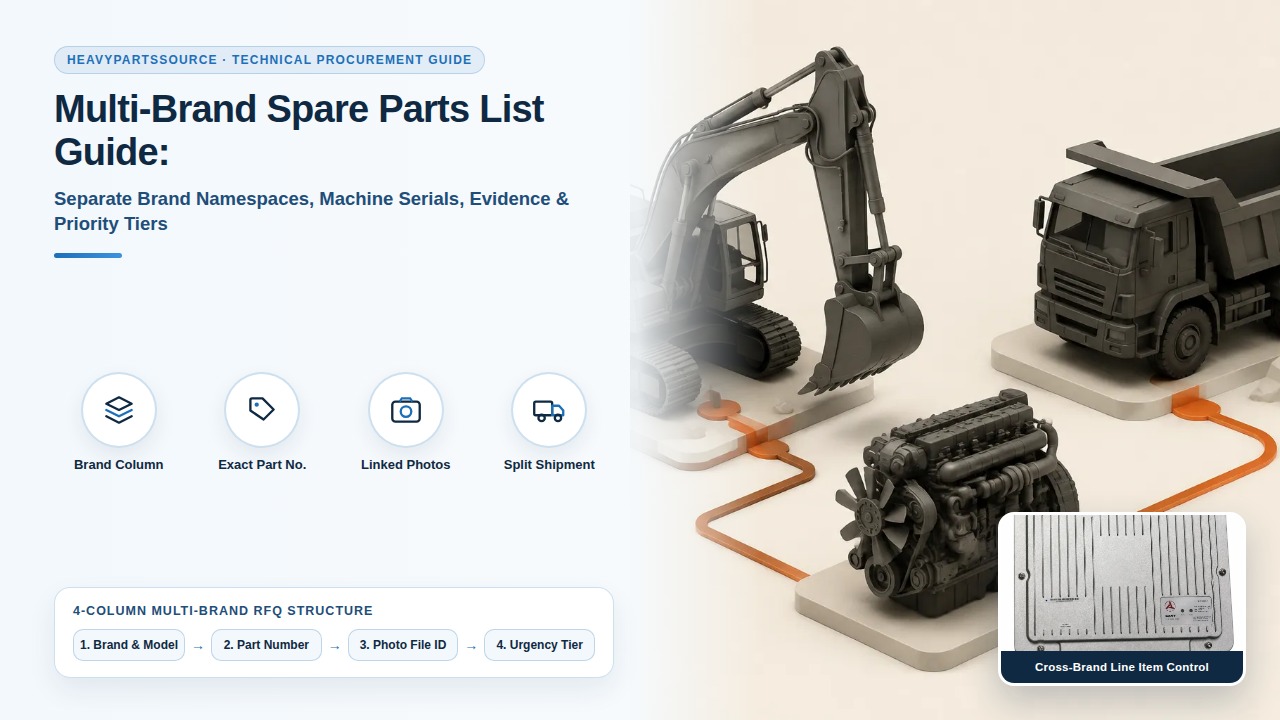
Submitting a multi-brand spare parts list as an unstructured spreadsheet—mixing Caterpillar, Komatsu, SANY, XCMG, Hitachi, and Volvo earthmoving machines with SHACMAN, Sinotruk HOWO, Cummins, Weichai, Isuzu, Perkins, Bosch Rexroth, Kawasaki, and WABCO sub-assemblies without brand namespaces or parent machine serials—causes wrong part shipments, costly machine downtime, cross-brand part-number collisions, spreadsheet leading-zero truncation, and undeclared UN 3164 pressurized accumulators grounding entire air-freight pallets. Before releasing a consolidated fleet Request for Quotation (RFQ) or purchase order, lock every request row to an immutable line number (line-01, line-02) backed by both the host machine identity (ISO 10261 PIN or ISO 3779 VIN) and the installed component's explicit brand namespace (ISO 8000-115).
To prepare a multi-brand spare parts list without cross-brand collisions, revision mismatches, or freight holds, structure your spreadsheet with eight mandatory engineering columns per line item (ISO 8000-110 master data baseline): (1) an immutable Line ID (line-01, line-02) kept unchanged from inquiry through packing list; (2) the parent Machine ID and 17-character ISO 10261 Product Identification Number (PIN) or ISO 3779 / 49 CFR § 565.15 Vehicle Identification Number (VIN); (3) the installed diesel engine dataplate (Cummins 8-digit ESN + CPL, Weichai WP10/WP12/WP13 suffix + DH code, Cat Arrangement No., or Isuzu/Komatsu ESN) and drivetrain sub-plate; (4) the explicit Reference Brand Namespace (SANY, Komatsu, Cat, SHACMAN) separated from the installed Tier-1 Sub-Vendor Namespace (Bosch Rexroth, Kawasaki, Cummins, Donaldson, Fast Gear, WABCO per ISO 8000-115); (5) the plain-text Verbatim Part Number preserving leading zeros (095-1678, 07000-15210) and trailing revision or kit suffixes (-0/-1/-2, K); (6) Component Description, Chassis/Machine Position (LH/RH, Axle 1–4), Supply Scope, and semantic Unit of Measure (PCS, SET, KIT, PAIR, ASSY); (7) the target Quality Tier (Genuine OEM, Tier-1 Sub-Vendor, or Verified Replacement); and (8) the Shipment Priority, Dangerous Goods flag (UN 3164 / UN 2794), and Incoterms 2020 / ISPM 15 consolidation split.
Scroll horizontally to view all columns.
| Multi-brand BOM structuring method | Governing standard or catalog baseline | Typical quote turnaround & verification accuracy | Freight & customs consolidation efficiency | Dominant failure mode & prevention |
|---|---|---|---|---|
| 1. Unstructured Description-Only or Merged-Number Spreadsheet | None (ad-hoc free-text rows, merged cells, bare integer quantities, no machine serials) | 5–10+ days (stalled by multi-time-zone clarification loops across 30–60% of lines) | Poor (wrong revisions shipped; single missing or restricted item holds entire order) | Failure mode: Merging identical numeric strings across brands, Excel stripping leading zeros (07000-15210 -> 700015210), or shipping 1 piece instead of 1 overhaul kit. Prevention: Enforce one part per row, plain-text (@) formatting, and explicit Brand_Namespace + UOM. |
2. Machine-Grouped Master RFQ Sheet (PIN/VIN + ESN per Row) | ISO 8000-110 (master data syntax/UOM), ISO 10261:2021 (17-char PIN), & ISO 3779 / 49 CFR § 565.15 (17-char VIN) | < 24–36 hours (every row is anchored to its parent machine build sheet and serial break) | High (parts can be pre-kitted and labeled by machine bay EX-04, TRK-12 before crating) | Failure mode: Assuming two machines of the same model (e.g., two SANY SY215C or two Komatsu PC200-8 excavators) share identical filters, seal kits, and pumps across serial breaks. Prevention: Repeat the parent Machine PIN/VIN + Engine ESN on every row of the spreadsheet. |
| 3. Dual-Namespace Sub-Vendor Cross-Referenced BOM Rows | ISO 8000-115 (issuer prefix + identifier) pairing Host OEM P/N with Tier-1 Sub-Vendor P/N (Rexroth R902..., Kawasaki, Cummins, WABCO) | < 24 hours with 18–35% lower cost on Tier-1 hydraulic, engine, and pneumatic assemblies | High (eliminates double-lookup delays between machine EPC and sub-vendor build plates) | Failure mode: Ordering by host machine catalog code alone after a hydraulic pump (Rexroth / Kawasaki), engine (Cummins / Weichai), or gearbox (Fast / ZF) was updated or swapped. Prevention: Provide separate columns for Requested_OEM_Ref and Stamped_SubVendor_Ref. |
| 4. Priority-Split Air Express vs. Consolidated Sea LCL/FCL BOM | Incoterms 2020 (FCA / FOB / CIF / DAP), ISPM 15 (56 °C / 30 min HT wood crating), IATA DGR PI 208 (UN 3164), & IMDG SP 283 | Immediate dispatch of < 25 kg line-down stoppers while bulk PM/undercarriage consolidates | Cuts multi-vendor LCL/customs fixed overhead by 60–80% and prevents airport X-ray DG holds | Failure mode: Co-packing a heavy 240 kg roller into urgent air freight or slipping one nitrogen-charged UN 3164 accumulator into a clean air pallet. Prevention: Assign explicit Priority-A (Air) vs. Priority-B (Sea LCL/FCL) and DG / Uncharged (0 bar) flags per line. |
How do you structure a multi-brand spare parts list under ISO 8000-110 and ISO 8000-115 so identities never collide?
When a mining contractor, construction fleet, or regional distributor consolidates spare parts across multiple equipment and truck brands into a single RFQ, the spreadsheet serves as a master data exchange specification governed by ISO 8000-110:2021 (Data quality — Part 110: Master data: Exchange of characteristic data: Syntax, semantic encoding, and conformance to data specification) and ISO 8000-115:2018 (Exchange of quality identifiers) (iso-8000-110-115-master-data-quality-bom.txt).
Under ISO 8000-115, a local part number is never globally unique on its own; an unambiguous part identifier ID_part is a composite tuple that binds the Issuing Brand Namespace (Prefix Element) to the Verbatim Part Number (Identifier Element) and the Host Machine Serial Context:
ID_part = ( Brand_Namespace , Verbatim_Part_Number , Revision_or_Scope_Suffix , Host_PIN_or_VIN , Engine_ESN_CPL )
Under ISO 8000-110, every quantitative line-item request must also pair its numeric quantity with an explicit, machine-checkable Unit of Measure (UOM)—distinguishing PCS (individual pieces, such as 6 PCS of a fuel injector or 12 PCS of track shoe bolts), SET (a matched mechanical set, such as 1 SET of upper and lower main bearings or a matched spiral-bevel crown wheel and pinion), PAIR (1 PAIR = LH + RH grader blades or brake linings), KIT (1 KIT containing all elastomeric seals for one hydraulic cylinder or a complete engine gasket kit), and ASSY (1 ASSY complete loaded final drive or hydraulic pump assembly).
The 10-Column Machine-Grouped Multi-Brand BOM Schema
Use one row per requested item (public/downloads/hps-parts-request-template.csv) and lock these ten columns across every quotation revision:
Scroll horizontally to view all columns.
| Column # & header name | Mandatory syntax & engineering content (ISO 8000-110 / 115) | Example valid entry (Plain Text @ format) | What goes wrong if omitted or merged | Dominant failure mode & prevention |
|---|---|---|---|---|
Col 1: Line_ID | Immutable alphanumeric row key (line-01, line-02... line-99) kept identical across RFQ, quote, PO, and crate packing list | line-04 | Deleting or renumbering rows mid-quote causes unit prices and photo files to shift onto the wrong part | Failure mode: Row shifts during spreadsheet sorting scramble quantities and prices. Prevention: Lock Line_ID permanently; mark cancelled lines as VOID rather than deleting the row. |
Col 2: Machine_ID & Fleet_Model | Fleet asset tag + machine make and full model designation ([SANY SY215C](/models/sany/sy215c), Cat 320D, Komatsu PC200-8, [SHACMAN X3000](/models/shacman/x3000)) | EX-07 | SANY SY215C | Warehouse cannot pre-bag or label consolidated parts by destination machine bay | Failure mode: Mechanics wasting days sorting a 200-item consolidated crate at the jobsite. Prevention: Tag every row with the fleet unit ID (EX-07, TRK-14) for bag-and-tag marshaling. |
Col 3: Host_PIN_or_VIN (17-Char) | Full 17-character ISO 10261 PIN (earthmoving) or ISO 3779 / 49 CFR § 565.15 VIN (heavy trucks) or Cat 3-char prefix + serial | SY0215CB93688xxxx | Misses mid-production OEM serial breaks (e.g., PC200-8 or SY215C hydraulic hose/cylinder revisions) | Failure mode: Ordering parts for two machines of the same model name that sit on opposite sides of an OEM serial break. Prevention: Repeat the 17-char PIN/VIN on every line item. |
Col 4: SubAssembly_Serial_Tag | Installed engine ESN + CPL / DH / AR# (Cummins, [Weichai WP12](/engines/weichai/wp12), Isuzu), gearbox tag (Fast / ZF / Eaton), or axle tag (Meritor / Hande / Sinotruk) | Isuzu 4HK1XYSA-02 | ESN 648xxx | Host machine PIN/VIN alone cannot identify field-repowered engines or multi-vendor truck drivetrains | Failure mode: Receiving Mitsubishi 4M50 or Cummins QSB6.7 filters/injectors for a SANY SY215C actually running an Isuzu 4HK1. Prevention: Record the physical engine/gearbox/axle plate per row. |
Col 5: Ref_Brand_Namespace | Issuing brand of the catalog part number (CAT, KOMATSU, SANY, XCMG, HITACHI, VOLVO, SINOTRUK, SHACMAN) | SANY | Bare numbers collide across OEMs or get confused with sub-vendor codes (ISO 8000-115) | Failure mode: Merging two rows because their numeric strings look similar across different brands. Prevention: Keep Ref_Brand_Namespace in its own dedicated column. |
Col 6: Requested_Part_Number | Verbatim part number formatted as Plain Text (@), preserving all leading zeros, hyphens, and trailing revision/kit suffixes | B220301000626 (or 07000-15210) | Excel strips leading 0s (095-1678 -> 951678), converts 10-12 to 12-Oct, or turns 12-digit codes into 4.32E+09 | Failure mode: Corrupted part strings fail EPC lookup or drop trailing -1 / -2 / K revision suffixes. Prevention: Pre-format Column 6 as Plain Text (@) and flag Catalog P/N vs. Casting Mark. |
Col 7: SubVendor_Brand_&_PN | Stamped Tier-1 manufacturer name and nameplate code (Bosch Rexroth R902..., Kawasaki K3V..., Donaldson, WABCO 10-digit) | Kawasaki K3V112DT-1XER-9N24 | Reg KR3G-9N24 | Forces buyer to pay machine-brand box markup or stalls identification when OEM code is superseded | Failure mode: Quoting a complete machine-OEM pump when only a Rexroth/Kawasaki rotary group or regulator valve is needed. Prevention: Transcribe both the host OEM code and the riveted sub-vendor plate. |
Col 8: Description_Position_Scope | Component name + vehicle-forward position (LH / RH, Axle 1–4, Boom / Arm / Bucket) + explicit scope (Complete ASSY vs. Bare Part vs. Seal KIT) | Main Hydraulic Pump ASSY (with regulator) — Complete Assembly | Shipping a bare cylinder seal ring instead of a full cylinder kit, or a right-hand headlamp for the left-hand side | Failure mode: Ambiguous scope ("final drive" or "overhaul kit") causes major price and content mismatches across quotes. Prevention: State exact physical inclusions and LH/RH orientation. |
Col 9: Qty_&_Semantic_UOM | Numeric quantity + explicit ISO 8000-110 Unit of Measure (PCS, SET, KIT, PAIR, ASSY, M) in separate sub-fields | 1 | ASSY (or 6 | PCS) | Entering "1" for fuel injectors or track rollers leaves it unclear whether 1 piece or 1 engine/machine set is needed | Failure mode: Receiving 1 PCS of a piston liner kit on a 6-cylinder engine overhaul (5 cylinders short). Prevention: Pair every integer quantity with PCS, SET (of 6), PAIR (LH+RH), or KIT. |
Col 10: Quality_Tier_&_Freight_Split | Target tier (Genuine OEM / Tier-1 Sub-Vendor / Verified Replacement), photo ID (line-04-tag.jpg), priority (Air vs. Sea LCL/FCL), & DG / 0-bar status | Tier-1 Sub-Vendor | Priority-A Air | Non-DG | line-04-pump-tag.jpg | Quote mixes unrequested low-grade electronics with overpriced OEM wear iron, or co-packs heavy/DG items into air freight | Failure mode: Air-freighting 300 kg of steel rollers or grounding an air shipment with a pressurized UN 3164 accumulator. Prevention: Assign quality tier and modal split on every line. |
Engineering Rule-of-Thumb (Mandatory Parent Machine PIN/VIN + ESN Column Attached to Every Line Item in a Mixed-Brand Sheet): If a fleet procurement spreadsheet combines N_lines >= 2 spare parts across multiple machines or brands (Caterpillar, Komatsu, SANY, XCMG, Hitachi, Volvo, SHACMAN, Sinotruk) → attach the parent Machine_ID + 17-character ISO 10261 PIN / ISO 3779 VIN + installed Engine ESN + Build Code (CPL / Arrangement No. / DH Code) directly onto every individual row (line-01, line-02) rather than placing machine serials only in an email header or merging identical part descriptions across the fleet, because mid-year OEM serial breaks (e.g., Komatsu PC200-8, SANY SY215C, or Cummins QSB6.7 / Weichai WP12) alter filter thread pitches, cylinder rod diameters, and sensor pinouts between two machines sharing the exact same model decal.
Takeaway: Never merge two lines on a multi-brand list just because their part descriptions or bare numeric references look alike; lock one item per row with its own Line_ID, Brand_Namespace, and Host_PIN/VIN + Engine_ESN.
How do you normalize part numbers across Caterpillar, Komatsu, SANY, Cummins, Rexroth, Kawasaki, and Sinotruk/Shacman without losing revision suffixes?
Each heavy-equipment, commercial-truck, diesel-engine, and hydraulic sub-vendor manufacturer enforces a strict internal numbering syntax (oem-cross-brand-part-number-syntax-normalization.txt). When fleet buyers paste these numbers into Microsoft Excel or Google Sheets without setting the column data type to Plain Text (@), spreadsheet auto-formatting silently corrupts the part numbers—stripping leading zeros, converting hyphenated codes into calendar dates, or rounding 12-to-13-digit codes into scientific notation (4.32E+09).
At the same time, buyers frequently confuse non-semantic display punctuation (such as spaces in a 10-digit WABCO number or the middle dash in a 7-character Caterpillar code) with semantic engineering suffixes (such as Komatsu and Isuzu trailing revision digits, SANY K kit suffixes, or Caterpillar 0R / 10R / 20R remanufactured prefixes).
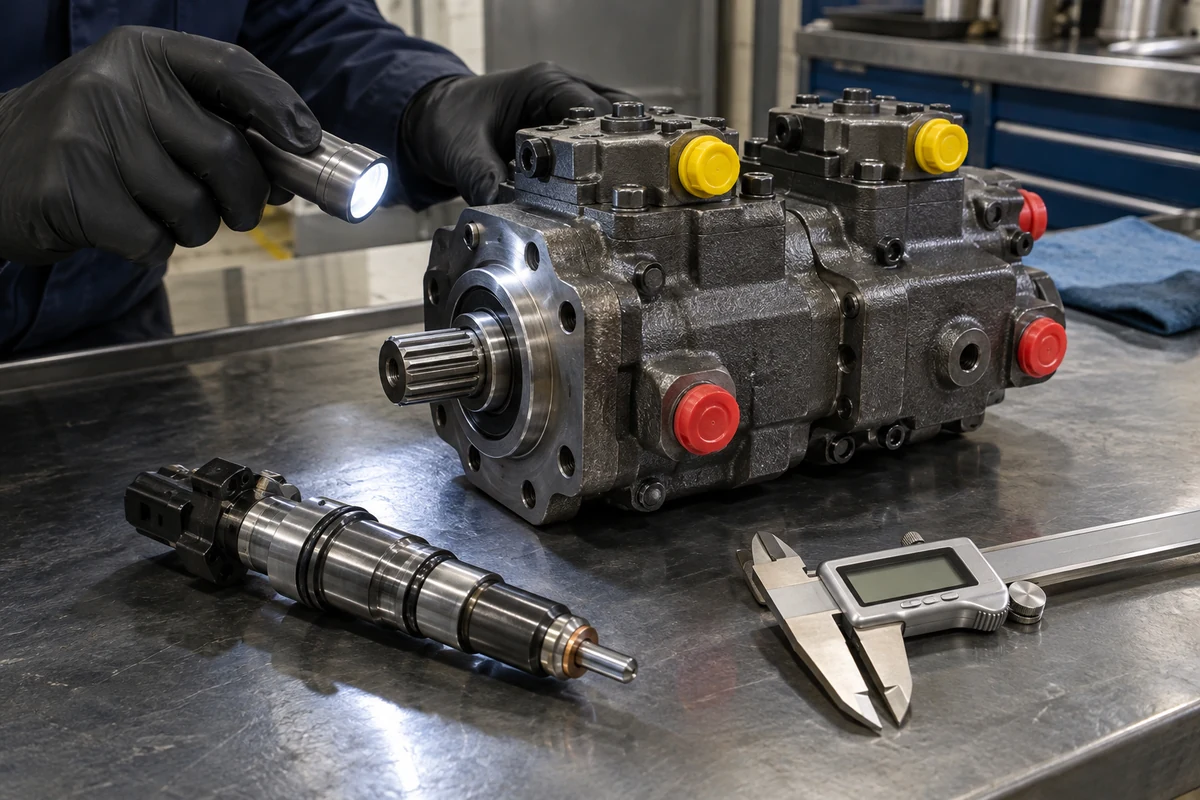
Cross-brand sub-vendor verification on the inspection bench: pairing the host machine catalog code with 10–25° raking-light inspection of the installed hydraulic pump casting, common-rail fuel injector body, and caliper-verified flange/port dimensions before locking a multi-brand BOM.
Cross-Brand OEM & Tier-1 Sub-Vendor Part Number Syntax Matrix
Use this reference table to audit and normalize part numbers across all major machine, engine, hydraulic, and truck brands before submitting your list:
Scroll horizontally to view all columns.
| Brand namespace & EPC system | Standard part number structure & character count | What leading prefixes & trailing suffixes mean | Spreadsheet corruption trap & normalization rule | Dominant failure mode & prevention |
|---|---|---|---|---|
Caterpillar (CAT — SIS 2.0) | New format: 7 chars with hyphen after 3rd char (NNN-NNNN or ANN-NNNN, e.g., 326-1642, 1R-0716, 247-5212).Legacy format: 5–6 chars (1W-7121, 095-1678). | 0R-, 10R-, 20R- prefixes = Factory Remanufactured core-exchange assembly (e.g., 10R-4469). Must not be confused with new production P/Ns. | Middle hyphen is optional (326-1642 == 3261642), but leading zero on 6/7-char codes (095-1678) is mandatory. Excel numeric columns strip the 0. | Failure mode: Dropping the leading zero on 095-1678 or ordering a 10R- Reman number without accounting for core return charges. Prevention: Format column as Plain Text (@) and pair every CAT line with the 3-char Serial Prefix + Arrangement No. |
Komatsu (KES / LinkOne / CSS) | 10-character hyphenated string: Machine/Hydraulics: 708-2L-00300, 20Y-30-00040, 707-99-57160.Engine: 600-211-1340, 6754-71-6130.KES Hardware/O-rings: 07000-15210. | 1st digit 0 = Komatsu Engineering Standard (KES) bolt, O-ring, or hose (07000-15210).10th (final) digit ( 0, 1, 2, 3) = Engineering revision counter (0 = initial design, 1, 2 = updated revision). | Excel strips the leading 0 on all 07000-... KES O-rings/bolts (-> 700015210), and buyers often truncate the 10th revision digit. | Failure mode: Truncating the trailing revision digit (-0 vs. -1 vs. -2) on a PC200-8 pump or SAA6D107E engine part, receiving an obsolete non-interchangeable casting. Prevention: Preserve all 10 characters and hyphens verbatim plus machine serial break. |
SANY (GSP / GCP) & XCMG | SANY 8-digit code: 60277731, 60282117, 13987636, 60035553K.SANY 13-char ERP code: A or B + 12 digits (B222100000591, B220301000626, A210204000161).XCMG: 800... / 803... (9–11 digits). | SANY A prefix = in-house welded/machined structure; B prefix = purchased sub-vendor item; trailing K (60035553K) = complete seal repair kit for cylinder 60035553. | 12-to-13-digit numeric strings are converted by Excel into scientific notation (6.00E+11) and lose the last 4 digits when saved to CSV. | Failure mode: Ordering SANY B220301000626 without recording the installed Kawasaki K3V112DT or Rexroth pump plate, or dropping the K suffix and quoting a $2,800 cylinder assembly instead of a $95 seal kit. Prevention: Record both the SANY 8/13-char code and the sub-vendor plate. |
Hitachi (HOP) & Volvo CE (PROSIS) | Hitachi: 7-digit numeric (4448336, 4630525) or 8–10 char alphanumeric (YA00000664, 9257596).Volvo CE / Trucks: 8-digit numeric (VOE 11110683, 20998367, 14531379). | VOE prefix designates Volvo Construction Equipment namespace (ISO 8000-115); Hitachi YA000... designates ZAXIS -5G / -6 generation parts. | Bare 7-digit Hitachi numbers (4448336) and 7-digit Cummins numbers (4921497) look identical in format if the brand column is missing. | Failure mode: Submitting a bare 7-digit or 8-digit integer without HITACHI vs. CUMMINS vs. VOLVO brand column. Prevention: Always prefix or isolate the brand namespace (HITACHI : 4448336 vs. VOLVO : 11110683). |
| Cummins, Weichai, Isuzu & Perkins Engines | Cummins: 7- or 8-digit integer (4921497, 5284083, 2882144).Weichai: 10–12 digit (612600081335, 1001710722).Isuzu ( 4HK1/6HK1): 10-digit N-NNNNN-NNN-R (8-97324-082-0).Perkins: 8-char (U5MK8267, 2654407). | Isuzu 10th digit (-0, -1, -2, -3) = mandatory engineering revision suffix.Weichai 612600... / 612630... = WD615 / WP10 / WP12 / WP13 family prefix. | Dropping the final -0 / -1 on an Isuzu 8-97324-082-0 part number leaves only 9 digits and fails catalog resolution or pulls the wrong EGR/injector revision. | Failure mode: Ordering engine internals across excavators or trucks by machine model alone without the 8-digit Cummins ESN + CPL, Weichai DH code, or Isuzu 10-digit P/N. Prevention: Follow our diesel engine parts ordering guide and attach ESN + CPL/DH to every engine row. |
| Bosch Rexroth & Kawasaki Hydraulics | Rexroth: Type Code (A11VO130LRDS/10R-NZD12K02, A4VG125...) + 10-digit Material No. starting with R9 (R902013824, R902155889).Kawasaki: Model ( K3V112DT-1XER-9N24, K5V140DTP) + 4-char Regulator Code (KR3G-9N24). | Rexroth R902xxxxxx locks the exact internal rotary group BOM, port thread (ISO 6162 Code 61/62), and pressure setting.Kawasaki -9N24 locks horsepower control curve. | Listing only "Rexroth A11VO130" or "Kawasaki K3V112DT" omits shaft spline profile (DIN 5480 vs. SAE), rotation (R vs. L), and regulator curve. | Failure mode: Receiving a hydraulic pump whose input spline or pilot regulator curve does not match the excavator's main control valve. Prevention: Photograph both the main pump plate (R902... / K3V...) and the separate regulator tag (see our hydraulic pump replacement guide). |
Sinotruk (HOWO), SHACMAN, Fast Gear & WABCO | Sinotruk: WG9725... / AZ9981320225 / VG1560... (10–12 chars).SHACMAN: DZ97189360054 / 81.xxxx.xxxx.Fast Gear: 12JSDX240T-1701190-2.WABCO: 10-digit 432 410 222 0 / 934 714 010 0. | WABCO 10th digit: 0 = complete new valve/dryer assembly, 2 = repair/seal kit, 7 = remanufactured exchange unit.Sinotruk AZ9981... = HC16/AC16 axle assembly. | Stripping spaces in WABCO (4324102220) is valid, but changing the 10th digit from 0 to 2 changes a $220 valve assembly into a $18 O-ring repair kit. | Failure mode: Ordering SHACMAN or HOWO drivetrain/brake parts without separating the chassis code (DZ9... / WG9...) from the Fast gearbox, Hande/HC16 axle, or WABCO 10-digit plate. Prevention: Follow our heavy-duty truck parts request guide. |
Engineering Rule-of-Thumb (Stripping Non-Semantic Punctuation Traps While Preserving Leading Zeros & OEM Revision/Kit Suffixes): If normalizing part numbers across a multi-brand CSV or Excel RFQ (ISO 8000-110 / ISO 8000-115) → format all part-number columns as Plain Text (@) before data entry so leading zeros (Cat 095-1678, Komatsu 07000-15210, Dana 0605661-1) and 10-to-13-digit strings (SANY B222100000591, WABCO 4324102220) are never truncated or converted into dates/scientific notation, and while standard display spaces or middle hyphens (Cat 326-1642 -> 3261642) may be normalized for database search, never strip trailing revision digits or kit suffixes (Komatsu 10th digit -0/-1/-2, Isuzu 10th digit -0/-1, SANY K seal-kit suffix, WABCO 10th digit 0 = new assembly vs. 2 = repair kit vs. 7 = reman, or Cat 0R/10R/20R Reman prefixes), because trailing characters govern physical engineering revisions and assembly scope.
Takeaway: Always flag in your Evidence column whether a transcribed code comes from an OEM parts catalog (EPC), a riveted component nameplate, or a raised foundry casting mark (see our excavator part number lookup guide, which explains why raised casting numbers on raw iron housings are unmachined blank codes rather than orderable part numbers).
How should you separate fast-moving PM consumables from precision hydraulic/engine cores and assign quality tiers (Genuine OEM vs. Tier-1 Sub-Vendor vs. Verified Replacement)?
A high-performing multi-brand spare parts list never applies a single blanket quality tier ("quote everything Genuine OEM" or "quote everything cheapest aftermarket") across a 50-line BOM. Applying Genuine machine-brand packaging to heavy steel wear parts inflates procurement spend by 25–45%, whereas buying unverified low-cost aftermarket common-rail fuel injectors, 2–4 um HPCR secondary fuel filters, or axial-piston hydraulic pump rotary groups risks catastrophic $8,000–$18,000 engine or hydraulic system contamination.
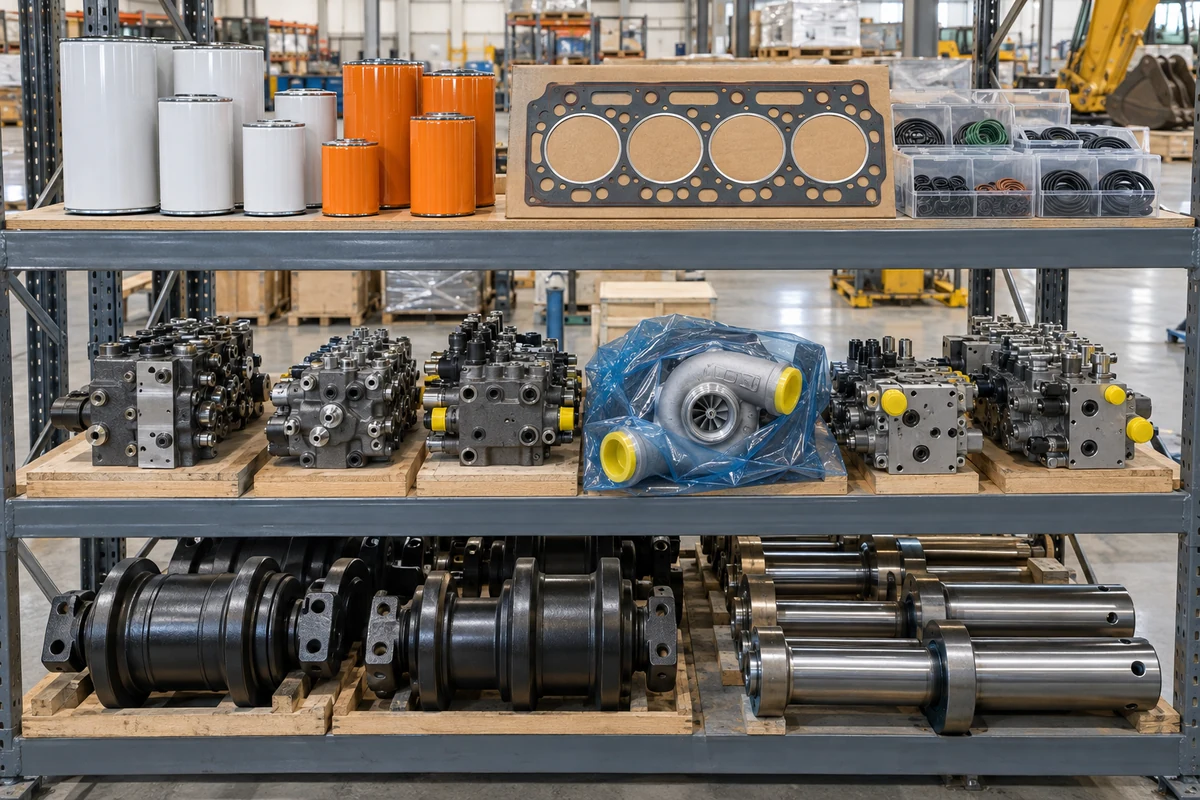
Segregating multi-brand BOM categories during warehouse verification and staging: keep fast-moving filtration elements, flat-backed MLS head gaskets, and elastomer seal kits on crush-protected upper shelving, precision VCI-wrapped hydraulic valves and turbochargers in isolated middle trays, and heavy forged undercarriage rollers and pins on the bottom structural deck.
Component Category Segmentation & Quality Tier Allocation Matrix
Divide your multi-brand spreadsheet into distinct functional blocks (or tag each row in Column 10) using the engineering thresholds below:
Scroll horizontally to view all columns.
| BOM functional group & component examples | Operating stress & tolerance threshold | Recommended primary & secondary quality tier | Mandatory scope & cross-reference checks | Dominant failure mode & prevention |
|---|---|---|---|---|
| 1. Precision Hydraulic Cores & Control Valves (Hydraulic pumps, main control valves, swing motors, travel motors, pilot regulators) | P_sys = 31.4–38.0 MPa (4,550–5,500 psi); piston-to-barrel diametral clearance 5–12 um | Primary: Tier-1 OEM Sub-Vendor (Bosch Rexroth R902..., Kawasaki K3V/K5V, Nabtesco, Kayaba KYB, Danfoss).Secondary: Genuine Machine OEM | Specify Complete Tested Assembly vs. Internal Rotary Group (Cylinder Block + Pistons + Valve Plate + Retainer). Verify shaft spline & regulator code. | Failure mode: Unverified aftermarket rotary groups galling or brass piston shoes delaminating at 34.3 MPa, sending brass swarf through every cylinder and valve on the excavator. Prevention: Specify Tier-1 Sub-Vendor (Rexroth / Kawasaki) or Genuine OEM on all high-pressure hydraulic cores. |
2. High-Pressure Diesel Fuel Injection, Turbochargers & Programmed ECUs (HPCR / HEUI / MEUI injectors, high-pressure fuel pumps, VGT/wastegate turbos, controllers) | P_rail = 160–250 MPa (23,200–36,250 psi), needle clearance 1–3 um; turbo speed 90,000–130,000 rpm; 12V/24V CAN-bus | Primary: Tier-1 Sub-Vendor (Bosch, Denso, Delphi, Cummins / Holset, Cat Reman 10R/20R) or Genuine OEM | Confirm whether ECUs (e.g., SANY 13987636, Cat ECM, Weichai Bosch EDC17) ship blank or pre-programmed to your machine PIN/ESN, and verify injector 6–8 char Trim/IMA codes. | Failure mode: Installing uncalibrated aftermarket common-rail injectors that over-fuel and melt a piston crown, or receiving an unprogrammed blank ECU at a remote site without OEM diagnostic software. Prevention: Demand genuine/Tier-1 injectors with laser Trim codes and confirm ECU flash status before ordering. |
| 3. Primary & Secondary Filtration Elements (Filter elements: HPCR secondary fuel filters, primary fuel-water separators, full-flow/bypass lube, hydraulic return/pilot filters) | Secondary HPCR fuel 2–4 um at Beta >= 200–1000 (ISO 19438); Primary separator 10–30 um (ISO 16332 water emulsification); Hydraulic 5–15 um (ISO 16889) | Primary: Tier-1 Filtration OEM (Donaldson, Parker Racor / Baldwin, Fleetguard, Mann+Hummel, Hydac) or Genuine OEM | Never merge primary fuel-water separators (34.5–41.4 kPa suction) and secondary HPCR filters (2–4 um pressure side) across fleet engines by thread pitch (1-14 UN vs. M30x2) alone (donaldson-f110024-eng.txt, p. 58). | Failure mode: Using a cheap nominal 15 um cellulose spin-on filter in a 2 um Tier 4 / Euro V common-rail secondary position, eroding injector control valves in < 200 hours. Prevention: Cross-reference every OEM filter to verified Donaldson / Fleetguard / Racor beta ratings (see our filter micron rating guide and filter replacement planning guide). |
| 4. Engine Overhaul Kits, Cylinder Liners & Elastomer Seal Kits (Piston-liner kits, main/con-rod bearings, MLS head gaskets, hydraulic boom/arm/bucket cylinder seal kits) | Wet liner flange protrusion 0.03–0.18 mm; hydraulic rod/piston seal pressure 35 MPa & temperature -30 to +110 °C (NBR / PTFE / PU / FKM) | Primary: Tier-1 Sub-Vendor / Verified Premium Aftermarket (IPD, Maxiforce, Mahle, NOK, Hallite, SKF / Parker) or Genuine OEM | Explicitly separate In-Frame (in-chassis) vs. Out-of-Frame (complete w/ front timing & rear main seals) overhaul kits, and state cylinder Bore x Rod OD (mm) + cylinder stamp P/N. | Failure mode: Ordering an "engine gasket kit" or "cylinder seal kit" by model name alone and discovering missing crankshaft main seals or wrong-diameter rod buffer rings during teardown. Prevention: Specify exact kit scope and review our hydraulic cylinder seal kits by size guide. |
5. Heavy Undercarriage, Ground-Engaging Tools (GET), Pins, Bushings & Truck Chassis Wear Iron (Undercarriage parts, track chains, rollers, idlers, sprockets, bucket teeth, cutting edges, brake drums/shoes) | Surface induction hardening HRC 52–58, core toughness HRC 32–40; high dead-weight (25–650 kg/item) | Primary: Verified Aftermarket Replacement (heat-treated forged alloy steel with QC hardness inspection) | Record track link pitch (mm, e.g., 190 / 203 / 216 mm), link count (45–51 links), shoe width (600 mm), bolt diameter, and pin OD x length (mm). | Failure mode: Paying 40% OEM brand-box markup on heavy steel track chains or bucket teeth, OR shipping unverified track links without checking link pitch and count. Prevention: Specify Verified Replacement on wear iron and lock dimensions using our excavator track chain fitment checklist and final drive scope guide. |
Engineering Rule-of-Thumb (Quality Tier Allocation: Genuine OEM vs. Tier-1 Sub-Vendor vs. Verified Replacement Per Line Threshold): If assigning target supply tiers across a mixed-brand BOM → specify Tier-1 OEM Sub-Vendor (Bosch Rexroth R902..., Kawasaki K3V/K5V, Cummins, Isuzu, Donaldson, Parker/Fleetguard, ZF, Fast Gear, WABCO, Knorr-Bremse) or Genuine Machine OEM for high-pressure hydraulic rotary groups (P_sys >= 31.4–34.3 MPa), common-rail fuel injectors (160–250 MPa), 2–4 um secondary HPCR filters, and programmed 12V/24V ECM controllers, while allocating Verified Aftermarket Replacement to high-mass mechanical wear items (undercarriage track rollers, idlers, track links, bucket pins/bushings, GET cutting edges/teeth, and cab glass/mirrors), because Tier-1 sub-vendor sourcing captures exact factory hydraulic and fuel-system tolerances at 18–35% lower unit cost than machine-brand packaging while verified wear iron lowers heavy steel replacement costs without risking precision system failure.
Takeaway: Never leave the Quality Tier column blank; state per line whether you require Genuine OEM, Tier-1 Sub-Vendor, Verified Replacement, or Quote Both Options for Comparison.
How do you split air vs. sea freight, segregate UN 3164 dangerous goods, and pack multi-brand crates under ISPM 15 and Incoterms 2020?
Once a multi-brand list is identified and priced, the physical logistics plan determines whether your urgent line-down parts arrive in 72 hours or sit impounded in an airport dangerous-goods warehouse or destination customs quarantine (iata-dgr-imdg-un3164-un2794-dg-part-segregation.txt, ispm-15-ippc-wood-packaging-export-crating.txt, incoterms-2020-trade-gov.txt).
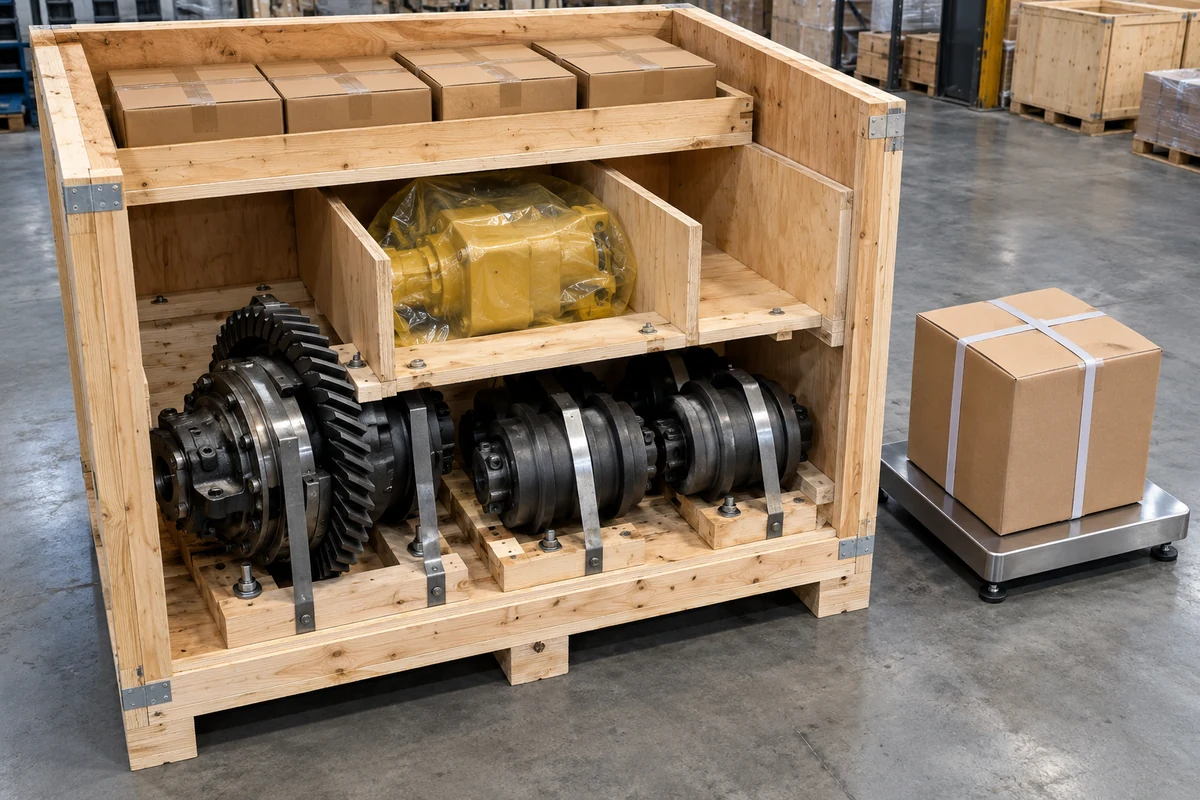
Physical shipment splitting and 3-zone heavy-over-light export crating in the consolidation warehouse: bolt heavy undercarriage and axle castings to the bottom skid base (Zone 1), isolate VCI-wrapped hydraulic and engine cores behind rigid internal partitions (Zone 2), place crush-sensitive filter and gasket cartons on an upper shelf (Zone 3), and split lightweight machine-down stoppers onto a separate air-express parcel.
1. Air Express Volumetric Weight vs. Sea LCL Freight-Ton Split Equation
International air carriers calculate billable weight W_charge_air (kg) as the greater of actual gross scale weight W_gross_kg and IATA volumetric (dimensional) weight W_vol_air at a standard air cargo density factor of 1 CBM = 166.67 kg (6,000 cm^3/kg), whereas ocean Less-than-Container-Load (LCL) consolidators bill by the Weight/Measurement (W/M) Freight Ton M_charge_lcl (1 W/M = max(1.0 CBM, 1,000 kg)):
W_vol_air = ( L_cm * W_cm * H_cm ) / 6000, W_charge_air = max( W_gross_kg , W_vol_air )
M_charge_lcl = max( V_cbm , W_gross_kg / 1000 ) (subject to 1.0 W/M minimum billable LCL threshold)
- Worked Example (Splitting a
4 kgLine-Down Controller from240 kgof Undercarriage Iron on the Same Multi-Brand List): Suppose a 15-line multi-brand list includesline-01(1 PCSexcavator controller + harness, gross weightW_gross = 4.0 kg, carton40 x 30 x 20 cm -> W_vol_air = 24,000 / 6000 = 4.0 kg) andlines 02–15(2 PCSbottom track rollers +1 PAIRgrader cutting edges + PM filter kit, gross weightW_gross = 240 kg, crate120 x 80 x 50 cm = 0.48 CBM -> W_vol_air = 80 kg, soW_charge_air = 240 kg). Shipping all 15 lines together by Air Express at$8.50/kgcosts244 kg * $8.50 = $2,074. Splittingline-01onto Priority-A Air Express (4 kg * $17.00/kg express parcel = $68, delivered in3–5 days) andlines 02–15onto Priority-B Sea LCL (max(0.48 CBM, 0.24 MT) -> 1.0 W/M minimum LCL = $165) cuts total freight from$2,074to$233($1,841or88.8%saved) without delaying the machine-down repair by a single hour.
2. Dangerous Goods (IATA DGR PI 208 / UN 3164), ISPM 15 Crating & Incoterms 2020 Consolidation Matrix
Before authorizing shipment of a consolidated multi-brand order, verify these four regulatory and physical segregation rules:
Scroll horizontally to view all columns.
| Consolidation & compliance layer | Governing international standard | Mandatory threshold & physical rule | How to mark your multi-brand RFQ list | Dominant failure mode & prevention |
|---|---|---|---|---|
1. Nitrogen-Charged Hydraulic Accumulators & Gas Struts (UN 3164) | IATA DGR Packing Instruction 208 (PI 208) / Special Provision A114 (Air) & IMDG Code SP 283 (Sea) | Pressurized hydraulic/pneumatic articles containing compressed N_2 (Class 2.2 Non-Flammable Gas) must withstand >= 5x burst pressure at 20 °C (IATA A114) and obey V_gas * P_charge <= 80 bar-L (IMDG SP 283). | For air shipments, specify Ship Uncharged (0 bar N2, certified gas-free on invoice/packing list) for local jobsite charging, OR split pre-charged UN 3164 units onto a separate DG-declared booking. | Failure mode: Packing one nitrogen-charged breaker or pilot accumulator (UN 3164) or cab gas spring inside a general air-freight carton; airport X-ray security rejects and impounds the entire multi-brand pallet. Prevention: Order accumulators uncharged (0 bar) for air freight or isolate DG lines on a separate airway bill. |
2. Batteries, Aerosols, Starting Fluids & Liquid Sealants (DG Class 2.1 / 3 / 8 / 9) | IATA DGR / IMDG Code (UN 2794 wet acid batteries, UN 3480 lithium-ion, UN 1950 aerosols, Class 3 flammable liquids < 60 °C flash point) | Liquid anaerobic flange sealants, RTV silicone tubes, Loctite bottles, brake cleaner cans, ether starting cylinders, and batteries cannot travel inside general air cargo boxes. | Instruct the consolidator: Strip all liquid sealants, aerosols, and fluids from air-freight overhaul kits (or ship liquids/batteries strictly via DG-declared surface/sea freight with valid SDS). | Failure mode: An OEM engine overhaul kit containing a small 50 mL tube of flammable liquid gasket sealant triggers an airport security hold on a $6,000 air-freight engine rebuild order. Prevention: Remove liquid chemicals from air-freight kits before dispatch. |
3. Solid Wood Crating & Phytosanitary Stamping (ISPM 15) | FAO IPPC ISPM 15 (Regulation of Wood Packaging Material in International Trade) | Solid wood crates, pallets, skids, and dunnage (> 6 mm thick) must use debarked lumber heated to >= 56 °C (132.8 °F) core temperature for >= 30 continuous minutes (HT) and display the IPPC wheat-ear mark on two opposite sides. | Specify ISPM 15 HT-stamped solid wood crate OR ISPM-15-exempt engineered plywood/OSB export crate on all consolidated LCL and air-pallet orders. | Failure mode: Destination customs (US CBP, EU, Australia, Latin America) quarantining or ordering mandatory re-export of a consolidated crate due to a single unstamped raw-timber brace ($1,500–$4,500 port demurrage). Prevention: Use certified ISPM 15 HT crates or 100% engineered plywood crates. |
4. Heavy-Over-Light 3-Zone Crating & Incoterms 2020 Handover | ICC Incoterms 2020 (EXW, FCA, FOB, CIF, CIP, DAP, DDP) & Export Crating CG Rules (CG height <= 40%) | Zone 1 (Base Skid): Heavy iron (rollers, axles, GET) bolted/banded to floor.Zone 2 (Middle): Capped & VCI-wrapped hydraulic/engine cores in rigid dividers. Zone 3 (Top Shelf): Crush-sensitive filters, flat MLS gaskets, & ECUs. | State your exact Incoterms 2020 rule and named place (e.g., FCA [Named Consolidation Warehouse] when using your own forwarder, or FOB / CIF / DAP [Destination Port/Site] when HeavyPartsSource manages export freight). | Failure mode: Loose cast-iron rollers shifting during ocean transit and crushing pleated spin-on filters or bending an MLS cylinder head gasket, or booking EXW across 5 factories without export customs coordination. Prevention: Enforce 3-zone internal crate dividers and consolidate under FCA / FOB / CIF / DAP (see our shipping policy). |
Engineering Rule-of-Thumb (Splitting Urgent Air-Freight Line-Down Stoppers & UN 3164 Dangerous Goods from Heavy Sea-Freight LCL/FCL Items): If a consolidated multi-brand order mixes urgent machine-down components with heavy structural iron or pressurized items → split lightweight line-down stoppers (m_item < 25 kg and volumetric air weight W_vol_air = L*W*H/6000 < 30 kg, such as controllers, sensors, seal kits, injectors, and cartridge valves) onto an immediate Priority-A Air Express shipment, consolidate high-density undercarriage, GET, cylinder, and axle assemblies (m_total >= 150 kg or V_total >= 1.0 CBM) onto a Priority-B Sea LCL/FCL crate built with ISPM 15 heat-treated wood (>= 56 deg C core for >= 30 min, HT IPPC stamp) or exempt engineered plywood, and isolate any nitrogen-charged hydraulic accumulator (UN 3164 Class 2.2), wet/lithium battery (UN 2794 / UN 3480), or aerosol/liquid sealant (Class 2.1 / Class 3) onto a separate DG-declared shipment (or order accumulators uncharged at 0 bar N2), because co-packing a single undeclared UN 3164 accumulator or flammable sealant tin causes airport X-ray rejection of the entire consolidated air pallet.
Takeaway: Always separate Priority-A (Machine-Down Air Express), Priority-B (Planned Sea LCL/FCL Consolidation), and Priority-C (Restricted/DG or Uncharged 0 bar Items) on your spreadsheet so one heavy or pressurized item never blocks urgent parts.
What does fragmented single-brand ordering and unkeyed spreadsheet errors cost in freight, customs fees, and fleet TCO?
Issuing five or six separate single-brand purchase orders to independent dealers—or sending an unkeyed spreadsheet that triggers multi-day clarification loops and wrong-revision shipments—multiplies fixed logistics fees and machine downtime across every maintenance cycle.
1. Quantitative Consolidated Multi-Brand Freight & Customs Clearance Savings Formula (Delta C_logistics)
When a fleet consolidates N_vendors separate single-brand parts orders (for example, combining Caterpillar, SANY, Cummins, Bosch Rexroth, and SHACMAN lines) into 1 unified export shipment through our multi-brand consolidation service under FCA, FOB, CIF, or DAP (Incoterms 2020), the direct logistics, documentation, and customs clearance cost savings Delta C_logistics ($) is governed by:
Delta C_logistics = ( N_vendors - 1 ) * ( C_doc + C_customs + C_min_freight ) + ( Delta r_bulk * W_total )
where N_vendors is the number of distinct brand/supplier shipments consolidated into one bill of lading or airway bill, C_doc is the per-shipment export documentation, bill-of-lading/AWB issuance, and international bank wire fee ($/shipment), C_customs is the destination customs brokerage entry, port drayage, and terminal release fee ($/entry), C_min_freight is the carrier minimum billable LCL (1.0 W/M) or minimum air-freight base charge penalty paid when small orders ship separately ($/shipment), and Delta r_bulk * W_total is the bulk freight-tier rate reduction ($/kg) achieved across the combined chargeable weight W_total (kg).
- Worked Example (Consolidating a
1,400 kg/2.8 CBMMixed-Fleet Order AcrossN_vendors = 5Brands into One Shipment): Suppose a fleet orders1,400 kgof parts acrossN_vendors = 5brands (SANY,Komatsu,Cummins,Bosch Rexroth, andSHACMAN). If shipped as 5 separate vendor consignments, each order incursC_doc = $145(export docs + wire fee),C_customs = $265(destination broker entry + port release), andC_min_freight = $240(minimum LCL/parcel split penalty), plus a$0.35/kghigher tiered freight rate than a single consolidated1,400 kgpallet lot:
Across justDelta C_logistics = (5 - 1) * (145 + 265 + 240) + (0.35 * 1400) = (4 * 650) + 490 = $2,600 + $490 = $3,090 saved per order cycle6consolidated replenishment cycles per year, eliminating(N_vendors - 1)duplicate customs entries and minimum-freight penalties saves$18,540/yearin pure logistics overhead.
2. Unkeyed-Line-Item Quote Delay & Wrong-Revision Standstill Cost Formula (C_delay_rfq)
Conversely, when a buyer submits a multi-brand list with N_unkeyed ambiguous lines (missing brand namespace, missing parent PIN/VIN + ESN, truncated leading zeros, or bare integer quantities without UOM), the resulting clarification lag and wrong-part risk cost C_delay_rfq ($) is:
C_delay_rfq = ( N_unkeyed * t_clarify * R_eng ) + ( D_quote_lag * N_down * H_shift * R_machine ) + ( P_err * C_reship )
- Worked Example (
40-LineMixed-Fleet RFQ Stalled by12Unkeyed Lines While1Excavator Waits): IfN_unkeyed = 12lines requiret_clarify = 0.75 h/lineof engineering re-verification atR_eng = $65/h($585), delaying quotation lock-in byD_quote_lag = 3 dayswhileN_down = 1excavator (H_shift = 10 h/day,R_machine = $160/h→$4,800standby loss) sits idle and carrying aP_err = 0.25probability of a$2,400wrong-revision reshipment ($600expected rework), the unkeyed spreadsheet costs the fleet:C_delay_rfq = (12 * 0.75 * 65) + (3 * 1 * 10 * 160) + (0.25 * 2400) = 585 + 4800 + 600 = $5,985 in avoidable delay and rework
3. 5-Year Multi-Brand Fleet Procurement TCO Ledger
Scroll horizontally to view all columns.
| 5-Year Fleet Procurement TCO Dimension | Fragmented Single-Brand POs & Unkeyed Spreadsheets | Consolidated Multi-Brand ISO 8000-110 / 115 Master BOM | Primary Cost Driver & Operational Impact | Dominant Failure Mode & Prevention |
|---|---|---|---|---|
1. Freight, Export Documentation & Customs Clearance (Delta C_logistics) | 5–8 separate small shipments per cycle; paying duplicate B/L, wire, minimum LCL (1 W/M), and customs brokerage fees | Single consolidated FCA / FOB / CIF / DAP shipment (N_vendors -> 1) with Priority-A Air vs. Priority-B Sea split | Saves $2,500–$4,500 per consolidated order ($15,000–$27,000/yr) in fixed customs and freight minimums | Failure mode: Paying five separate $265 customs entries and $240 minimum LCL charges for 80 kg sub-lots. Prevention: Consolidate multi-brand lines onto one master commercial invoice and packing list. |
| 2. Cross-Brand Numeric Collisions & Excel Formatting Errors | Merging identical numeric strings across brands; Excel stripping leading 0s (07000-15210) or converting hyphens to dates | Dedicated Ref_Brand_Namespace column (ISO 8000-115) + Plain Text (@) cells + preserved -0/-1/K suffixes | Eliminates $1,500–$8,000 wrong-part shipments and restocking penalties | Failure mode: Ordering the wrong brand's 7-digit part or losing the Komatsu/Isuzu 10th revision digit. Prevention: Enforce one part per row, Plain Text (@) formatting, and verbatim revision suffixes. |
| 3. Sub-Vendor Hydraulic, Engine & Pneumatic Cost Optimization | Buying 100% of parts in machine-brand boxes (Cat, SANY, Komatsu, Volvo) or risking unverified cheap copies | Dual-namespace cross-referencing (Machine OEM Code <-> Rexroth / Kawasaki / Cummins / Donaldson / WABCO) | Reduces precision component spend by 18–35% while maintaining exact factory OEM tolerances | Failure mode: Paying machine-brand box markup on a standard Rexroth R902... pump or Donaldson filter, or destroying injectors with unverified filters. Prevention: Record the stamped Tier-1 sub-vendor plate on every hydraulic, engine, and brake line. |
4. Airport Dangerous Goods (UN 3164) & Customs ISPM 15 Holds | Co-packing gas-charged accumulators (UN 3164) or liquid sealants into air freight; unstamped raw-wood crates | Mandatory UN 3164 (0 bar uncharged vs. DG) segregation + ISPM 15 HT (56 °C / 30 min) or engineered plywood crating | Prevents 7–21 day airport X-ray rejections and $1,500–$4,500 destination port quarantine fines | Failure mode: One pressurized hydraulic accumulator or unstamped wood brace halting an entire consolidated shipment. Prevention: Strip liquids/gases from air cargo and require ISPM 15 HT or plywood crates + 3-zone heavy-over-light packing. |
| 5. Receiving Marshaling & Workshop Bay Turnaround | Unlabelled loose parts dumped into one crate; mechanics spend days matching parts to machines | Every bag/box barcoded and labeled with Line_ID + Machine_ID (EX-07 / TRK-14) + OEM P/N + Offered P/N | Cuts site receiving and bay distribution time from 2–3 days to < 2 hours upon crate arrival | Failure mode: Workshop installing a late-serial SY215C seal kit onto an early-serial SY215C because bags were not tagged by Line_ID and Machine_ID. Prevention: Require line-numbered bag-and-tag labeling tied to our pre-dispatch quality checks. |
Takeaway: Reconciling every supplier quotation line-by-line against your original Line_ID—recording any proposed Tier-1 sub-vendor or aftermarket substitution in a separate Offered_Reference column rather than overwriting your requested part number—protects both technical traceability and total landed cost.
Download CSV templates & copy the multi-brand spare parts list worksheet
You can download our blank spreadsheet templates directly or copy the interactive multi-brand worksheet below:
- Download the blank multi-brand parts request template (CSV, English): Keep one item per row, format part-number columns as Plain Text (
@), and retain the reference brand, verbatim part number, parent machinePIN/VIN + ESN, quantity, semantic unit (PCS / SET / KIT), and photo filenames. - Download the quotation review & reconciliation checklist (CSV, English): Match every offered line back to your original
Line_ID; record the offered manufacturer, quality tier, supply scope, unit price, freight split, validity,Incoterms 2020delivery terms, and explicit written approval for any substitution or partial shipment.
Scroll horizontally to view all columns.
| Reconciliation stage | Engineering verification rule (ISO 8000-110 / 115) | Example multi-brand line reconciliation |
|---|---|---|
1. Request received (Original Line_ID) | Never merge two lines that share a similar numeric string across different brands or different machine serials | line-01 requests 2 PCS under SANY (Machine EX-01, PIN SY0215...); line-02 requests 2 PCS under Komatsu (Machine EX-04, PIN KMTPC200...). Keep both lines separate. |
| 2. Sub-vendor or revision cross-check | Record offered Tier-1 sub-vendor or superseded OEM numbers in Offered_Reference without overwriting Requested_Reference | line-03 requests SANY B220301000626 (1 ASSY main pump); nameplate photo line-03-pump-tag.jpg confirms Kawasaki K3V112DT-1XER-9N24. Quote records both references explicitly. |
| 3. Unresolved lines & split dispatch | Flag any line missing a machine plate or caliper dimension as Pending Verification and split urgent air items from bulk sea crates | line-04 (ECU controller, 4 kg) ships immediately via Priority-A Air Express; lines 05–18 (undercarriage rollers & PM filters, 680 kg) consolidate in an ISPM 15 HT crate via Priority-B Sea LCL. |
Takeaway: Pair your completed spreadsheet with 10–25 deg raking-light nameplate photos named after each line (line-01-machine-pin.jpg, line-03-pump-tag.jpg) following our 5-shot part photography guide and sourcing and quotation process guide.
Frequently asked questions about preparing a multi-brand spare parts list
Why should I repeat the 17-character machine PIN/VIN and engine ESN on every line of a multi-brand spreadsheet?
In a mixed-brand fleet (Caterpillar, Komatsu, SANY, XCMG, Hitachi, Volvo, SHACMAN, Sinotruk), placing machine serial numbers only in an email cover note—or grouping parts by generic model name (e.g., "SANY SY215C" or "Komatsu PC200-8")—fails whenever your fleet operates two machines of the same model built across different production years (iso-10261-preview.txt, komatsu-serial-lookup.md). Mid-series OEM serial breaks routinely change hydraulic cylinder rod diameters, main pump regulators, primary/secondary filter thread pitches, and engine emission tiers (Tier 2/3 vs. Tier 4 Final / Stage V). Repeating the parent Machine_ID + 17-char PIN/VIN + Engine ESN/CPL on every row (ISO 8000-110) ensures each line item is verified against its exact factory build sheet and survives spreadsheet sorting by category or priority.
How do I prevent Microsoft Excel or Google Sheets from corrupting OEM part numbers when saving a CSV or XLSX list?
Before typing or pasting any part numbers, select the Requested_Part_Number, SubVendor_Part_Number, Host_PIN_or_VIN, and Engine_ESN columns and format them explicitly as Plain Text (@) (iso-8000-110-115-master-data-quality-bom.txt). Left in General or Number format, spreadsheet software automatically strips mandatory leading zeros (turning Caterpillar 095-1678 into 951678 and Komatsu KES O-ring 07000-15210 into 700015210), converts hyphenated strings (10-12 or 04-2026) into calendar dates, and truncates 10-to-13-digit numeric identifiers (SANY B222100000591 or WABCO 4324102220) into scientific notation (4.32E+09). Also preserve all trailing revision digits (Komatsu and Isuzu 10th digit -0, -1, -2, SANY K kit suffix, and WABCO 10th digit 0 / 2 / 7).
When should I request Genuine OEM versus Tier-1 Sub-Vendor (Rexroth, Kawasaki, Cummins, Donaldson, WABCO) versus Verified Replacement on a multi-brand list?
Assign quality tiers line by line based on operating pressure, micron clearance, and failure consequence (oem-cross-brand-part-number-syntax-normalization.txt):
- Specify Tier-1 OEM Sub-Vendor (
Bosch Rexroth R902...,Kawasaki K3V/K5V,Cummins,Isuzu,Weichai,Donaldson,Fleetguard,ZF,Fast Gear,WABCO,Knorr-Bremse) or Genuine Machine OEM for high-pressure hydraulic pumps/motors/valves (31.4–38.0 MPa), common-rail fuel injectors (160–250 MPa),2–4 umHPCR secondary fuel filters, and programmed12V/24Velectronic controllers—capturing exact OEM assembly-line manufacturing quality while saving18–35%compared to machine-brand outer packaging. - Specify Verified Aftermarket Replacement for high-mass mechanical wear iron—such as excavator track chains, rollers, idlers, sprockets, bucket teeth, cutting edges (
GET), pins, bushings, brake drums, and cab glass—where verified heat-treatment (HRC 52–58) and dimensional QC deliver full service life at a lower landed cost.
Why must nitrogen-charged hydraulic accumulators (UN 3164), batteries, and liquid sealants be separated on an air-freight spare parts list?
Under IATA Dangerous Goods Regulations (Packing Instruction 208 / Special Provision A114) and the IMDG Code (SP 283), hydraulic breaker nitrogen chambers, pilot accumulators, and cab gas struts pre-charged with compressed nitrogen gas are regulated as UN 3164 (Articles, pressurized, hydraulic/pneumatic, Class 2.2 Non-Flammable Gas) (iata-dgr-imdg-un3164-un2794-dg-part-segregation.txt). Similarly, wet/lithium batteries (UN 2794 / UN 3480), starting-fluid aerosols (UN 1950), and flammable liquid gasket sealants (Class 3) are restricted in air transport. If a supplier packs a single undeclared pre-charged UN 3164 accumulator or a 50 mL tube of flammable sealant inside a consolidated air-freight pallet, airport X-ray screening will reject and impound the entire consignment. For urgent air orders, instruct us to ship hydraulic accumulators uncharged (0 bar N2, certified gas-free) for local nitrogen charging at your workshop and strip liquid chemicals from air-freight overhaul kits.
What to send us
Scroll horizontally to view all columns.
| Item | Why we need it | Example format |
|---|---|---|
1. Completed Multi-Brand BOM Spreadsheet (CSV / XLSX or Worksheet) | Locks immutable Line_ID, Brand_Namespace, plain-text Part_Number, semantic Qty + UOM (PCS / SET / KIT), and Quality_Tier | Completed CSV template or worksheet below submitted via our quote request form |
2. Parent Machine 17-Char PIN / VIN & Installed Engine ESN + Build Code per Row | Resolves mid-year OEM serial breaks (Cat, Komatsu, SANY, SHACMAN, HOWO) and field engine swaps (Cummins CPL / Weichai DH) | Col 3: SY0215CB93688xxxx | Col 4: Isuzu 4HK1 ESN 648xxx + line-01-machine-pin.jpg |
3. Stamped Tier-1 Sub-Vendor Nameplate Photos (10–25 deg Raking Light) | Cross-references machine catalog numbers to Bosch Rexroth R902..., Kawasaki K3V..., Fast 12JSD, Meritor/Hande, or WABCO 10-digit tags | line-03-rexroth-tag.jpg, line-07-wabco-tag.jpg (camera flash OFF, oblique LED light) |
4. Component Scope, Handing (LH/RH) & Caliper Verification | Separates Complete ASSY vs. Rotary Group vs. In-Frame / Out-of-Frame Kit vs. Seal Kit, and locks LH/RH and Axle 1–4 position | Main Pump ASSY w/ Regulator or Boom Cylinder Seal Kit (Bore 125 x Rod 90 mm) |
5. Priority Split (Air vs. Sea LCL/FCL), DG / 0-bar Instructions & Incoterms 2020 | Separates < 25 kg urgent air stoppers from ISPM 15 heavy sea crates, prevents UN 3164 airport holds, and sets delivery terms | Lines 01–03: Priority-A Air Express (Accumulators 0 bar uncharged); Lines 04–25: Priority-B Sea LCL, CIF Callao / FCA Warehouse |
A shared numeric string across two catalog brands or a preliminary hit in our catalog search does not by itself establish cross-brand interchangeability, serial-break compatibility, or assembly supply scope. When your multi-brand list and line-numbered nameplate photos are ready, submit your consolidated parts list for engineering verification and quotation. Explore our heavy equipment parts hub (including our SANY brand page and SANY SY215C model guide), heavy-duty truck parts hub (including SHACMAN and the SHACMAN X3000 model reference), and diesel engine parts directory (including Weichai and the Weichai WP12 engine reference), or review our multi-brand consolidation service, part identification service, parts sourcing service, sourcing and quotation process guide, and pre-dispatch quality checks to see how HeavyPartsSource verifies, bags-and-tags, and crates multi-brand fleet orders before dispatch.
Takeaway: Structuring every multi-brand RFQ with an immutable Line_ID, explicit Brand_Namespace (ISO 8000-115), plain-text part number with preserved revision suffixes, parent 17-character PIN/VIN + Engine ESN, line-level quality tier, and Priority-A Air vs. Priority-B ISPM 15 Sea split turns fragmented fleet purchasing into a fast, zero-collision consolidation workflow.
Method and sources
This multi-brand spare parts list engineering guide and master BOM worksheet were compiled from international master-data, vehicle/machinery identification, phytosanitary crating, dangerous-goods transport, and commercial trade standards alongside OEM catalog numbering systems, reviewed October 2026:
- ISO 8000-110:2021 (Data quality — Part 110: Master data: Exchange of characteristic data: Syntax, semantic encoding, and conformance to data specification) & ISO 8000-115:2018 (Exchange of quality identifiers) (
iso-8000-110-115-master-data-quality-bom.txt): syntactic atomicity of BOM rows, explicit semantic encoding of Units of Measure (PCS,SET,KIT,PAIR,ASSY), and composite quality identifier structure pairing the issuing brand namespace prefix with the local part number (Brand_Namespace : Part_Number). - ISO 10261:2021(E) (Earth-moving machinery — Product identification numbering system) & US 49 CFR § 565.15 / ISO 3779 (Road vehicles — Vehicle identification number (VIN)) (
iso-10261-preview.txt,49-cfr-565-15-vin-content-structure-check-digit.txt): 17-character off-road machine PIN (WMC,MDS,Check Letter,MIS) and 17-character commercial truck VIN (WMI,VDS, Position 9 Modulo-11Check Digit,VIS) required on every machine-grouped BOM row. - Cross-Brand OEM Part Number Syntax, Punctuation Normalization & Sub-Vendor Cross-Referencing Reference (
oem-cross-brand-part-number-syntax-normalization.txt,cat-serial-prefix-sis.md,komatsu-serial-lookup.md,cummins-dataplate-esn-cpl-guide.txt,sinotruk-howo-hc16-ac16-axle-guide.txt,eurotruck-wabco-knorr-bremse-valve-id.txt,donaldson-f110024-eng.txt): part number character counts, leading-zero rules, trailing revision suffixes, and OEM-to-sub-vendor cross-referencing across Caterpillar (SIS 2.0), Komatsu (KES), SANY (8-digit & 13-char A/B codes), XCMG, Hitachi, Volvo (VOE), Cummins (ESN + CPL), Weichai (DH code), Isuzu (10th digit revision), Perkins, Bosch Rexroth (R902...10-digit material number vs. type code), Kawasaki (K3V/K5V+ regulator code), Sinotruk (WG9/AZ9), SHACMAN (DZ9), Fast Gear (12JSD), WABCO (10-digit), and Donaldson. - ICC Incoterms 2020 Official Rules (
incoterms-2020-trade-gov.txt) & FAO IPPC ISPM 15 (Regulation of Wood Packaging Material in International Trade,ispm-15-ippc-wood-packaging-export-crating.txt): consolidation handover, export customs clearance, and risk transfer underEXW,FCA,FOB,CIF,CIP,DAP, andDDP; mandatory>= 56 °C(132.8 °F) for>= 30 mincore Heat Treatment (HT) and IPPC wheat-ear stamping on solid-wood export crates versus exempt engineered plywood crates; and 3-zone heavy-over-light crating segregation. - IATA Dangerous Goods Regulations (
Packing Instruction 208 / Special Provision A114) & IMDG Code (Special Provision 283) (iata-dgr-imdg-un3164-un2794-dg-part-segregation.txt): air and ocean transport rules for nitrogen-charged hydraulic accumulators (UN 3164, Class 2.2 Non-Flammable Gas,>= 5xburst pressure at20 °C,80 bar-Lthreshold, and0 baruncharged air-freight option), wet/lithium batteries (UN 2794 / UN 3480), and flammable aerosols/sealants (UN 1950 / Class 3).