
Publisher: HeavyPartsSource
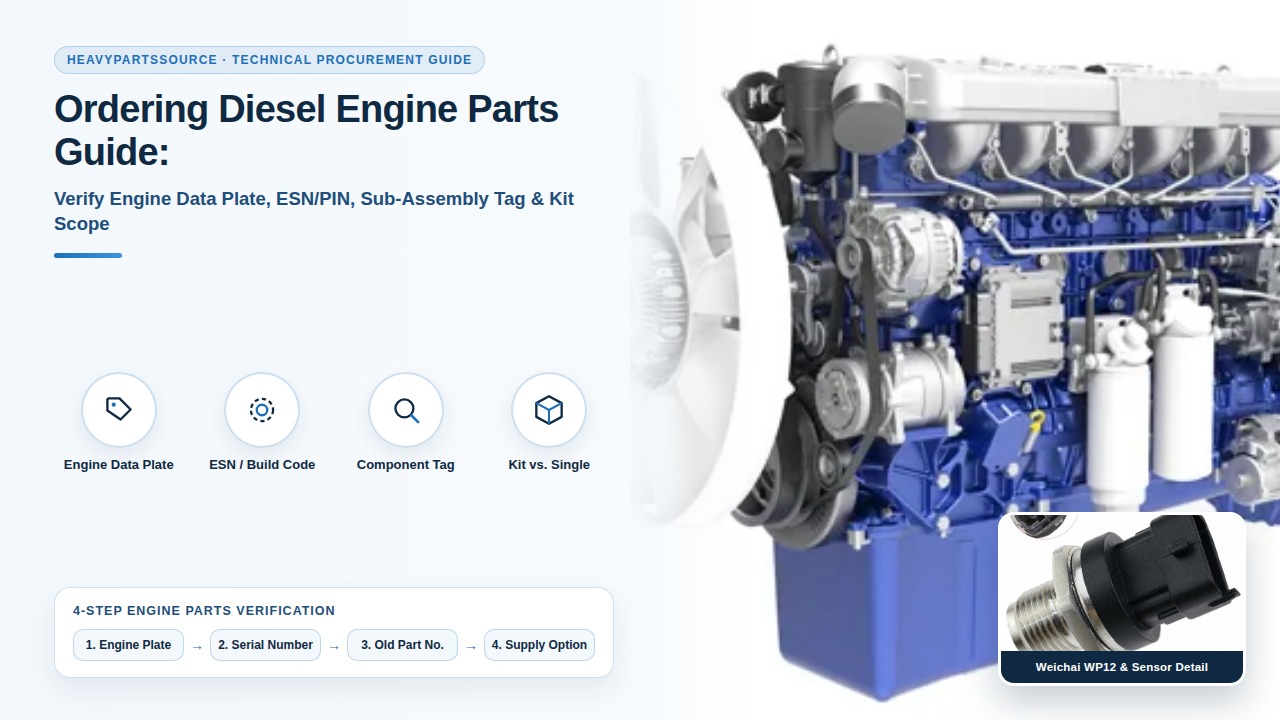
Ordering replacement pistons, cylinder liners, crankshaft bearings, turbochargers, or fuel injectors using only a machine model decal or bare engine family name (Cummins 6BT5.9, Cat C9, Isuzu 4HK1, Komatsu SAA6D107E, Weichai WP12) causes Tier 3 versus Tier 4 piston-bowl collisions, uncalibrated injector misfires, crushed head-gasket fire rings, and multi-day open-engine bay downtime. Before releasing a purchase order, lock the installed engine's physical dataplate, configuration build code, sub-assembly calibration numbers, and micrometer-verified wear dimensions on a line-by-line procurement record.
To order heavy-duty diesel engine parts without fitment or calibration mismatches, record six mandatory engineering verification inputs for each request line (line-01, line-02): (1) the installed engine's full serial number (ESN) and build configuration code from the engine dataplate and block stamping—specifically the 8-digit ESN plus 3-to-4-digit Control Parts List (CPL) on Cummins, the 3-character serial prefix plus 7-digit Engine Arrangement Number (AR#) on Caterpillar, the dash/application suffix on Komatsu (SAA6D107E-1B-W vs. -3B), the block stamping on Isuzu (4HK1, 6HK1, 6WG1), the build list on Perkins, or the DH configuration code on Weichai (WP10, WP12); (2) the host machine's 17-character Product Identification Number (ISO 10261:2021 PIN) or truck VIN plus confirmation of whether the engine was ever repowered; (3) the declared power, rated speed (rpm), and emission tier certification (ISO 3046-1 / SAE J1349 & EPA 40 CFR Part 1039 Tier 2/3 vs. Tier 4 Final / EU Stage V); (4) old sub-assembly part numbers and laser-etched injector calibration trim codes (6–8 character Cat HEUI/MEUI trim codes, IMA/IMA2 codes, or Tier 4 SIS .trm serial files); (5) micrometer-verified crankshaft journal sizes (STD vs. -0.25 / -0.50 / -0.75 mm undersize) and wet cylinder liner flange protrusion (0.03–0.10 mm or 0.06–0.18 mm); and (6) the exact supply scope (single component, loaded cylinder pack, in-frame overhaul kit, or out-of-frame complete overhaul kit).
Scroll horizontally to view all columns.
| Verification layer or input field | Governing standard or OEM catalog baseline | Why it governs diesel engine part fitment & operation |
|---|---|---|
1. Engine Serial Number (ESN) & block pad stamp | Cummins QSOL 8-digit numeric ESN (45275188); Cat SIS 3-char prefix (6NZ, BXS, CKH); Isuzu machined block pad (4HK1, 6HK1, 6WG1) | Connects the request to the exact factory bill of materials and mid-production engineering serial breaks rather than a generic marketing series |
2. Build configuration code (CPL / Arrangement / Build List) | Cummins CPL (CPL 2079, CPL 0954); Cat Arrangement No. (207-1080); Komatsu suffix (SAA6D114E-3B-WT); Perkins 2-letter build list | Locks the matched internal combustion group: piston bowl depth, compression ratio, wrist-pin diameter, camshaft timing, turbocharger, and injector flow |
| 3. Host machine PIN / truck VIN & repower status | ISO 10261:2021 17-character machine PIN (>= 4 mm cab plate or >= 6 mm / >= 0.2 mm deep right-hand frame stamp) | Governs OEM chassis-mounted interfaces (flywheel housing, oil pan sump orientation, fan drive, harness) and flags swapped/repowered engines |
| 4. Power rating & emission tier architecture | ISO 3046-1 (p_r = 100 kPa, T_r = 298 K / 25°C, phi_r = 30%) & EPA 40 CFR Part 1039 (Tier 2/3 vs. Tier 4 Final / EU Stage V) | Separates mechanical or HEUI cylinder heads and piston bowls from High-Pressure Common Rail (HPCR), cooled EGR, VGT, and DPF/SCR hardware |
| 5. Sub-assembly tags & injector calibration codes | 6–8 char laser-etched Cat HEUI/MEUI trim codes, IMA/IMA2 codes, or SIS digital .trm files; SAE J2030 Deutsch DT04/DT06 connectors | Compensates for microsecond solenoid opening delays and +-2% pilot/idle fuel delivery across Cylinders #1–#6 (jspartsonline.com) |
| 6. Liner protrusion & crankshaft bearing micrometry | Wet liner flange protrusion 0.03–0.10 mm (0.06–0.18 mm Cat spacer-plate blocks per IPD); crank journals STD vs. -0.25 / -0.50 / -0.75 mm | Prevents crushed Multi-Layer Steel (MLS) head gasket fire rings, combustion gas blow-by, and spun bearings on previously ground crankshafts |
| 7. Overhaul kit & filtration supply scope | Single item vs. cylinder pack vs. in-frame kit (upper gaskets + pan seal) vs. out-of-frame kit (full lower seals + front/rear main seals) | Ensures front timing cover gaskets, crankshaft seals, torque-to-yield head bolts, and primary/secondary filters (Donaldson F110024-ENG, p. 58) are not omitted |
| Dominant failure mode & prevention | Wrong-CPL piston-to-valve contact, uncalibrated injector knock, or STD bearings installed on a -0.50 mm reground crankshaft | Prevented by mandatory 10–25 deg raking-light dataplate photography, ESN + CPL/AR# catalog lookup, and pre-order micrometer verification |
Why is a bare engine series name (6BT5.9, C9, 4HK1, SAA6D107E, WP12) never enough to order internal diesel parts?
A base diesel engine family designation—such as Cummins 6BT5.9 or QSB6.7, Caterpillar C6.6, C7.1, C9, C13, or C15, Isuzu 4HK1, 6HK1, or 6WG1, Komatsu SAA6D107E or SAA6D114E, Weichai WP10 or WP12, Mitsubishi 6D34 or 6M60, Perkins 1104 / 1106, or Yanmar 4TNV94 / 4TNV98—identifies only the cylinder block architecture, cylinder count, and nominal swept volume. Across a 10-to-20-year production run, a single engine family is built in hundreds of distinct internal and external configurations to match excavator hydraulic pump torque curves, wheel-loader transmissions, highway truck retarders, stationary generator governing (1500 / 1800 rpm), and regional emission standards (EPA 40 CFR Part 1039 Tier 2, Tier 3, Interim Tier 4, Tier 4 Final, and EU Stage V).
Under ISO 3046-1 Clauses 5, 6, and 12 (Reciprocating internal combustion engines — Performance — Part 1), an engine's declared net brake power (P_r, evaluated at standard reference conditions of p_r = 100 kPa total barometric pressure, T_r = 298 K / 25 deg C air temperature, phi_r = 30% relative humidity, and T_cr = 298 K charge-air coolant temperature) is achieved through a tightly matched combination of essential engine components—specifically the fuel injection pump, high-pressure injectors, exhaust turbocharger, charge-air cooler, camshaft profile, and piston combustion bowl. Furthermore, field engine swaps (repowers) are common on older excavators, loaders, and dump trucks: if a maintenance crew replaced a Tier 3 electronic engine with a remanufactured mechanical build or a different arrangement code five years ago, looking up parts strictly by the machine's chassis serial number will pull the factory-original bill of materials rather than the engine physically bolted in the frame today.
OEM Diesel Engine Dataplate Decoding & Block Stamping Matrix
Before comparing aftermarket or OEM quotations in our diesel engine parts directory, locate and clean both the engine dataplate and the machined cylinder-block serial stamping for the specific manufacturer:
Scroll horizontally to view all columns.
| Engine manufacturer & core heavy-duty families | Primary dataplate lookup key (ESN / Prefix) | Mandatory internal build code (CPL / AR# / Suffix) | Physical dataplate & backup block stamping locations | Dominant failure mode & prevention |
|---|---|---|---|---|
Cummins (4BT3.9, 6BT5.9, ISB/QSB6.7, ISC/QSL9, ISM/QSM11, ISX15, N14, QSK19/45/60) | 8-digit numeric ESN (e.g., 45275188, 57123456) entered into Cummins QuickServe Online (QSOL) | CPL (Control / Critical Parts List): 3-to-4-digit code (e.g., CPL 2079, CPL 0954, CPL 8430) defining piston, injector, cam, and turbo group | 4BT/6BT: front gear housing or oil-cooler side of block; ISB/QSB: rocker cover or gear housing side; ISC/ISL/QSL: top of gear housing; ISM/QSM: fuel-pump-side rocker housing; ISX: top of rocker cover; backup ESN stamped on passenger/rear block pad (4btdiesel.com, HHP) | Failure mode: Ordering a 6BT5.9 or QSB6.7 piston kit by displacement alone and receiving the wrong wrist-pin diameter or combustion bowl depth for the installed CPL. Prevention: Never release a Cummins internal part order without both the 8-digit ESN and 3/4-digit CPL code. |
Caterpillar (3126, 3406E, C4.4, C6.6, C7, C7.1, C9, C9.3, C13, C15 ACERT, 3500) | 3-character alphanumeric Serial Prefix + 5-digit sequence (e.g., 6NZ, MBN, BXS, MXS on C15; 8MW, CKH on C9; KCB, LEE on C13; APW, RLA on C7.1) | Engine Arrangement Number (AR#): 7-digit Cat part number (e.g., 207-1080) + Performance Spec / Flash File part number in Cat SIS | Riveted metal dataplate on the valve cover, intake manifold, or left/right side of the cylinder block; backup serial prefix + sequence stamped on a machined boss near the rear oil cooler or governor pad | Failure mode: Mixing Pre-ACERT (6NZ/MBN) and ACERT (BXS/MXS) C15 cylinder packs, or ordering HEUI vs. HPCR C9/C9.3 injectors without the Arrangement No.. Prevention: Record both the 8-character ESN (Prefix + Sequence) and the 7-digit Arrangement Number. |
Isuzu Industrial (4LE2, 4JG1, 4JJ1, 4BG1, 4HK1, 6BG1, 6HK1, 6UZ1, 6WG1) | 6-digit numeric Engine Serial Number stamped into the machined cylinder block boss | Full Model + Emission/Turbo Suffix (e.g., 4HK1XYSA-02, 6HK1XQA, 6WG1X Tier 3 vs. Tier 4 Final) cross-referenced with host excavator PIN (Hitachi, Case, JCB, SANY, Sumitomo) | Machined block stampings (Hamilton Power Solutions guide): 4HK1 on right center, lower block; 6HK1 on right front, upper block below #1 exhaust port; 6WG1 on left front, top block in front of injection pump; 4JJ1/4JG1 at left rear, top block; 6UZ1/6SD1 at left center, lower block | Failure mode: Looking only at the adhesive valve-cover decal (which peels off under steam washing) or swapping Tier 3 and Tier 4 Final 4HK1 / 6HK1 EGR coolers and Denso common-rail injectors. Prevention: Clean and photograph the machined cylinder-block serial stamping at the exact family coordinate. |
Komatsu (SAA6D95LE, SAA6D102E, SAA6D107E, SAA6D114E, SAA6D125E, SAA6D140E) | Numeric Engine Serial Number (e.g., S/N 26850001-Up) paired with the Komatsu CSS serial break | Dash Generation + Application Build Suffix across 330+ catalog variants (e.g., SAA6D107E-1B-W vs. -2A vs. -3B; SAA6D114E-2A-KU vs. -3B-WT vs. -5A vs. -6C per K-Part) | Aluminum dataplate riveted to the top/side of the rocker cover or front timing gear housing, plus machined serial pad on the cylinder block | Failure mode: Requesting an overhaul kit for a "Komatsu 6D107" or "6D114" without the -1, -2, -3, -5, or -6 build suffix, resulting in mismatched piston crown recesses and head gaskets. Prevention: Transcribe the complete hyphenated build string (SAA6D107E-1B-W) and engine serial number. |
Weichai Power (WP6, WP10, WP12, WP13, WD615, WD10) | Complete Engine Serial Number on the block and valve-cover plate | DH / Configuration Material Code (e.g., WP12.375E40 or WP12.430E201 + specific DH build code) | Metal nameplate riveted to the rocker cover or cylinder block side; secondary serial stamping on the machined cylinder block pad (see our Weichai WP12 engine reference) | Failure mode: Treating a dump-truck or loader marketing brochure (WP12) as a universal parts list across Euro II mechanical and Euro IV/V Bosch common-rail variants. Prevention: Provide the full WP12 rating suffix, DH configuration code, and nameplate photo. |
Perkins, Yanmar & Mitsubishi (Perkins 1104/1106, Yanmar 4TNV94L / 4TNV98 / 4TNV98T, Mitsubishi 6D34 / 6M60) | Perkins 15-char serial; Yanmar/Mitsubishi engine serial number on tag and block | Perkins 2-letter family code + Build List (RE, PK, U); Yanmar Spec Code (4TNV98-ZNSA vs. turbocharged 4TNV98T per Maxiforce); Mitsubishi full sub-suffix (6D34-TLU2D) | Perkins: left side of block near flywheel housing/fuel pump or timing cover; Yanmar 4TNV98: valve cover plate or near fuel injection pump/timing housing; Mitsubishi: valve cover and block top edge | Failure mode: Ordering Yanmar 4TNV98 (4 cyl, 98 mm bore) pistons, head gaskets, or water pumps by compact-loader make (Takeuchi, Gehl, Mustang, ASV) without the engine build spec. Prevention: Capture the full engine specification code and serial number from the valve cover and block. |
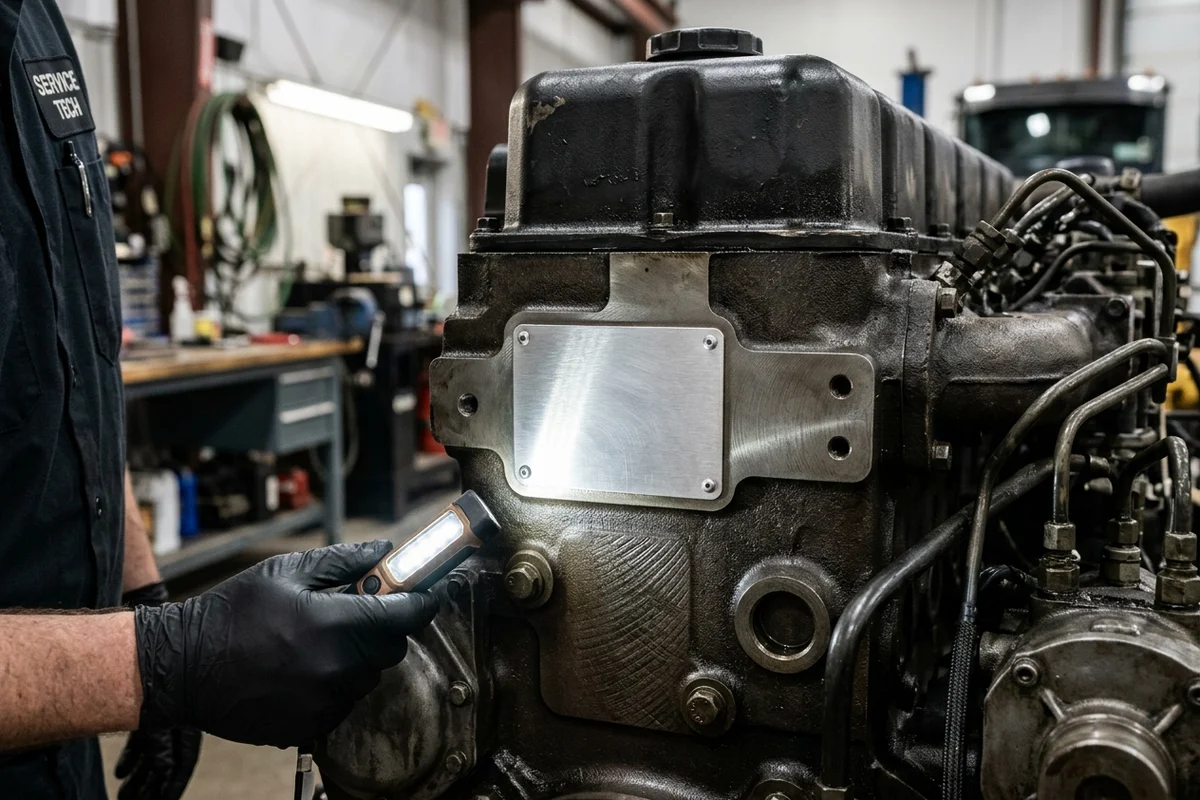
Capturing installed diesel engine identity in the service bay: use a 10–25° oblique raking LED light with camera flash OFF to photograph both the riveted valve-cover/gear-housing dataplate (ESN, CPL, or Arrangement No.) and the backup serial stamping machined into the cast-iron cylinder block.
Engineering Rule-of-Thumb (Engine Dataplate ESN + CPL / Arrangement Code vs. Bare Series Name Threshold): If a diesel engine parts inquiry specifies only a base engine series name (Cummins 6BT5.9 / QSB6.7, Cat C7.1 / C9 / C15, Isuzu 4HK1 / 6HK1, Komatsu SAA6D107E / SAA6D114E, Weichai WP12, or Yanmar 4TNV98) or relies solely on the host machine's chassis serial number (ISO 10261 PIN) under internal or fuel-system procurement → halt part selection and recover the installed engine's Engine Serial Number (ESN) plus its internal configuration code (Cummins CPL, Cat Arrangement Number, Komatsu Dash/Application Suffix, Perkins Build List, or Weichai DH Code) from the physical engine dataplate and block stamping, because a single engine displacement spans 20 to 330+ incompatible piston-bowl, wrist-pin, camshaft, turbocharger, and injector builds and may have been repowered in the field.
Takeaway: Always pair the host machine's 17-character ISO 10261:2021 PIN (which governs radiator, fan-drive, engine-mount, and chassis-harness interfaces—see our excavator part number identification guide and heavy-duty truck parts request guide) with a 10–25 deg raking-light macro photo of the installed engine's dataplate and block stamping (following our 5-shot part photography protocol).
What internal measurements and sub-assembly codes must be verified before ordering pistons, liners, bearings, and injectors?
Even when the engine serial number (ESN) and CPL / Arrangement Number are locked, ordering internal overhaul components or high-pressure fuel-system parts requires verifying two physical boundary conditions that no factory catalog can predict from a serial number alone: first, whether the cylinder block counterbores or crankshaft journals were machined to an oversize/undersize dimension during a previous rebuild; and second, which electronic calibration codes or emission-tier hardware are installed on the fuel injectors and turbocharger.
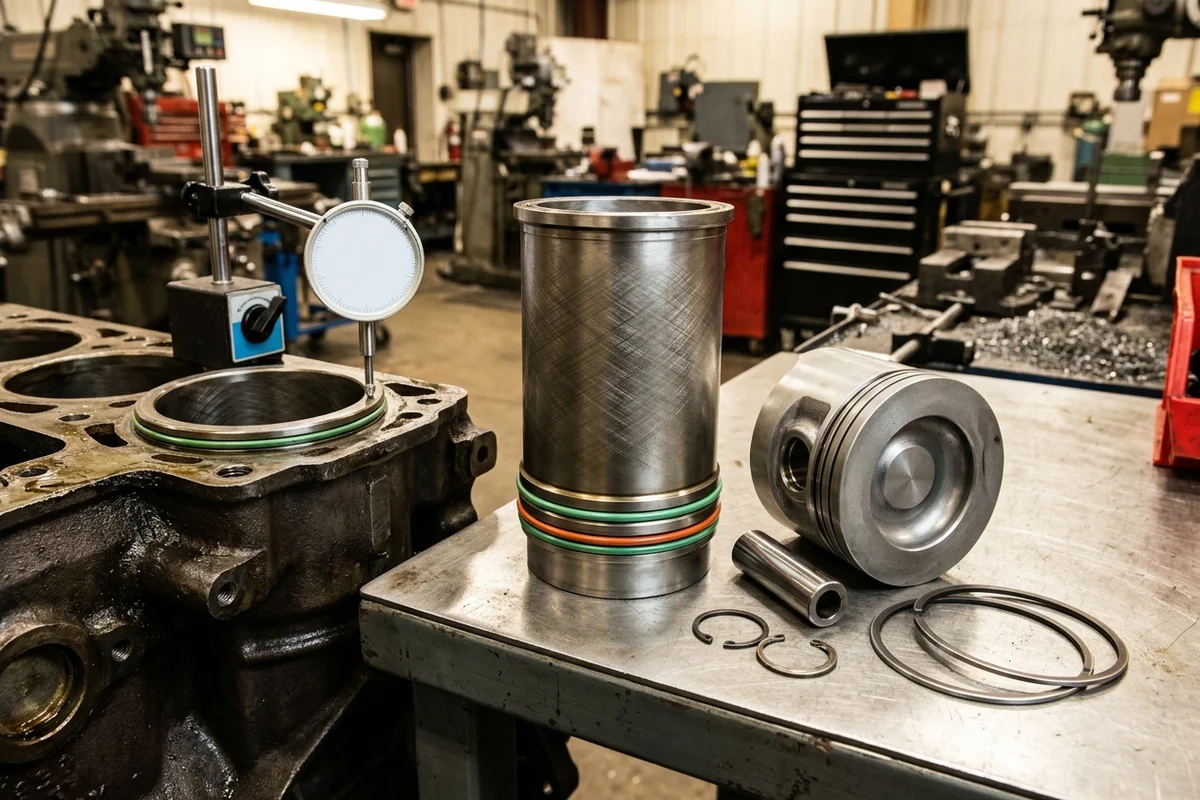
Pre-order cylinder pack and block deck verification: checking wet cylinder liner flange protrusion in the flat inner sealing valley with a sled dial indicator alongside a matched re-entrant combustion-bowl piston, wrist pin, and ring pack.
1. Wet Cylinder Liner Flange Protrusion, Counterbore Shim Stack-Up & Piston-to-Head Clearance Equation
On heavy-duty wet-liner diesel engines (such as Cummins QSL9 / QSM11 / ISX15 / N14, Caterpillar 3406E / C13 / C15 / 3500, Komatsu SAA6D114E / SAA6D125E, and Weichai WP12), the top flange of each replaceable cylinder liner sits in a machined counterbore ledge in the cylinder block (or spacer plate) and protrudes slightly above the block deck surface. When the cylinder head is torqued down, this liner protrusion (P_liner) sets the exact clamping crush on the head gasket's combustion fire ring.
If counterbore fretting has sunk the liner flange, or if the block counterbore was previously cut and fitted with a stainless-steel counterbore shim of thickness t_shim, the net liner protrusion P_liner, the adjacent-cylinder protrusion step delta_P_adj, and the dynamic running piston-to-head (squish) clearance C_piston-head obey the axial stack-up equations:
P_liner = H_flange + t_shim - D_counterbore
Delta P_adj = | P_liner,i - P_liner,i+1 | <= 0.080 mm and (P_liner,max - P_liner,min)_all <= 0.100 mm
C_piston_head = H_gasket_compressed - P_piston_deck
where H_flange is the liner flange thickness (mm), t_shim is the counterbore recovery shim thickness (mm, 0 mm on unshimmed standard counterbores), D_counterbore is the machined block (or spacer-plate) counterbore depth (mm), H_gasket,compressed is the compressed Multi-Layer Steel (MLS) or fire-ring head gasket thickness (mm), and P_piston,deck is the piston crown projection above the block deck at Top Dead Center (mm).
As documented in IPD's Heavy-Duty Liner Protrusion Technical Bulletin (ipd-cylinder-liner-protrusion.txt), on upgraded raised-edge (fire-dam ridge) liners for Caterpillar 3400 / C15 (5.4 in / 137.16 mm bore) engines, the outer perimeter ridge stands delta_H_ridge = 0.012 in (0.305 mm) proud of the flat inner fire-ring sealing valley. If a technician rests a wide sled-gauge contact tip on top of that raised ridge instead of inside the flat valley (tip diameter < 0.270 in / 6.86 mm), the gauge reads falsely high by +0.305 mm.
- Worked Example (Cylinder Liner Protrusion & Shim Verification on a Heavy-Duty Inline-6 Rebuild): Suppose Cylinder
#3's counterbore was resurfaced during a prior overhaul to depthD_counterbore = 10.010 mm, while a new standard replacement wet liner has a flange thickness ofH_flange = 10.040 mm. Without a counterbore shim (t_shim = 0 mm), the installed protrusion isP_liner = 10.040 - 10.010 = 0.030 mm(0.0012 in)—sitting at the extreme bottom limit where fire-ring gas blow-by occurs (< 0.060 mmminimum on Cat spacer-plate blocks). Installing at_shim = 0.050 mm(0.0020 in) counterbore shim restores protrusion to:
If the technician mistakenly places the dial indicator tip on top of aP_liner = 10.040 + 0.050 - 10.010 = 0.080 mm (0.0031 in)0.305 mm(0.012 in) raised outer liner ridge rather than in the flat inner sealing valley, the gauge falsely displaysP_apparent = 0.080 + 0.305 = 0.385 mm(0.0152 in), causing the mechanic to misdiagnose a properly shimmed liner as0.305 mmover-protruded.
Engineering Rule-of-Thumb (Wet Cylinder Liner Flange Protrusion & Sled-Gauge Valley Measurement Threshold): If wet cylinder liner flange protrusion P_liner measured across 4 compass points falls below 0.03 mm (0.0012 in) on mid-range wet-liner blocks or < 0.06 mm (0.0024 in) on Caterpillar 3400 / C15 spacer-plate blocks—or if protrusion variation exceeds 0.050 mm (0.0020 in) on a single liner, 0.080 mm (0.0031 in) between adjacent cylinders, or 0.100 mm (0.0040 in) across all six cylinders (IPD Technical Bulletin) → order calibrated counterbore shims, a replacement spacer plate, or an out-of-frame overhaul kit for block counterbore machining (and always seat a < 0.270 in / 6.86 mm sled-gauge tip inside the flat sealing valley using soft fiber hold-down washers rather than on top of any 0.012 in / 0.305 mm raised outer ridge), because insufficient protrusion (< 0.03–0.06 mm) causes combustion gas blow-by while excessive protrusion (> 0.10–0.18 mm) crushes the head-gasket fire ring and cracks the liner flange.
2. Crankshaft Journal Grinding Undersize, Bearing Wall Thickness & Radial Oil Film Clearance Equation
Never check the box for "Standard (STD) Main and Rod Bearings" on an overhaul kit quote without either confirming that the crankshaft has never been removed or measuring the main and connecting-rod journals with an outside micrometer (0.001 mm resolution). When a heavy-duty diesel crankshaft is reground during an overhaul to remove scoring or taper, the machine shop grinds the journal diameter down by a standardized metric undersize step U_grind in [0.25, 0.50, 0.75, 1.00] mm (0.010, 0.020, 0.030, 0.040 in).
To maintain the required hydrodynamic radial oil film clearance C_oil (0.040 to 0.100 mm) inside a parent connecting-rod or main bearing bore of diameter D_housing, the replacement undersize bearing half-shells must have an increased wall thickness t_shell,US governed by:
U_grind = D_journal,STD - D_journal,meas
t_shell,US = t_shell,STD + (U_grind / 2)
C_oil = D_housing - (2 * t_shell) - D_journal,meas
- Worked Example (Installing
STDvs.-0.50 mmUndersize Rod Bearings on a Reground Crankshaft): Consider a heavy-duty diesel connecting rod with housing boreD_housing = 90.070 mm, factory standard journal diameterD_journal,STD = 85.000 mm, and standard bearing shell wall thicknesst_shell,STD = 2.500 mm(giving design oil clearanceC_oil,STD = 90.070 - 2(2.500) - 85.000 = 0.070 mm). If the crankshaft was previously ground-0.50 mm(0.020 in) undersize toD_journal,meas = 84.500 mm, ordering and installingSTD(2.500 mm) bearing shells produces an actual clearance of:
Measuring the journal first (C_oil,wrong = 90.070 - (2 * 2.500) - 84.500 = 0.570 mm (8.1x normal oil clearance -> immediate oil pressure loss & rod knock)84.500 mm) and ordering-0.50 mm(0.020 in) undersize bearings with wall thicknesst_shell,US = 2.500 + (0.500 / 2) = 2.750 mmrestores the exact hydrodynamic film clearance:C_oil,correct = 90.070 - (2 * 2.750) - 84.500 = 0.070 mm
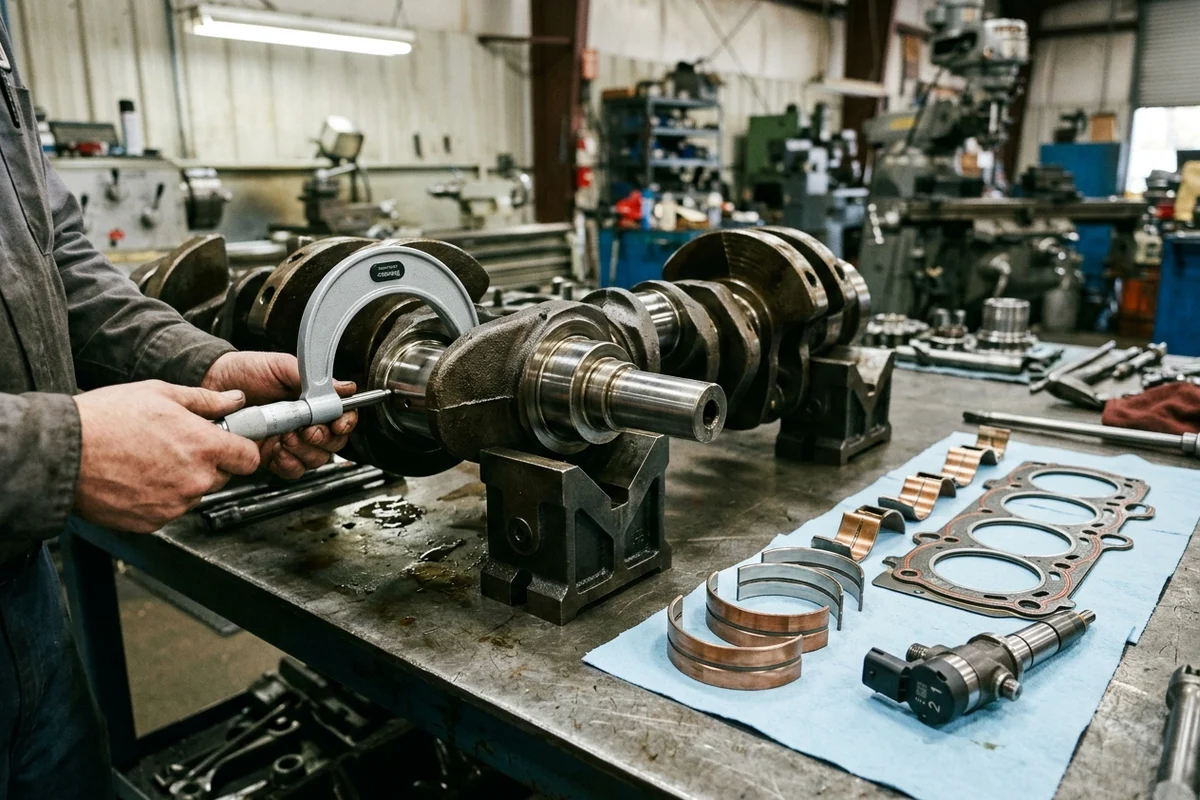
Crankshaft journal micrometry and fuel injector verification bench: measure
main and connecting-rod journals with an outside micrometer and inspect the
back of old bearing shells (STD, 0.25, 0.50 mm) alongside laser-etched
injector trim codes before finalizing an overhaul kit order.
Engineering Rule-of-Thumb (Crankshaft Journal Micrometry Before Ordering STD vs. -0.25 / -0.50 mm Undersize Bearings Threshold): If a diesel engine has unknown prior rebuild history or exhibits main/connecting-rod journal out-of-roundness or taper exceeding 0.025 mm (0.0010 in) under teardown inspection → measure every main and rod journal across two perpendicular axes (A-A and B-B) with an outside micrometer and read the stamping on the steel back of the removed bearing shells (STD, -0.25 mm / 0.010", -0.50 mm / 0.020", -0.75 mm / 0.030") before specifying bearing sizes in your overhaul kit order, because installing STD shells on a -0.25 mm or -0.50 mm reground journal increases radial clearance C_oil by +0.25 to +0.50 mm (4x–8x design clearance) and causes immediate low oil pressure and spun bearings on first start-up.
3. Internal Overhaul Component & Emission-Tier Sub-Assembly Verification Matrix
Use the engineering matrix below to verify every internal and fuel/air subsystem before submitting a request:
Scroll horizontally to view all columns.
| Diesel engine subsystem | Critical specification & standard baseline | Mandatory numbers & physical checks to record | Why series-only ordering fails across Tier 2/3 vs. Tier 4 Final | Dominant failure mode & prevention |
|---|---|---|---|---|
| Pistons, wrist pins & ring packs | EPA 40 CFR Part 1039 / EU Stage V combustion bowl geometry; one-piece forged steel vs. articulated two-piece (steel crown + aluminum skirt) vs. cast aluminum | Piston crown stamping number, combustion bowl diameter/depth, compression height, wrist-pin OD (mm), and ring groove profile (keystone vs. rectangular) | A Tier 3 vs. Tier 4 Final QSB6.7, C7.1, 4HK1, or SAA6D107E uses a completely different re-entrant bowl shape matched to injector spray cone angle and EGR rate | Failure mode: Spray-wall impingement (melting the piston crown edge) or wrist-pin bore mismatch during assembly. Prevention: Match piston P/N strictly to ESN + CPL / Arrangement No. and verify the old piston crown stamping. |
| Cylinder liners & counterbore seals | Wet liners (Cummins QSL/QSM/ISX, Cat C15, Komatsu 6D114, Weichai WP12) vs. dry slip/press-fit liners (6BT5.9, 4HK1) | Liner flange OD, flange thickness H_flange, raised fire-dam ridge (IPD 0.012"), anti-polish ring (APR), outer O-ring / D-ring seal count, or +0.50 mm oversize bore | Mid-series block updates change liner flange thickness, lower crevice seal groove count (2 vs. 3 O-rings), or introduce anti-polish carbon scraper rings | Failure mode: Coolant leaking past lower liner seals into the oil pan, or blown head gaskets from P_liner < 0.03 mm or > 0.18 mm. Prevention: Verify block ESN break, liner flange style, and counterbore protrusion with a < 0.270" sled gauge tip. |
| Main, con-rod & thrust bearings | Bi-metal or tri-metal sputter shells (STD, -0.25 mm / 0.010", -0.50 mm / 0.020", -0.75 mm / 0.030", -1.00 mm / 0.040") + optional oversize OD for line-bored blocks | Outside micrometer reading of main and rod journals (D_journal,meas), parent bore ID (D_housing), and stamped size code on the back of old shells | Catalogs default to STD bearings, which only fit unground factory crankshafts and standard un-bored main bearing saddles | Failure mode: Ordering STD bearings before tearing down an engine whose crank was ground -0.50 mm in a prior rebuild. Prevention: Inspect old bearing shell backs and micrometer-check journals before locking the kit bearing size. |
| Fuel injectors & high-pressure pumps | Cat HEUI (C7/C9), MEUI-A/B (C13/C15), and HPCR (Bosch, Denso, Cummins, Perkins/Cat C6.6/C7.1) | Full OEM & sub-vendor part number (e.g., Bosch 0445120*, Denso 095000-*, Cat 387-9428 / 456-3493) + laser-etched 6–8 char Trim Code / IMA code / injector serial number (jspartsonline.com) | Even within the same engine model, injector nozzle flow rate, solenoid opening delay (us), and ECM personality flash file change by horsepower rating and emission tier | Failure mode: Rough idle, P0261–P0278 faults, over-fueling cylinder wash, or entering trim codes from the flywheel end instead of Cylinder #1 at the radiator/fan end. Prevention: Photograph every injector's laser-etched trim code and serial number before installation and program via Cat ET / Cummins INSITE. |
| Turbochargers & VGT actuators | Fixed-geometry wastegate vs. Variable Geometry Turbocharger (Holset HE300VG / HE400VG, Garrett, BorgWarner, MHI) | Complete turbocharger nameplate: Assembly Part No., Serial No., Customer OEM No., and 12V vs. 24V electronic actuator part number + SAE J2030 connector keyway | Host machine applications (excavator vs. wheel loader vs. on-highway truck) rotate turbine/compressor housing clock angles and use different electronic actuator calibrations | Failure mode: Exhaust downpipe or charge-air pipe flange misalignment, or CAN-bus J1939 actuator fault codes after bolting on an uncalibrated VGT. Prevention: Photograph the riveted turbocharger tag under 10–25 deg raking light and specify complete turbo with calibrated actuator vs. cartridge (CHRA). |
| Engine ECM & harness sensors | Engine Electronic Control Module (ECM / ECU), rail pressure sensor, crank/cam speed sensors (SAE J2030 Deutsch DT04/DT06) | ECM dataplate Part No., Serial No., Software/Personality Flash File No., system voltage (12V vs. 24V), and connector cavity count + keyway (Key A/B/C/D) | An unprogrammed ("blank") or differently flashed ECM from our controllers category will not fire injectors or communicate with the machine monitor | Failure mode: Ordering a bare hardware ECM without specifying whether factory software flashing and injector trim programming are available on site. Prevention: Submit the old ECM plate photo, engine ESN, and machine PIN so software requirements are stated in writing. |
| Primary & secondary fuel/oil filters | Primary suction water separator (34.5–41.4 kPa / 5–6 psi, nominal 10–30 um) vs. secondary high-pressure filter (4–10 um / 2 um HPCR per Donaldson F110024-ENG, pp. 11, 57–58) | Full part number on both old filter elements, filter head/housing model, water-in-fuel (WIF) sensor plug, and companion cover/vent O-ring kit scope | Consolidating spin-on filters across engines by matching thread pitch and canister OD alone bypasses micron efficiency and bypass-valve cracking pressure rules | Failure mode: High-pressure common-rail injector erosion caused by substituting a coarse 10–30 um element into a 2–4 um secondary position. Prevention: Separate primary and secondary stages using our diesel fuel filter micron rating guide and filter replacement planning guide. |
Engineering Rule-of-Thumb (EPA Tier 2/3 vs. Tier 4 Final / Stage V Piston Bowl & Injector Calibration Threshold): If a replacement piston, cylinder head, turbocharger, or electronic fuel injector is ordered for an engine platform that spans EPA 40 CFR Part 1039 Tier 2/3 and Interim Tier 4 / Tier 4 Final / EU Stage V (such as Cummins QSB6.7 / QSL9, Caterpillar C6.6 / C7.1 / C9 / C9.3 / C13 / C15, Isuzu 4HK1 / 6HK1, or Komatsu SAA6D107E / SAA6D114E) → verify both the emission-tier family on the engine dataplate and the old component's stamped part number—and for any electronic injector (Cat HEUI / MEUI / HPCR, Bosch, Denso), photograph the 6–8 character laser-etched trim code (or IMA code and injector serial number) before installation and program Cylinder #1 through #6 starting from the front radiator/fan end (jspartsonline.com), because Tier 3 and Tier 4 Final pistons use incompatible re-entrant bowl profiles and uncalibrated injectors cause > 2% idle fueling imbalance, cylinder hot-spotting, and crankshaft torsional vibration.
Takeaway: Never guess bearing sizes (STD vs. -0.25 / -0.50 mm), liner flange styles, or injector trim codes—measure journals and liner protrusion before ordering, and photograph every sub-assembly tag before installation.
How do you specify the exact supply scope: single part, loaded cylinder pack, in-frame kit, or out-of-frame overhaul kit?
One of the most frequent commercial disputes in diesel engine procurement occurs when a buyer asks for an "engine rebuild kit" or "piston kit" without defining the assembly boundary. As documented in heavy-duty engine rebuild standards (ATL Diesel, Maxiforce, Caterpillar Bronze/Silver/Gold/Platinum tiers), different kit names include or omit critical lower-end seals, timing-cover gaskets, and cylinder-head hardware:
Scroll horizontally to view all columns.
| Supply scope tier | Standard bill of materials (BOM) included | What is typically OMITTED (must be ordered separately if needed) | When to select this supply scope | Dominant failure mode & prevention |
|---|---|---|---|---|
| 1. Bare Piston vs. Piston Kit vs. Cylinder Kit (Liner Kit) | Bare Piston: piston crown/skirt only. Piston Kit: piston + wrist pin + 2 snap retainers + piston ring set. Cylinder Kit / Liner Kit: piston kit + wet/dry cylinder liner + liner crevice/O-ring seals ( 1 cylinder) | Connecting rod, rod bushing, rod bearings, main bearings, cylinder head gasket, and counterbore shims | Single-cylinder scuffing repair or ordering 4 or 6 individual cylinder kits alongside separate custom bearing sets | Failure mode: Requesting "6 pistons" and receiving bare piston crowns without wrist pins, snap rings, piston rings, or liner seals. Prevention: State explicitly on your RFQ line: Cylinder Kit (piston + rings + pin + retainers + liner + liner seals) x 6. |
| 2. Loaded Cylinder Pack (Cat Platinum-style) | Factory pre-assembled cylinder liner, piston, piston rings, wrist pin, retainers, and remanufactured or new connecting rod pre-fitted into the liner (1 cylinder) | Main bearings, thrust washers, upper/lower engine gasket sets (unless ordered as part of a full Platinum overhaul kit) | Rapid workshop turnaround on Cat C9, C13, C15, 3400, 3500 where pre-compressed ring packs cut bay labor hours and prevent ring installation breakage | Failure mode: Breaking a brittle plasma-moly top compression ring with a shop ring compressor during hurried in-bay assembly. Prevention: Request pre-loaded cylinder packs when available for the verified Cat Arrangement No.. |
| 3. In-Frame (In-Chassis) Overhaul Kit | Cylinder kits for all cylinders (pistons, rings, pins, retainers, liners, liner seals) + main bearing set + connecting-rod bearing set + thrust washers + upper (cylinder head) gasket set + oil pan gasket (ATL Diesel) | Front timing gear cover gasket, front crankshaft main oil seal, rear crankshaft main oil seal, flywheel housing gasket, and complete lower-block seals | Preventive mid-life rebuild (200,000–500,000 miles or 6,000–10,000 hours) where the cylinder block and crankshaft remain bolted inside the machine or truck frame | Failure mode: Hoisting the engine out of the excavator or truck for a full teardown after ordering an in-frame kit, leaving the shop short of front/rear crankshaft main seals and timing housing gaskets. Prevention: Confirm before ordering whether the front timing cover or flywheel housing will be removed. |
| 4. Out-of-Frame (Complete Overhaul) Kit | All components in the In-Frame Kit (cylinder kits + main/rod bearings + thrust washers + upper gasket set + pan gasket) PLUS the complete lower gasket set, front timing cover gaskets, and front & rear crankshaft main oil seals | Torque-to-yield (TTY) cylinder head bolts, counterbore shims, camshaft bushings, oil pump, water pump, oil cooler core, fuel injectors, and remanufactured cylinder head | Major overhaul (> 700,000 miles or > 12,000 hours), spun main bearing, cracked/warped block deck requiring counterbore machining, or crankshaft removal for -0.25 / -0.50 mm grinding | Failure mode: Reusing stretched torque-to-yield head bolts or an oil cooler packed with bearing debris after a spun-bearing failure. Prevention: Add a head-bolt kit, oil cooler element, oil pump, and primary/secondary filters as explicit companion lines on out-of-frame rebuild orders. |
Takeaway: Always state on your quotation request whether you need a single component, a complete 1-cylinder liner kit, an in-frame overhaul kit, or an out-of-frame complete overhaul kit, and specify your verified bearing size (STD, -0.25 mm, -0.50 mm) in writing.
What does ordering diesel engine parts without ESN, CPL, or micrometer verification cost in teardown downtime and TCO?
Ordering heavy-duty diesel engine parts from an incomplete model name ("Cummins 6BT", "Cat C15", "Isuzu 4HK1", "Weichai WP12") or guessing "STD bearings" before micrometer inspection creates severe financial exposure. Unlike an external bracket or mirror, an internal engine part mismatch is often discovered only after the cylinder head is off, the oil pan is dropped, or the engine is reassembled and cranked—triggering a second teardown, scrapped one-time-use Multi-Layer Steel (MLS) head gaskets and torque-to-yield (TTY) head bolts, two-way international air freight on 80–160 kg cast-iron liner kits, and a stalled excavator or dump truck occupying a service bay for an extra week.
ISO 3046-1 Site Ambient Power Adjustment & Wrong-CPL Overhaul Downtime Cost Equation
First, when verifying whether an installed engine build or turbocharger/fuel-pump rating matches a high-altitude or high-temperature jobsite, ISO 3046-1 Clause 10 (iso-3046-1-preview.txt, page 5) relates the site-adjusted net brake power P_x (kW) to the manufacturer's declared ISO standard power P_r (kW at p_r = 100 kPa, T_r = 298 K, phi_r = 30%) via the ambient power adjustment factor alpha:
P_x = alpha * P_r, where alpha = k - 0.7 * (1 - k) * [ (1 / eta_m) - 1 ]
where k is the ratio of indicated power under site barometric pressure p_x and ambient temperature T_x relative to standard reference conditions, and eta_m is the engine mechanical efficiency (eta_m = 0.80 standard baseline per ISO 3046-1 Clause 10 Note 4, simplifying alpha = k - 0.175(1 - k) = 1.175,k - 0.175).
Second, the total financial loss C_overhaul,err caused by a single wrong-CPL piston/liner kit or wrong-undersize bearing shipment during an engine overhaul is governed by:
C_overhaul_err = (D_wait * H_shift * R_machine) + (H_re_teardown * R_tech) + (2 * W_crate * R_air) + (P_kit * f_restock) + C_gasket_scrap
where D_wait is the additional open-engine bay standby delay (days), H_shift is daily operating shift length (h/day), R_machine is the hourly standby cost of the idled excavator or truck ($/h), H_re,teardown is wasted mechanic labor to strip and reassemble the engine (h) at shop rate R_tech ($/h), W_crate is the crated overhaul kit weight (kg) shipped at air-freight rate R_air ($/kg), P_kit * f_restock is the supplier restocking fee on opened/unsealed kit boxes, and C_gasket,scrap is the cost of crushed one-time-use MLS head gaskets, liner seals, and torqued head bolts that cannot be reused.
- Worked Example (6-Cylinder Excavator Diesel Overhaul Stalled by a Wrong-CPL Piston &
STDBearing Order): Suppose a workshop orders an in-frame overhaul kit (P_kit = $2,600, crated weightW_crate = 110 kg) for a 6-cylinder excavator engine by model name alone, without checking theCPL / Arrangement No.or micrometer-measuring a-0.25 mmreground crankshaft. Discovering the mismatch during assembly stalls the excavator forD_wait = 7 days(H_shift = 8 h/day,R_machine = $175/h→$9,800machine downtime), wastesH_re,teardown = 18 hof mechanic labor atR_tech = $85/h($1,530), incurs two-way air freight atR_air = $8.50/kg($1,870), af_restock = 15%restocking fee ($390), and scraps$480in crushed MLS head gaskets and stretched head bolts:
Taking 25 minutes before ordering to photograph the engine dataplate (C_overhaul_err = (7 * 8 * 175) + (18 * 85) + (2 * 110 * 8.50) + (2600 * 0.15) + 480 = 9800 + 1530 + 1870 + 390 + 480 = $14,070ESN + CPL/AR#), check liner protrusion, and micrometer-verify the crankshaft journals prevents a $14,070 single-rebuild loss.
Scroll horizontally to view all columns.
| 5-Year Fleet Engine Procurement TCO Dimension | Casual Model-Only / Piecemeal Engine Ordering | Verified ESN + CPL/AR# + Micrometer + Complete Kit Protocol | Primary Cost Driver & Mechanical Impact | Dominant Failure Mode & Prevention |
|---|---|---|---|---|
| Piston bowl, wrist-pin & compression ratio mismatches | 12%–18% mis-shipment rate when ordering by bare series (6BT5.9, QSB6.7, C9, 4HK1, WP12) | < 0.5% mismatch rate; piston crown P/N locked to exact CPL, Arrangement No., or Build Suffix | Two-way air freight on 100+ kg iron liner kits ($1,500–$2,500) + 5–10 days open-engine bay downtime | Failure mode: Installing Tier 3 pistons into a Tier 4 Final common-rail engine, causing spray-bowl impingement and cracked pistons. Prevention: Lock ESN + CPL/AR# and verify the stamped number on the old piston crown. |
| Crankshaft main & con-rod bearing sizing errors | Ordering default STD shells without measuring a previously ground (-0.25 / -0.50 mm) crankshaft | Micrometer journal check + old shell back-stamp verification (STD / 0.25 / 0.50 / 0.75 mm) prior to order | Spun rod/main bearing on initial start-up ($8,000–$18,000 catastrophic block/crank loss) or multi-day wait for undersize shells | Failure mode: Assuming an high-hour engine still carries an unground STD crankshaft. Prevention: Measure journals across two axes with an outside micrometer before releasing the bearing line item. |
| Electronic injector trim code & ECM calibration faults | Installing replacement HEUI / MEUI / HPCR injectors without recording or programming trim codes/files | Every injector's 6–8 char trim code, IMA code, and serial number photographed before installation & flashed via Cat ET / INSITE | Rough idle, P0261–P0278 balance faults, +5% to +8% excess fuel burn, and accelerated ring/liner wear on over-fueled cylinders | Failure mode: Seating injectors under the rocker cover before writing down their laser-etched trim codes, or entering codes backwards from the flywheel end. Prevention: Photograph all 6 injector codes on the bench and program Cylinders #1–#6 from the radiator end. |
| In-frame vs. out-of-frame gasket & seal omissions | Piecemeal ordering or buying an in-frame kit when the engine is pulled out of the chassis | Explicit scope selection (In-Frame vs. Out-of-Frame) + companion TTY head bolts, counterbore shims, and thermostat seals | Work stoppage mid-assembly waiting for a $45 front timing cover gasket or rear crankshaft main seal while a $175/h machine sits idle | Failure mode: Discovering during an out-of-frame rebuild that front/rear crankshaft main seals and lower timing gaskets were omitted. Prevention: Specify Out-of-Frame Complete Overhaul Kit whenever the block leaves the chassis. |
| Fuel filtration & oil cooler contamination after rebuild | Reusing a debris-contaminated oil cooler or consolidating spin-on fuel filters by thread size alone | Matched oil cooler replacement + verified primary (10–30 um) and secondary (2–4 um HPCR) filters (Donaldson F110024-ENG, p. 58) | Metal shavings from a prior failure wiping out new bearings or unfiltered particles destroying $3,000+ in new common-rail injectors | Failure mode: Destroying newly installed HPCR injectors within 50 hours because a coarse filter was substituted by thread match. Prevention: Pair every engine overhaul with verified elements from our fuel filter vs. water separator guide and multi-brand parts list guide. |
Takeaway: A complete overhaul kit matched to your verified ESN, CPL / Arrangement Number, and micrometer bearing size costs far less than piecemeal ordering and eliminates five-figure secondary teardown losses.
Copy the diesel engine parts & overhaul verification worksheet
Edit the worksheet below, copy it, and paste it into your quotation request alongside your unedited 10–25 deg raking-light dataplate photos. Keep unknown or unmeasured fields explicitly marked as Unknown — verify before ordering rather than guessing STD bearings or deriving a configuration from the machine model decal.
Scroll horizontally to view all columns.
| Worksheet section | Mandatory data to record before ordering | What happens if left blank or guessed |
|---|---|---|
| 1. Installed engine dataplate & block stamp | Manufacturer, full model + suffix, 8-digit ESN (or prefix + sequence), and CPL / Arrangement No. / Build List / DH Code | Quotation cannot lock internal piston bowl, camshaft, injector, or turbocharger configuration |
2. Host machine PIN (ISO 10261:2021) & repower check | 17-character machine PIN (or truck VIN), equipment make/model, and confirmation of whether the engine is factory-original or swapped | External mounts, oil pan sump, flywheel housing, fan drive, and chassis harness plugs may not fit |
| 3. Sub-assembly tags & injector calibration codes | Old part numbers on fuel pump, injectors, turbocharger, and ECM + 6–8 char injector trim codes / IMA codes / serial numbers | Replacement injectors or VGT actuators may be incompatible with the installed ECM flash file |
4. Overhaul metrology (liner protrusion & crank journals) | Wet liner flange protrusion (mm in flat valley), block bore condition, and micrometer crankshaft main/rod journal size (STD vs. -0.25 / -0.50 / -0.75 mm) | High risk of ordering STD bearings for a ground crankshaft or omitting required counterbore shims |
| 5. Supply scope, companion items & destination | Single part vs. Cylinder Kit (x6) vs. In-Frame Kit vs. Out-of-Frame Kit + TTY head bolts, oil cooler, filters, quantity, and destination | Missing front/rear crankshaft main seals, lower gaskets, or one-time-use head bolts stalls reassembly |
Takeaway: Submitting this completed worksheet alongside line-numbered photos (line-01-engine-plate.jpg, line-01-injector-tag.jpg) allows our part identification service to verify every serial break and kit BOM before issuing a quotation.
Frequently asked questions about ordering diesel engine parts
What is the difference between an Engine Serial Number (ESN) and a Cummins CPL or Caterpillar Arrangement Number?
An Engine Serial Number (ESN)—such as a Cummins 8-digit numeric serial (45275188) or a Caterpillar 8-character prefix-plus-sequence (6NZ12345)—identifies one specific individual engine block as it left the factory assembly line. A Cummins Control Parts List (CPL, e.g., CPL 2079) or Caterpillar Engine Arrangement Number (AR#, e.g., 207-1080) defines the master engineering bill of materials for a specific horsepower, torque, emission tier (EPA 40 CFR Part 1039), and application build—locking the exact combination of pistons, cylinder liners, camshaft, fuel injectors, and turbocharger. Always supply both the ESN and the CPL / Arrangement Number when ordering internal engine parts.
Where can I find the diesel engine serial number if the valve-cover dataplate is missing or painted over?
Every major heavy-duty diesel manufacturer stamps a backup engine serial number directly into a flat machined boss on the cast-iron cylinder block:
- On Cummins (
4BT/6BT,ISB/QSB,ISC/QSL,ISM/QSM,ISX) engines, check the oil-cooler side of the block, the top/side of the front gear housing, or the passenger-side / rear flat pad of the cylinder block (cummins-dataplate-esn-cpl-guide.txt). - On Caterpillar (
C6.6,C7.1,C9,C13,C15) engines, check the machined block pad near the rear oil cooler housing or governor mounting pad. - On Isuzu (
4HK1,6HK1,6WG1,4JJ1,6UZ1) engines, inspect the right center, lower cylinder block on4HK1, the right front, upper block just below the #1 exhaust port on6HK1, and the left front, top block in front of the injection pump on6WG1(hamilton-isuzu-engine-serial-locations.txt). Wipe the machined pad with solvent and photograph it with your camera flash OFF using a10–25 degoblique raking LED light.
Why do I need to record injector trim codes and verify crankshaft bearing undersizes before ordering?
Modern electronic diesel injectors (Cat HEUI, MEUI-A/B, and Bosch/Denso/Cat HPCR) carry a factory laser-etched 6–8 character trim code (or IMA code / digital .trm file linked to the injector serial number) that calibrates the ECM for microsecond solenoid opening delays and individual nozzle flow tolerances (jspartsonline.com). Without matching and programming these codes into Cylinders #1–#6 (counted from the front radiator end), the engine will suffer rough idle, misfire codes, and uneven cylinder temperatures. Similarly, if a crankshaft was ground -0.25 mm (0.010 in) or -0.50 mm (0.020 in) undersize during a prior rebuild, ordering standard (STD) bearings leaves +0.25 to +0.50 mm of excess radial clearance—causing immediate oil pressure loss and spun bearings.
Should I order an in-frame overhaul kit or an out-of-frame complete overhaul kit?
Order an in-frame (in-chassis) overhaul kit when the cylinder block and crankshaft are structurally sound and remain bolted inside the machine or truck frame; it includes cylinder kits (pistons, rings, pins, retainers, liners, liner seals), main and rod bearings, thrust washers, the upper cylinder-head gasket set, and the oil pan gasket (atl-diesel-inframe-vs-outofframe-overhaul.txt). Order an out-of-frame (complete overhaul) kit whenever the engine is hoisted out of the chassis for crankshaft grinding, block line-boring, or counterbore resurfacing, because an out-of-frame kit adds the front timing cover gaskets, front and rear crankshaft main oil seals, and complete lower gasket set omitted from in-frame kits.
What to send us
Scroll horizontally to view all columns.
| Item | Why we need it | Example format |
|---|---|---|
1. Engine dataplate & block stamp photos (10–25 deg raking light) | Locks the exact ESN, CPL, Arrangement No., Build List, or Dash Suffix without flash glare | line-01-engine-plate.jpg, line-01-block-stamp.jpg + typed text |
2. Host machine 17-character PIN (ISO 10261:2021) or truck VIN | Verifies chassis-mounted cooling, flywheel housing, oil pan sump, and harness interfaces and flags repowers | line-01-machine-pin.jpg + equipment brand, model, and repower status |
| 3. Sub-assembly tags & laser-etched injector trim codes | Matches fuel pump, turbocharger actuator (12V/24V), ECM flash compatibility, and injector calibration | line-01-injector-trim.jpg, line-01-turbo-tag.jpg + verbatim numbers |
| 4. Crankshaft journal micrometer & liner protrusion readings | Confirms STD vs. -0.25 / -0.50 / -0.75 mm bearing shells, liner flange thickness, and counterbore shims | Rod journals: 84.50 mm (-0.50 mm US); Main: STD; Liner protrusion: 0.08 mm |
| 5. Requested supply scope, companion items & destination | Separates single part, cylinder kit (x6), in-frame kit, and out-of-frame kit and scopes freight | Completed worksheet below submitted via our quote request form |
A preliminary match in our catalog search or a shared engine family name does not by itself confirm piston bowl geometry, bearing undersize, injector trim calibration, or overhaul kit bill of materials. When you are ready to source replacement diesel engine components, send your completed engine verification worksheet and dataplate photos for quotation review. Browse our diesel engine parts hub, heavy equipment parts directory, and heavy-duty truck parts hub, or review our parts sourcing service, multi-brand consolidation service, sourcing and quotation process guide, and pre-dispatch quality checks to see how HeavyPartsSource documents manufacturer origin, kit contents, and interface verification in writing before you place an order.
Takeaway: Locking the installed engine's ESN and CPL / Arrangement Number, photographing sub-assembly tags under 10–25 deg raking light, and verifying crankshaft bearing undersizes and liner protrusion before ordering turns a high-risk engine rebuild into a predictable, first-time-right installation.
Method and sources
This heavy-duty diesel engine parts procurement guide and overhaul verification worksheet were compiled from international internal-combustion engine and earth-moving machinery standards, OEM engine dataplate and injector calibration manuals, and heavy-duty engine rebuild metrology bulletins, reviewed October 2026:
- ISO 3046-1 (and ISO 15550 / SAE J1349), Reciprocating internal combustion engines — Performance — Part 1: Standard reference conditions and declarations of power, fuel consumption and lubricating oil consumption (Clauses 5, 6, 7, 10, 12, and 13): standard reference conditions (
p_r = 100 kPa,T_r = 298 K / 25 deg C,phi_r = 30%,T_cr = 298 K, distillate fuel lower calorific value42,000 kJ/kg), separation of essential engine components (fuel injection pump, turbocharger, charge-air cooler) from auxiliaries, ambient power adjustment equation (P_x = alpha * P_r), and mandatory customer-supplied application and site data. - ISO 10261:2021(E), Earth-moving machinery — Product identification numbering system (Third edition, August 2021, Clauses 4.1–4.9, 5.1–5.3, 6.1–6.2, and 7): 17-character alphanumeric machine PIN structure (
WMC,MDS,Check Letter,MIS) and minimum character height/depth requirements (>= 4 mmcab plate,>= 6 mm/>= 0.2 mmdeep right-hand frame stamping) used to separate host-machine interfaces from repowered or multi-arrangement engines. - US EPA 40 CFR Part 1039 (Control of Emissions from New and In-Use Nonroad Compression-Ignition Engines, Subparts B & C) and EU Stage V (Regulation (EU) 2016/1628): emission-tier certification families governing non-interchangeable Tier 2/Tier 3 versus Interim Tier 4 / Tier 4 Final / Stage V piston combustion bowls, HPCR fuel injection, cooled EGR, and VGT/DPF/SCR hardware.
- Cummins Engine Serial Number (ESN) & Control Parts List (CPL) Dataplate Lookup References (
4btdiesel.com, September 2026;Highway and Heavy Parts (HHP), April 2026; andCummins QuickServe Online): 8-digit numeric ESN and 3-to-4-digit CPL dataplate decoding and block stamping locations across4BT3.9,6BT5.9,ISB/QSB6.7,ISC/ISL/QSL9,ISM/QSM11,ISX15,N14, andQSKfamilies. - Caterpillar Electronic Injector Trim Codes, SIS Trim Files & Arrangement Number Technical Guide (
jspartsonline.com, retrieved October 2026):6–8 characterlaser-etched alphanumeric trim codes (HEUIC7/C9,MEUI-A/BC13/C15 ACERT),IMA/IMA2and SIS digital.trmfiles (C4.4/C6.6/C7.1/C9.3), front-to-rear Cylinder#1–#6numbering, andCat ETcalibration requirements. - IPD Parts Heavy-Duty Liner Protrusion Technical Bulletin (Liner Protrusion on Raised Edge Liners, September 2025) and ATL Diesel (In-Frame vs. Out-of-Frame Kits, 2026): cylinder liner flange protrusion windows (
0.03–0.10 mm/0.06–0.18 mm), maximum variation tolerances (<= 0.050 mmper liner,<= 0.080 mmadjacent,<= 0.100 mmacross all six liners),< 0.270 in(6.86 mm) sled-gauge tip placement inside0.012 in(0.305 mm) raised fire-dam ridges, and in-frame versus out-of-frame overhaul kit BOM boundaries. - Hamilton Power Solutions / Palmer Johnson Official Isuzu Industrial Engine Serial Location Guide (
4HK1,6HK1,6WG1,4JJ1,6BG1,6UZ1), Komatsu SAA6 Series Catalog Reference (K-Part,330+build variants acrossSAA6D102E / SAA6D107E / SAA6D114E / SAA6D125E), Maxiforce Yanmar4TNV98& Perkins/Deere Overhaul Guide (October 2026), and Donaldson Engine Liquid Filtration Product Guide (F110024-ENG, pages 11–12 and 57–58).