
Publisher: HeavyPartsSource
Applying a single blog mileage rule across a mixed diesel fleet either wastes serviceable filter elements too early or risks fuel-restriction downtime on high-hour machines. There is no universal change interval: each unit follows the schedule published by its equipment or engine manufacturer, adjusted for fuel cleanliness, duty cycle, and any condition indicator built into the installed filter assembly.
This guide helps heavy-equipment and truck parts buyers turn OEM maintenance schedules and housing-specific indicator rules into a line-by-line spare-parts plan. It does not publish universal mileage or hour targets, diagnose engine faults, estimate remaining filter life from fuel color alone, or provide mechanical removal and priming steps.
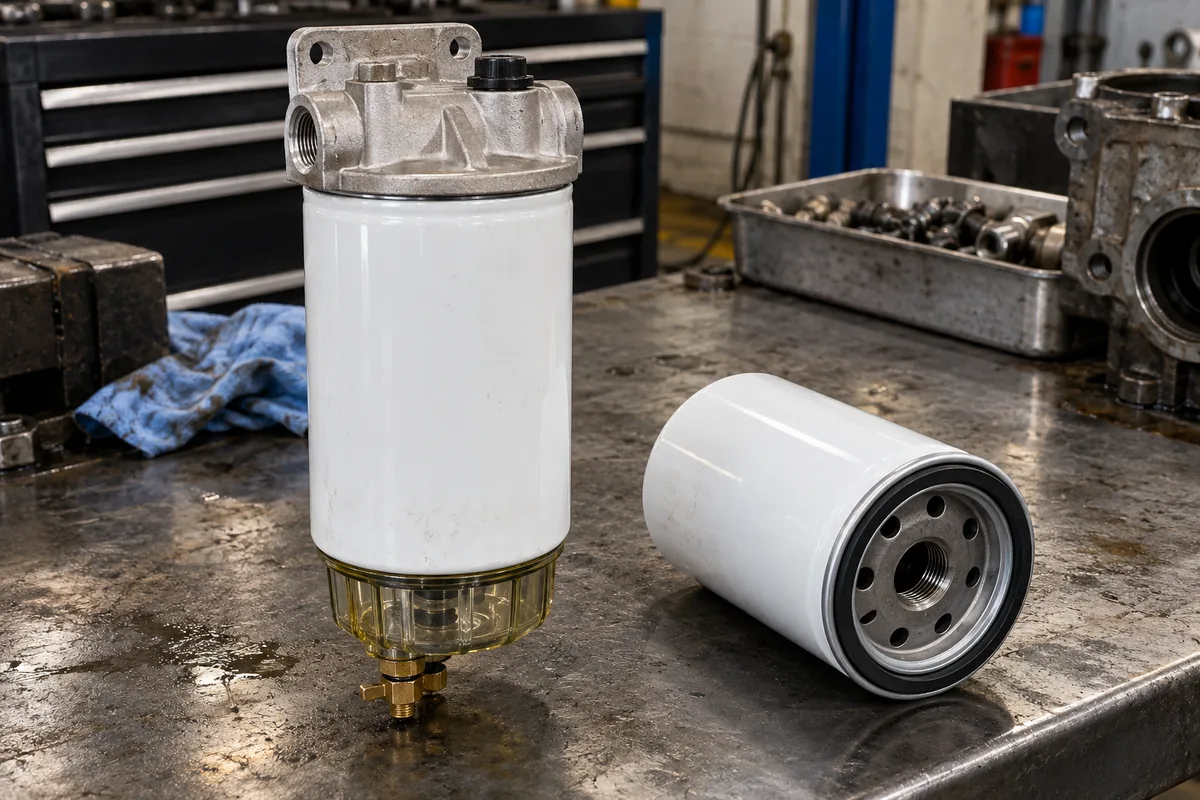
A primary spin-on fuel water separator with a clear lower bowl and brass drain beside a shorter secondary spin-on fuel filter can on a steel workbench.
Why generic mileage rules fail on a mixed heavy fleet
Public articles and owner forums often quote a single distance range for light-duty diesel pickups while adding a reminder to check the owner's manual. That reminder is the controlling rule. In the engine liquid filtration product guide F110024-ENG (page 57, Fuel Filtration Frequently Asked Questions), the filter manufacturer answers “How often should I change my fuel filter(s)?” directly: always follow the equipment or engine manufacturer's recommendation on change intervals, because the type of equipment and its usage determine how often filters need to be changed.
In the same catalogue's Engine Fuel Filtration System Application Design Worksheet (F115345 ENG, page 62), the change-interval field records units in km, miles, or hours. A single shop rule cannot cover a mixed yard where machines track service on different meters:
Scroll horizontally to view all columns.
| Fleet unit category | Typical meter basis in OEM schedules | Why a single fleet-wide number misfires |
|---|---|---|
| Excavators, loaders and dozers | Operating hours and calendar limits | Off-highway machines log zero road miles while burning high fuel volumes under load |
| On-highway heavy trucks and tractors | Road miles or km, engine hours, or calendar age | High PTO or stationary idle time loads fuel media faster than odometer distance reflects |
| Stationary generators and industrial packs | Operating hours and standby calendar limits | Low annual run hours still require scheduled inspection and water-management checks |
| Engines running biodiesel blends or bulk | OEM severe-duty or fuel-blend derated schedule | Bulk storage transfer and biodiesel blends can shorten the standard interval in the manual |
Before setting reorder quantities, connect each unit on your list to both its machine serial plate and its installed engine plate. The diesel engine parts identification guide and the heavy-duty truck parts request guide explain how to capture those two identities so the maintenance schedule you pull matches the engine configuration actually mounted in the frame.
Separate primary and secondary stages on every machine row
Many diesel engines carry two filtration stages that do different jobs at different pressures. Catalogue F110024-ENG (pages 11 and 57) distinguishes the two positions:
- Primary fuel filter (suction side): Mounted between the fuel tank and the transfer pump, where suction pressure in that reference is typically 34,474–41,369 Pa (5–6 psi). It protects the transfer pump, removes water and coarse contaminants, and reduces the contaminant load reaching the downstream filter.
- Secondary fuel filter (pressure side): Mounted between the transfer pump and the injectors. It operates under higher pressure and protects close-tolerance injection components.
Because primary water separators and secondary spin-on or cartridge filters carry different part numbers, efficiency ratings, and companion hardware, logging “fuel filter replacement” as a single row hides half the order. Some OEM schedules replace both stages together, while others set separate intervals or allow the primary processor to run until its dedicated restriction or level trigger is reached.
Use the fuel filter and water separator scope guide to record whether each stage requires a bare element or an assembly with a collection bowl, drain valve, or water-in-fuel sensor. When comparing candidate replacement elements for either position, keep the filtration specification on the diesel fuel filter micron-rating comparison sheet rather than assuming both stages share a rating.
How assembly-specific condition triggers work
Filter service life is governed by contaminant loading and differential pressure ($\Delta P$), not by how dark the filter looks through a housing cover or after removal. Catalogue F110024-ENG (page 54, Liquid Filtration Pressure Drop) explains that as particles plug media pores, restriction rises toward the system's terminal pressure drop limit.
On page 57 (What is asphaltene?), the same catalogue addresses a common shop misconception: all diesel fuels contain asphaltenes formed by fuel oxidation, typically 0.5 to 2 microns in size. These soft, tarry particles stick to filter fibers and turn the dirty side of the media dark brown or black during normal operation. Darkened media or dark fuel alone does not establish that an element has reached terminal restriction across all filter designs.
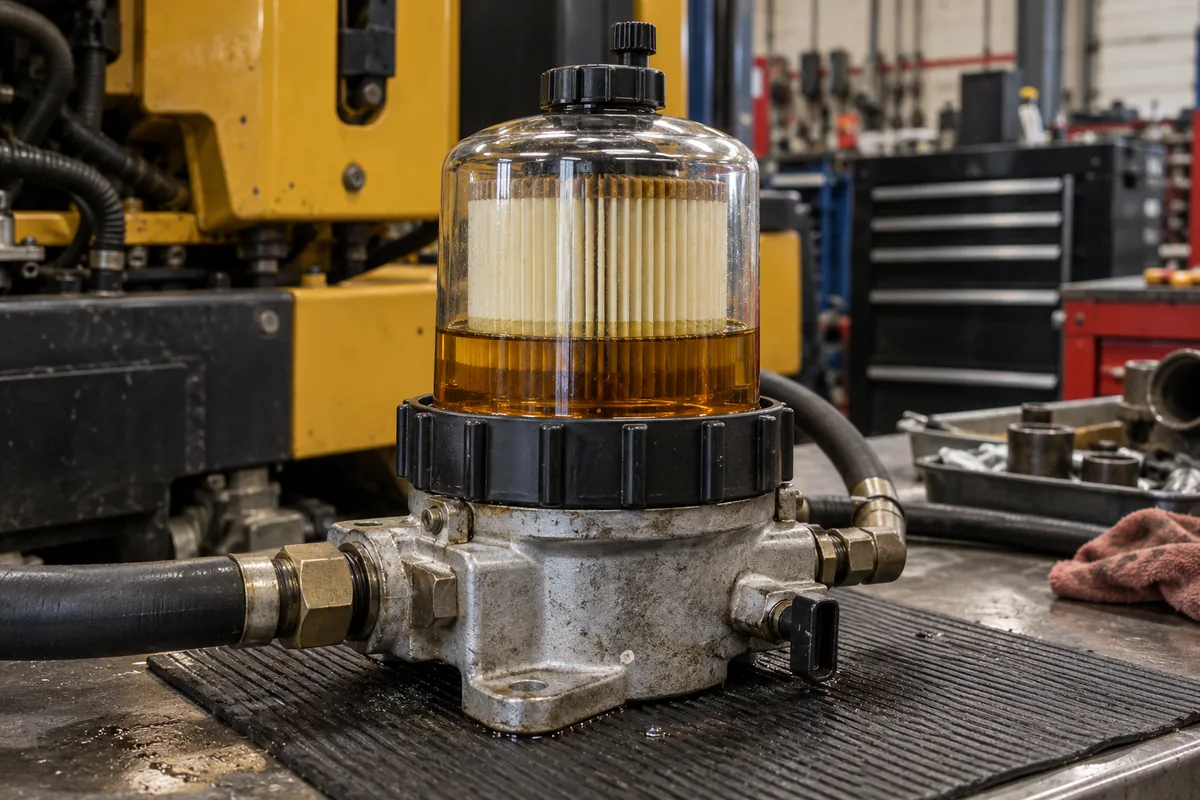
A diesel fuel processor with a cast-aluminum base and a clear upper dome cover showing fuel partially submerging the lower pleats of a cartridge element.
Where an assembly includes a built-in visual or mechanical indicator, the replacement trigger must come from that exact housing's technical manual:
Scroll horizontally to view all columns.
| Condition observation | Example documented rule (DAVCO Fuel Pro 385 Manual F1385 REV B) | Boundary for procurement planning |
|---|---|---|
| Fuel level sits near the bottom of the cover | Normal on a new element; fuel rises only as the lower media plugs (pages 2, 11) | Applies only to this upward-flow clear-cover processor; gravity bowls below spin-on cans stay full of liquid at all times |
| Fuel covers more than half the element height | “Normal — Do not change the filter”; clean media remains above the liquid line (pages 2, 11) | Prevents premature element changes when technicians mistake a rising level or darkened lower pleats for a spent cartridge |
| Fuel reaches the top of the filter element | Change the filter when fuel reaches the top of the filter / top of the cover band, or on power loss (pages 11, 13) | Stock replacement elements and cover O-ring kits so units approaching the upper band can be serviced at the next planned stop |
| Water accumulates at the base of the housing | Drain water weekly or as observed via the bottom drain valve without changing the filter (pages 11, 14) | Routine water draining is an operating check, not an element replacement event unless the scheduled interval or top band is met |
Never transfer the F1385 REV B rising-fuel-level rule to a sealed spin-on canister, a cartridge housing without an upward-flow clear dome, or another manufacturer's separator. Record a visual or gauge trigger on your fleet sheet only when you hold the manual for the exact housing installed on that machine.
The machine-by-machine replacement and spare-parts ledger
Copy this ledger into your maintenance and purchasing record. Give each filtration stage on each machine its own row. Enter a number or rule only after verifying it in the applicable OEM manual or housing sheet; write “Unknown / verify on the unit” in any cell that has not been confirmed.
Scroll horizontally to view all columns.
| Planning field | What to record (verified data only) | Unit 1 — Primary Stage | Unit 1 — Secondary Stage |
|---|---|---|---|
| Machine identity and serial / VIN | Brand, model, and full serial or VIN from the frame plate | Unknown / verify on the unit | Unknown / verify on the unit |
| Installed engine model and serial | Engine family, arrangement/cpl, and serial from the engine plate | Unknown / verify on the unit | Unknown / verify on the unit |
| Filter stage and installed housing identity | Primary suction separator or secondary pressure filter; housing model as marked | Unknown / verify on the unit | Unknown / verify on the unit |
| Controlling OEM manual title, revision and page | Exact manual publication number, revision date, and maintenance-table page | Unknown / verify on the unit | Unknown / verify on the unit |
| Scheduled interval rule | Hours, miles/km, or calendar limit, plus any biodiesel or severe-duty modifier | Unknown / verify on the unit | Unknown / verify on the unit |
| Assembly condition trigger and source | Restriction gauge limit, ECU warning, or manual-verified clear-cover level rule | Unknown / verify on the unit | Unknown / verify on the unit |
| Separate water-drain cadence | Daily or weekly drain check rule from the manual (distinct from element change) | Unknown / verify on the unit | Not applicable / verify |
| Last service reading and date | Hour-meter or odometer reading and calendar date of the last element change | Unknown / verify on the unit | Unknown / verify on the unit |
| Verified element part number | Full part number from the old element and parts book | Unknown / verify on the unit | Unknown / verify on the unit |
| Companion seals and hardware required | Cover O-ring, vent-cap O-ring, base gasket, bowl seal, or WIF sensor plug | Unknown / verify on the unit | Unknown / verify on the unit |
| Stock quantity per service cycle | Planned order quantity based on verified interval and machine utilization | Unknown / verify on the unit | Unknown / verify on the unit |
Account for companion seals, drain hardware and cross-fleet part numbers
A replacement schedule that lists only the bare element number can still stall a service bay if required seals are missing or if similar-looking cans are consolidated across incompatible engines:
- Check whether service seals come in the filter box or require separate kit numbers. In F1385 REV B (pages 13–15), the filter change procedure requires discarding and replacing both the cover O-ring and the vent-cap O-ring at every element change. While those two O-rings are included with the replacement filter kit for that housing, the manual also catalogues separate service kits (such as O-ring service kit
380072DAVand vent-cap service kit240023DAV) for maintenance spares. Confirm on every quotation whether cover gaskets, O-rings, and drain seals are packed with the element or ordered separately. - Keep reusable bowls and sensors distinct from consumable elements. Unless damaged or replaced during a housing change, clear bowls, metal housings, and water-in-fuel probes remain on the machine across multiple element changes, but their mounting O-rings and electrical connectors must match the replacement element.
- Do not consolidate filter part numbers across different machines by thread and size alone. Catalogue F110024-ENG (page 58, Can some filters be substituted for other filters?) warns against reducing inventory by using one filter number across multiple applications just because dimensions and threads match. As the filters category notes, internal media specifications, pressure ratings, and OEM updates remain tied to the individual application. When ordering for several machines at once, keep each unit's verified reference separate using the multi-brand spare parts list guide.
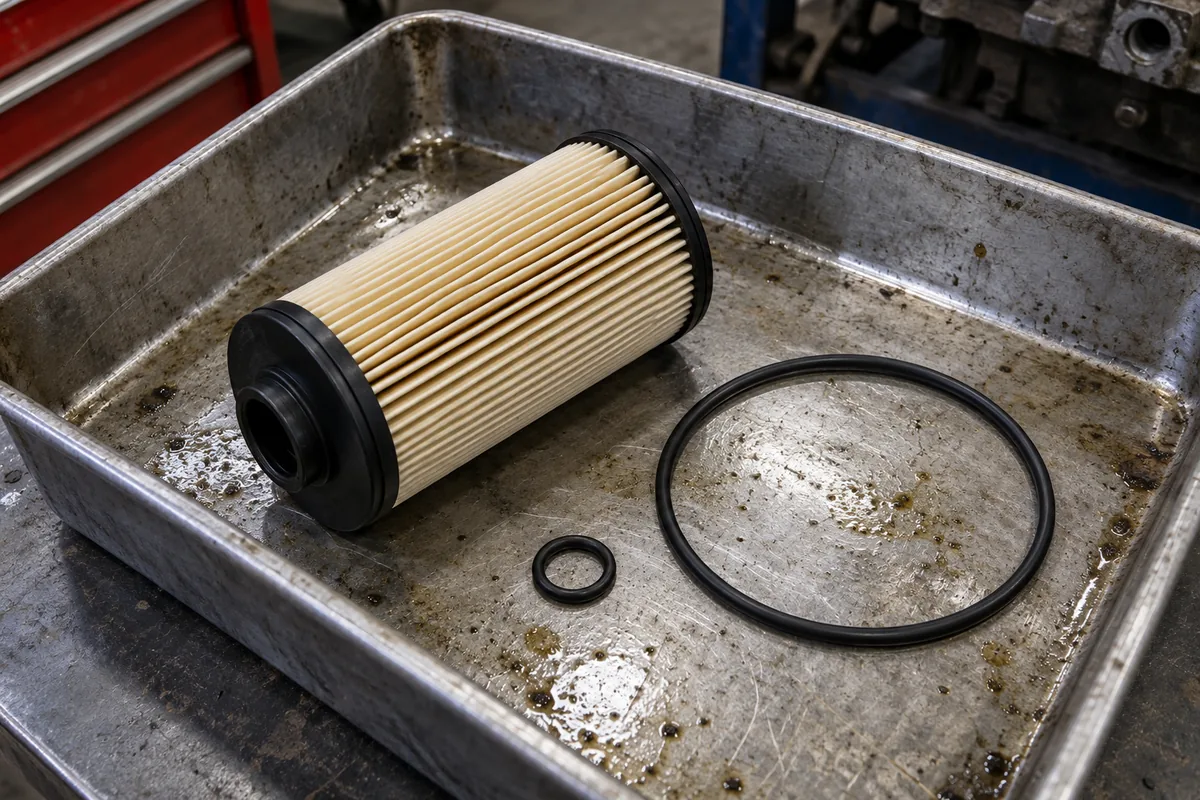
A pleated fuel filter cartridge element resting in a steel parts tray beside a large housing cover O-ring and a small vent-cap O-ring.
What to send with a fleet filter sourcing request
Scroll horizontally to view all columns.
| Item | Why we need it | Example format |
|---|---|---|
| Machine and installed engine identities | Tie each line to the exact equipment and engine serial configuration | Nameplate photos or copied model and serial numbers per unit |
| Filter stage and housing identity | Separate primary suction separators from secondary pressure elements | Primary or secondary stage note, plus housing markings and photos |
| Old element and companion seal references | Confirm the element number and whether O-rings or gaskets are included | Full markings on the old element and list of required cover or bowl seals |
| Completed fleet replacement ledger lines | Keep verified intervals, unknown cells, and per-unit quantities clear | Filled table rows with manual references; unverified fields marked |
| Planned order quantity per stage and destination | Scope the consolidated quotation and shipment | Quantity per part number, pack preference, and destination country/port |
Send your fleet filter list for sourcing review, including the machine and engine identities, stage and housing details, old element and seal references, completed ledger rows, and target quantities and destination listed above. HeavyPartsSource uses the supplied records to review the request; each quotation confirms the offered manufacturer, included seal scope, compatibility, and availability. Leave unverified fields marked as unknown rather than guessing an interval or part number.
Method and sources
This planning guide and ledger template were compiled from public filtration manuals, reviewed maintenance articles, and the site's published sourcing workflow. It contains no universal change interval, fleet stock multiplier, or cross-brand interchange approval.
- Donaldson Engine Liquid Filtration Product Guide (Catalog No. F110024 ENG 4/21), pages 11–12, 54, 57–58, and 61–62 (Engine Fuel Filtration System Application Design Worksheet, Doc. No. F115345 ENG), retrieved October 2026: OEM interval precedence, km/miles/hours worksheet units, primary suction vs. secondary pressure positions, pressure-drop loading, asphaltene darkening on media, and the caution against consolidating filter numbers across applications.
- DAVCO Fuel Pro 385 Technical Manual (F1385 REV B), pages 1–2, 5, 11, and 13–15, retrieved October 2026: upward-flow clear-cover visual diagnostics, the model-specific top-of-filter change trigger, weekly water draining versus element replacement, and companion cover and vent-cap O-ring replacement requirements.
- Donaldson Technical Sheet F111540-ENG, Comparing Fuel Filters and Micron Ratings, pages 1–2, retrieved October 2026: relationship between finer micron media, dirt-holding capacity, and service life before terminal restriction.
- Reviewed US search results for
how often should diesel fuel filter be changed(including light-duty diesel maintenance guides and owner forums), retrieved October 2026: confirmed that public guides defer to the owner's manual while focusing on single-vehicle mileage rules rather than multi-unit heavy-fleet spare-parts ledgers. - HeavyPartsSource filters category, fuel filter vs. water separator guide, diesel fuel filter micron-rating guide, and quote page, read October 2026: identification inputs, delivery scope, and quotation boundaries.