
Publisher: HeavyPartsSource
Choosing a diesel fuel filter by micron number alone can leave the filtration requirement unresolved. Use the rating specified for the installed engine and filter position, together with the required efficiency and test basis; there is no single micron number for every diesel engine.
This guide helps heavy-equipment and truck parts buyers compare replacement candidates. It does not approve a filter substitution or specify a rating for an unidentified engine.

Two plain spin-on filter cans of different heights on a workbench.
What to establish before comparing micron ratings
Scroll horizontally to view all columns.
| Input or item | Where to obtain it | Why it matters |
|---|---|---|
| Installed engine identity | Engine plate and applicable parts or service documentation | Connects the replacement to the actual engine |
| Filter position | Fuel-system documentation for that engine | Separates the primary and final filtration duties |
| Particle size and efficiency | Candidate filter manufacturer's data sheet | Gives the removal performance at the stated size |
| Test standard and conditions | Data sheet or supporting test report | Shows whether two ratings can be compared |
| Flow and restriction requirements | Engine requirements and candidate performance data | Checks suitability beyond particle capture |
| Water separation and assembly scope | Applicable specification and installed housing | Keeps the required function and supplied parts clear |
Record the full old-element number and housing identity as well as the engine identity. The diesel engine parts identification guide explains why the installed engine needs its own identification record. If a field is missing, write “Unknown / verify on the unit” rather than deriving it from the machine family or engine-series name.
Why the micron number needs an efficiency rating
A micron is a unit of particle size. It does not state what proportion of particles a filter removes. The manufacturer's technical sheet F111540, Comparing Fuel Filters and Micron Ratings, explains that two filters carrying the same size rating can have different removal efficiencies. A useful comparison therefore pairs the particle size with its efficiency and the test method used to obtain it.
A Beta ratio expresses the upstream particle count relative to the downstream count at a stated particle size. Higher Beta means higher removal efficiency at that size. A Beta value without its particle size is incomplete too. The manufacturer's technical article on Beta ratings makes both points; this is a laboratory performance description, not confirmation that a candidate fits your engine.
Copy the whole rating from the data sheet, including any particle-size suffix, efficiency or Beta value, and the test reference. Keep “nominal” or “absolute” if the supplier uses those terms, but request the associated efficiency and method. Do not treat either word as the missing test result.
Primary and secondary filters have different duties
The engine-liquid filtration catalogue describes a primary filter on the suction side of the transfer pump, where low restriction matters. The secondary filter is downstream of the transfer pump and protects the injection equipment. These positions face different pressure conditions. Verify the actual arrangement in the engine documentation before assigning either position to a replacement.
The catalogue's general FAQ gives nominal ranges of 10–30 microns for primary filters and 4–10 microns for secondary filters. These are descriptions of typical arrangements in that catalogue, not a selection chart for a particular engine. They neither establish the required efficiency nor authorize a replacement for a modern common-rail system.
When asked whether to choose 2, 5, 10 or 30 microns, start with the engine's specified element and application requirements. If those are unavailable, the selection is still open. Choosing the smallest number is not a substitute for recovering the specification.
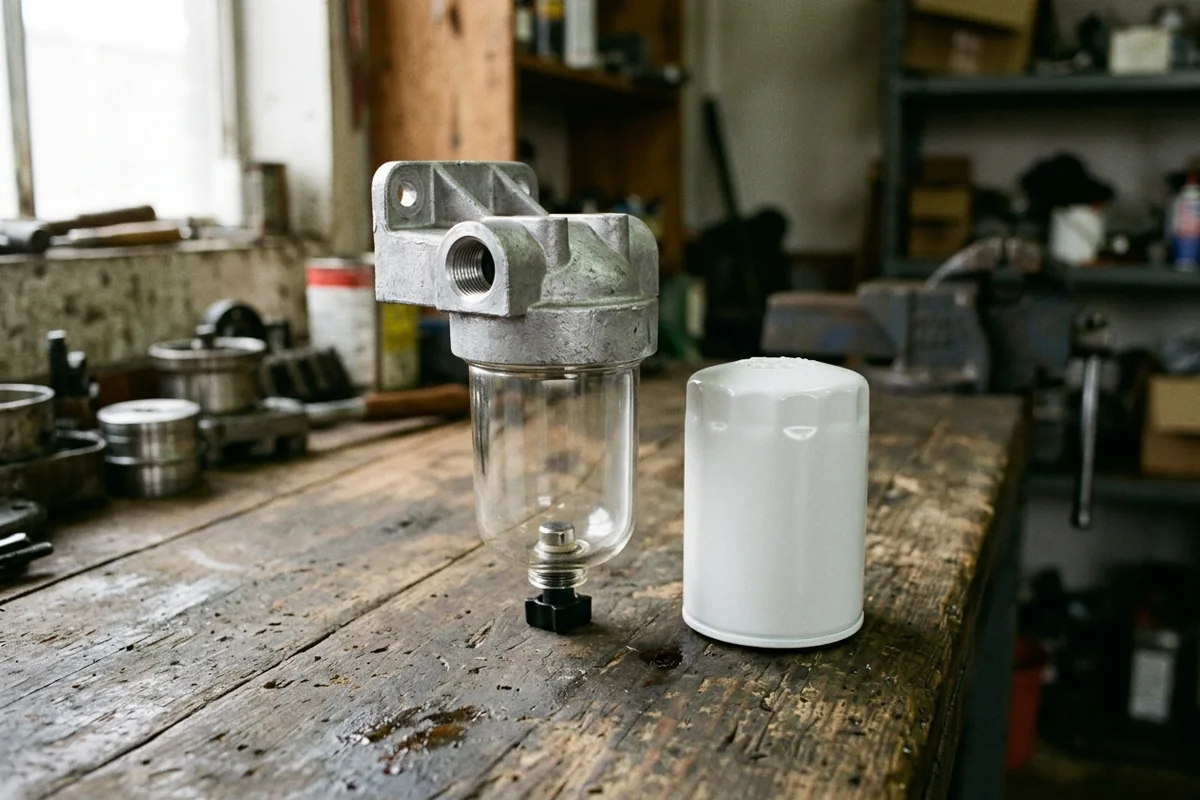
A filter assembly with a clear lower bowl beside a separate white filter can on a workbench.
Water separation is a separate comparison field. A particle-size number alone does not describe it. Use the fuel filter and water separator scope guide to record whether the request includes an element, bowl, drain, head or sensor. Keep those scope details alongside the filtration specification.
Compare two candidates on the same evidence sheet
Copy this table for each filter position. The candidate columns are intentionally blank: no two offered products or engine-specific requirements have been verified here. Fill them from the applicable engine document and each candidate's manufacturer data, retaining document titles and revisions. A blank means evidence is still needed.
Scroll horizontally to view all columns.
| Comparison field | Engine or installed-system requirement | Candidate A | Candidate B |
|---|---|---|---|
| Full element number and housing identity | |||
| Official application reference for this engine | |||
| Position: primary or secondary | |||
| Particle size, with notation as published | |||
| Removal efficiency or Beta at that size | |||
| Test standard, revision and stated conditions | |||
| Rated flow and supporting performance curve | |||
| Restriction at the relevant flow and fluid conditions | |||
| Permitted system restriction and pressure requirements | |||
| Water-separation requirement and supporting data | |||
| Dimensions, threads and sealing interfaces | |||
| Supply scope: element, seals, bowl, head or sensor | |||
| Source document, revision and unresolved questions |
Read the table in this order:
- Establish the application. Identify the installed engine and housing before comparing performance. Similar dimensions or a matching thread do not establish the filtration specification, as the filters category notes.
- Align the rating basis. If two candidates publish the same particle size but only one supplies efficiency, they are not yet comparable. Request the missing data rather than ranking them by the shared number.
- Check operating requirements. Compare flow and restriction data with the engine's requirements and keep water separation on its own line. Do not transfer a result from one test condition into another without supporting documentation.
- Keep unresolved fields visible. A complete-looking quotation should not erase a missing application reference or test basis. Mark the question for confirmation before accepting a substitution.
Why a finer filter is not automatically a better replacement
The engine-liquid catalogue defines restriction as pressure drop at a given flow, temperature and fluid viscosity. Its technical reference also explains that restriction changes as contaminants load the media. Request the performance information needed for the actual system; the micron label alone cannot settle that check.
The micron-comparison technical sheet warns that a finer filter may reach its dirt capacity sooner. It also explains that laboratory tests use controlled contaminant and fluid conditions and do not reproduce field vibration and flow variation. A test rating is useful comparison evidence, but it does not guarantee the cleanliness achieved on a working machine or establish its service interval. When setting reorder quantities across multiple units, use the diesel fuel filter replacement planning guide to record each machine's manual interval and housing condition trigger on its own line.
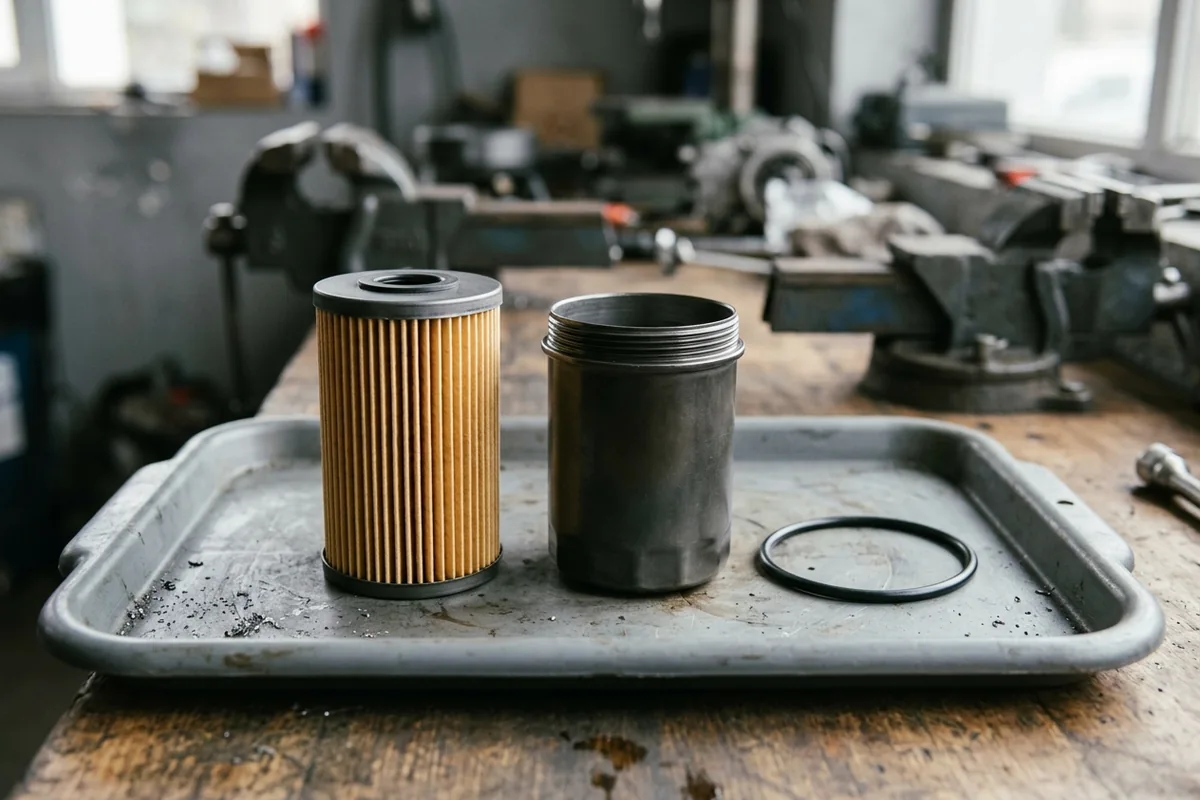
A pleated filter cartridge beside a dark housing and a sealing ring on a service tray.
A cartridge photograph can help record physical form. It cannot establish capture efficiency, dirt capacity or approved interchangeability. Keep those claims tied to documents rather than appearance.
What to send with a sourcing request
Scroll horizontally to view all columns.
| Item | Why we need it | Example format |
|---|---|---|
| Machine and installed engine identity | Connect the request to the unit being serviced | Plate photos and exact model and serial text |
| Old element and housing identity | Establish the current reference and physical interfaces | Full markings, dimensions and sealing-face photos |
| Filter position and assembly scope | Distinguish the filtration stage and parts requested | Documentation excerpt; element only or listed assembly parts |
| Completed comparison sheet and available specifications | Preserve rating evidence and outstanding questions | Filled table with source sheets; unknown fields retained |
| Quantity and destination | Define the requested supply | Quantity and destination country or port |
Send the comparison sheet for sourcing review, with the identities, position, scope, available specifications, quantity and destination listed above. HeavyPartsSource uses the supplied information to review the sourcing request; the quotation confirms the offered manufacturer, compatibility and availability. Leave unknown fields marked rather than guessing them.
Method and sources
This is a procurement evidence checklist compiled from public technical documents and the site's published identification process. It contains no product test, universal replacement rating or approved interchange list.
- Filter manufacturer's technical sheet F111540, Comparing Fuel Filters and Micron Ratings, pages 1–2, retrieved 15 October 2026: size versus efficiency, finer-media capacity caveat, and laboratory-test limitations.
- Filter manufacturer's Understanding Beta Ratings of Liquid Filters, sections on micron size and Beta ratio, retrieved 15 October 2026: interpreting the particle-size and efficiency pair.
- Filter manufacturer's Engine Liquid Filtration Product Guide, F110024, technical reference “Liquid Filtration Pressure Drop” and fuel-filtration FAQ, retrieved 15 October 2026: restriction, stage positions and the explicitly qualified nominal ranges above.
- HeavyPartsSource filters category, engine-parts guide, fuel-filter scope guide and quote page, read 15 October 2026: identification inputs, delivery scope and the existing request process.
The engine-specific specification remains the controlling input. Where it has not been supplied, the table records a gap rather than a filter recommendation.