
Publisher: HeavyPartsSource
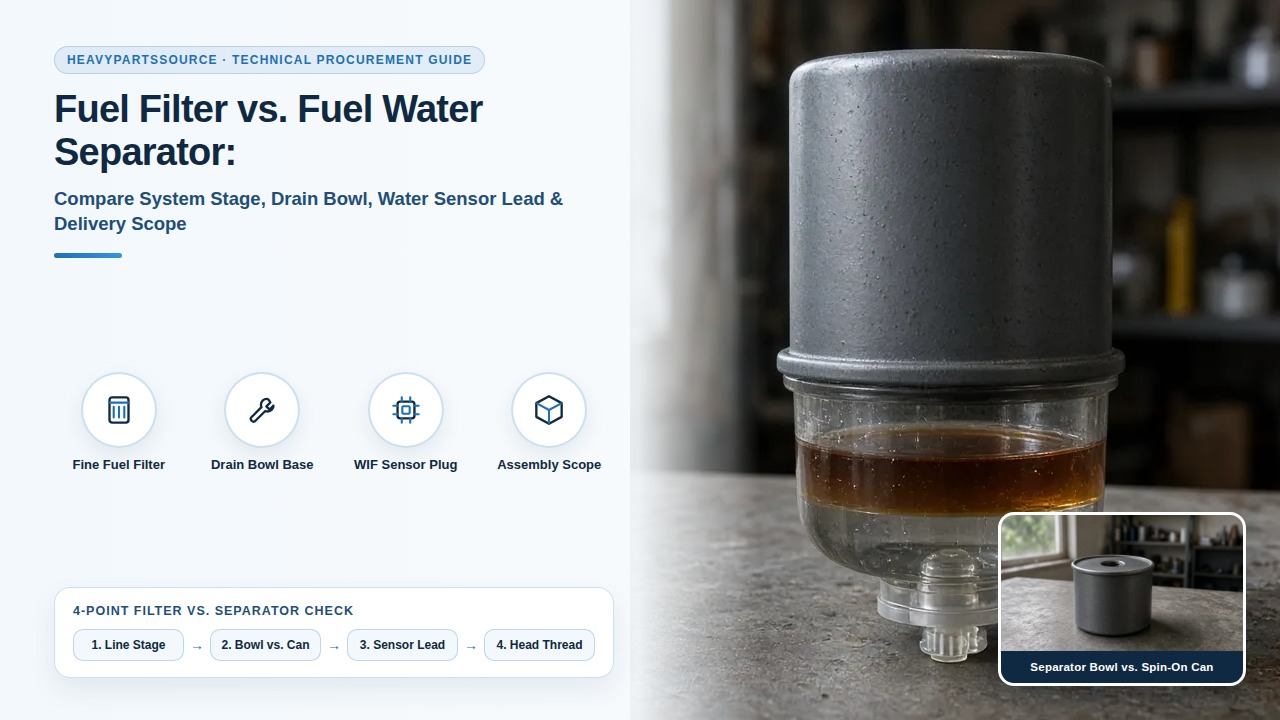
Ordering by the label alone can bring back a bare element when the machine also needs a bowl, a drain or a sensor plug, or a whole assembly when only the element was due. A fuel filter traps particles. A fuel water separator also pulls water out of the fuel and holds it at the bottom of the filter or in a collection bowl.
A fuel water separator element also traps particles, so the label alone does not tell you what to order. Compare what the replacement includes and where it sits in the fuel system. This page covers function and delivery scope only. It does not compare micron ratings, cross-reference numbers, or change intervals, and it is not a draining or installation guide.
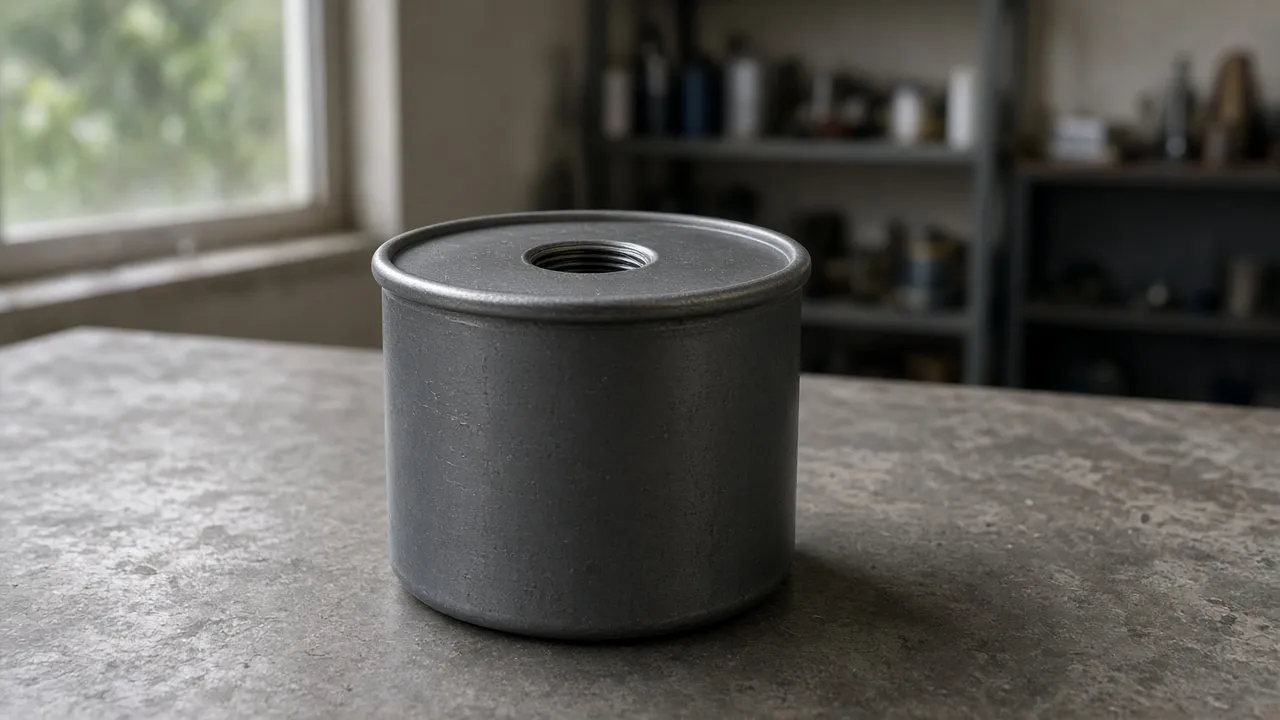
A plain spin-on filter can standing on a workbench.
How do the two differ in function?
Both hold back solid particles. Only the separator is built to remove water as well. One filter manufacturer's engine filtration catalogue says water separated by its separator media drains to the bottom of the can or to a water collection bowl, and particles are trapped and held in the media. The same catalogue lists fuel filters with and without water separation.
Scroll horizontally to view all columns.
| What to check | Fuel filter without water separation | Fuel water separator |
|---|---|---|
| Traps solid particles | Yes | Yes |
| Separates water | No | Yes |
| Where separated water goes | Not applicable | Bottom of the filter can, or a collection bowl |
| How water leaves | Not applicable | A drain valve or plug, where one is fitted |
| Parts that may come with it | Element, sometimes a head | Element, head, bowl, drain, water-in-fuel sensor |
A heavy-equipment parts seller's article notes that not every heavy-equipment fuel filter includes a water separator, and that this varies by manufacturer. Check the old part and the parts book for the machine. Do not assume from the machine type.
The delivery-scope card
Copy this card into your request. Fill a cell only when the item is printed on the machine nameplate, marked on the old part, or shown in a parts book or drawing you hold. Leave every other cell empty. An empty cell is a question for the quotation, not a guess.
Scroll horizontally to view all columns.
| Item | Fitted on the machine now | Included in this order | Where you read it |
|---|---|---|---|
| Element (spin-on can or cartridge) | |||
| Filter head or housing | |||
| Water collection bowl | |||
| Drain valve or plug | |||
| Water-in-fuel sensor and its connector | |||
| Heater | |||
| Priming pump on the head | |||
| Position: primary or secondary |
The card holds no micron rating, flow rate or part number. Those belong to the old part, the parts book and the quotation.
Where does each one sit in the fuel system?
The catalogue separates two positions. A primary fuel filter sits on the suction side of the fuel pump, must keep restriction low, and protects the transfer pump. A secondary fuel filter sits between the transfer pump and the injectors, protects the injectors, and sees higher pressure. The catalogue says its treated cellulose separator media is typically used on the suction side.
The parts seller's article describes the separator as installed before the machine's original fuel filter. Where both are fitted, the separator is the first stage and the second fuel filter follows it.
If the engine carries two fuel filters, give each its own line and write its position on the card. A primary separator and a secondary filter do different jobs at different pressures. Both being called a fuel filter does not make one a substitute for the other.
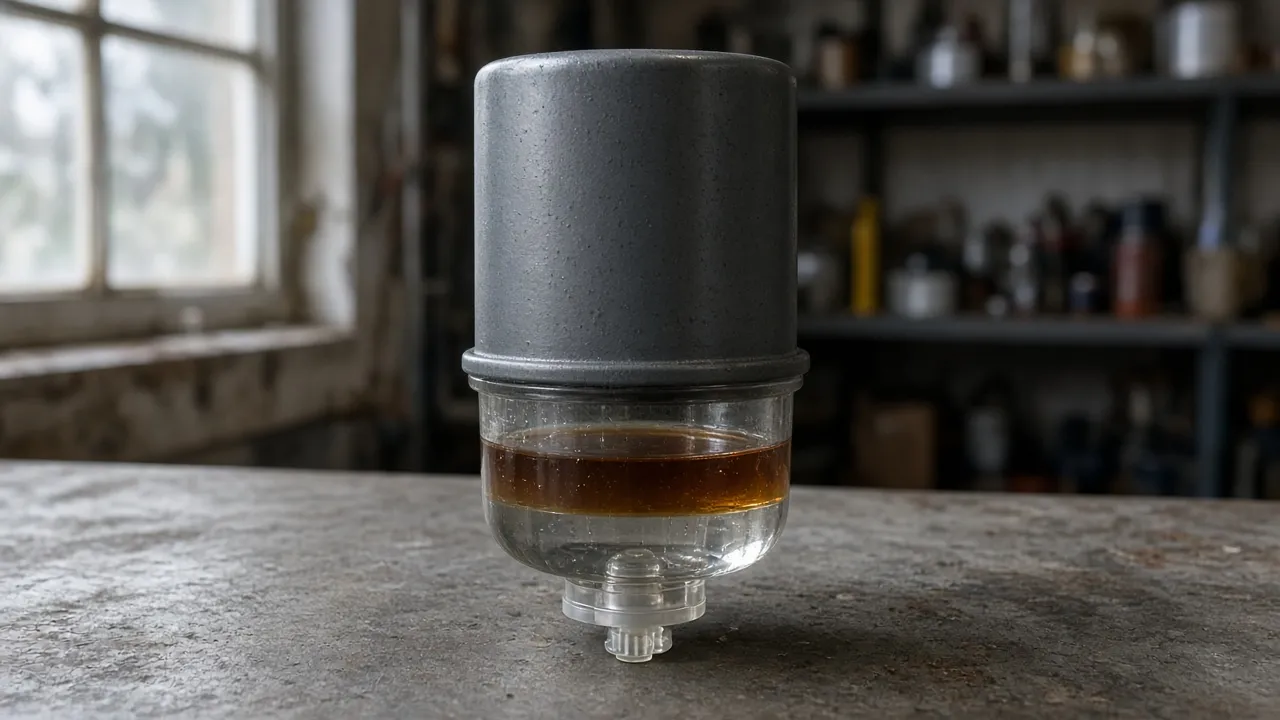
A spin-on filter with a clear collection bowl and a drain valve at the bottom, on a workbench.
Why does the title on a part reference not settle the order?
The filters category publishes part references titled Fuel Filter, Fuel Filter Element, Fuel Water Separator and Fuel Water Separator Element. A title records how the part was catalogued. Whether a line is the element alone or a housing assembly is confirmed from the full reference and the housing it fits.
The category asks you to clarify element only versus housing assembly and the quantity per pack. It also states that a similar size or thread does not establish the required filtration specification. For identification, it asks for the full old-element number, the housing or installed-unit identity, existing dimensions, and sealing-face or gasket photographs.
The manufacturer's catalogue shows the same point from the supply side. It lists several filters that fit the same head and differ in length and filtration performance. It sells the clear water collection bowl as a separate optional part. It offers a standard drain valve and a drain valve with a threaded sensor port. Two lines both titled fuel water separator can therefore mean an element alone, an element with a bowl, or a head assembly.
What about the sensor, heater and pump on the head?
These items change the delivery, so record them on the card even when the element is the only part due. In the catalogue, the water-in-fuel sensor comes in digital or passive versions with more than one connector type. A sensor and display kit adds a sensor drain valve with an electrical plug, a wiring loom, and a dashboard display. Heater options are listed for some head sizes. Head options include a basic head, a head with a bleed valve, a hand priming pump, and an electric pump.
The parts seller's article adds that some machines have a dashboard warning light for water in fuel. If a wire is attached at the bottom of the old filter or bowl, photograph the connector and write the sensor on the card.
The bowl is not only a container. For one filter, the catalogue lists a lower operating-pressure limit with the bowl fitted than without it. Fitting a bowl, or leaving one off, is a scope decision for the quotation, not a cosmetic choice.
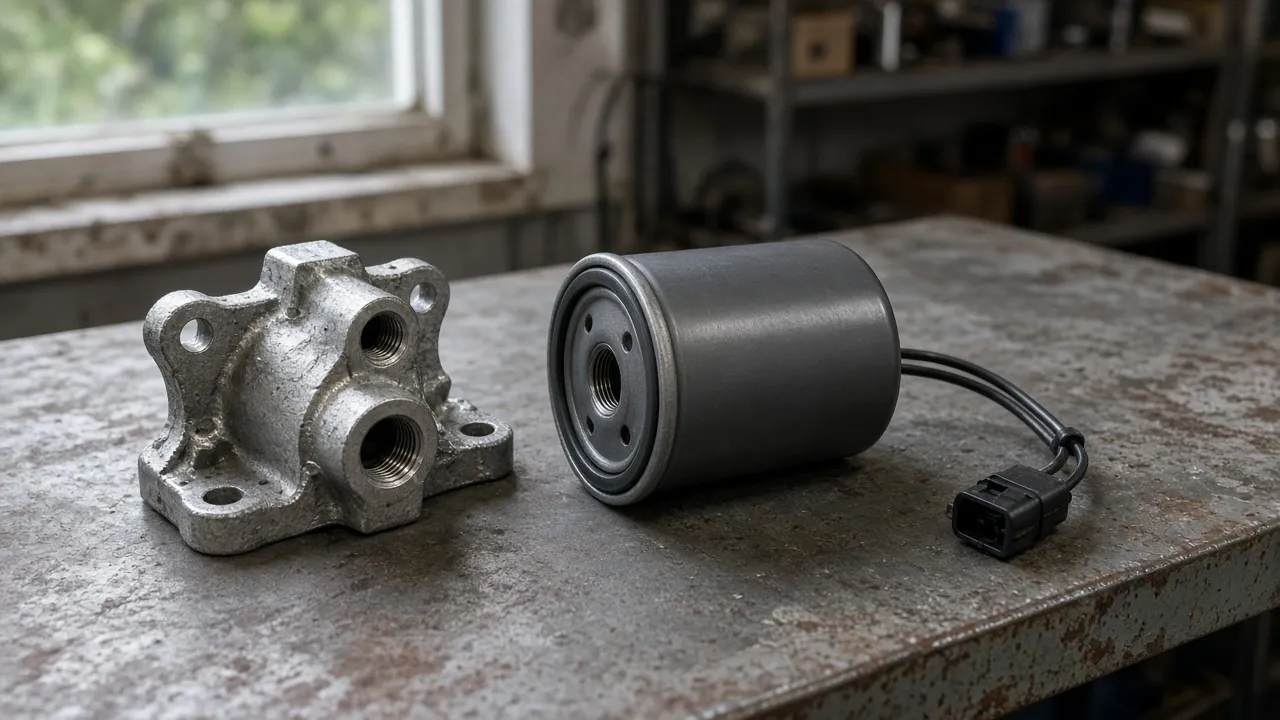
A cast filter head with two threaded ports beside a spin-on filter can with a short wiring lead and plug at its far end, on a workbench.
For the next selection step, use the diesel fuel filter micron-rating comparison sheet to record particle size, efficiency, test basis and the applicable engine requirement. The delivery-scope card above identifies the parts requested; the comparison sheet keeps the filtration evidence alongside them.
What to send
The quote page asks for the machine model and serial number exactly as they appear on the serial plate. The filters category asks for part numbers, quantities, destination, and photos of the unit nameplate and old part. Leave a cell empty when you cannot fill it from the plate, the old part, or a parts book.
Scroll horizontally to view all columns.
| Item | Where it comes from | How to fill it |
|---|---|---|
| Machine model and serial number | The serial plate | Copied from the plate, or empty |
| Old element number | The old filter can, cartridge or invoice | Full number as marked, or empty |
| Housing or installed-unit identity | The head, housing or parts book | As marked, or empty |
| Function | The old part or the parts book | Fuel filter, or fuel water separator |
| Position | The parts book or the fuel line layout | Primary or secondary, or empty |
| Delivery-scope card | This page | Filled cells only; others empty |
| Dimensions and sealing-face photos | The old part | Existing dimensions; gasket and sealing-face photos |
| Connector photo | The sensor lead, if one is attached | Photo, or "no wire attached" |
| Quantity per pack and destination | Your order | Quantity, pack size, destination country or port |
Send the card through the quote page. Include the machine model and serial number, the old element number, the housing or installed-unit identity, the function, the position, the filled delivery-scope card, dimensions and sealing-face photos, a connector photo if a wire is attached, and the quantity per pack and destination. Empty cells are allowed. Catalog references support identification; availability, the manufacturer, and compatibility are confirmed for each quotation.
Method and sources
- HeavyPartsSource filters category, read 14 October 2026: the category intro, the identification and scope notes, the request step, the published part reference titles, and the notice shown before a quotation.
- HeavyPartsSource quote page, read 14 October 2026: the list of what to send with a request.
- A filter manufacturer's North American engine liquid filtration catalogue, retrieved 11 October 2026: the fuel filtration media pages, the assembly option tables, and the fuel filtration questions in the technical reference. These are that manufacturer's descriptions of its own range, not a specification for any machine.
- A heavy-equipment parts seller's article on fuel water separators, dated 5 January 2026 and retrieved 11 October 2026: the statements on installation order, manufacturer variation, and dashboard warning lights.
- Library search on 14 October 2026 for fuel water separator documents. It returned no heavy-equipment fuel filter specification, so this page publishes no micron rating, flow rate, price or machine fit.