
Publisher: HeavyPartsSource
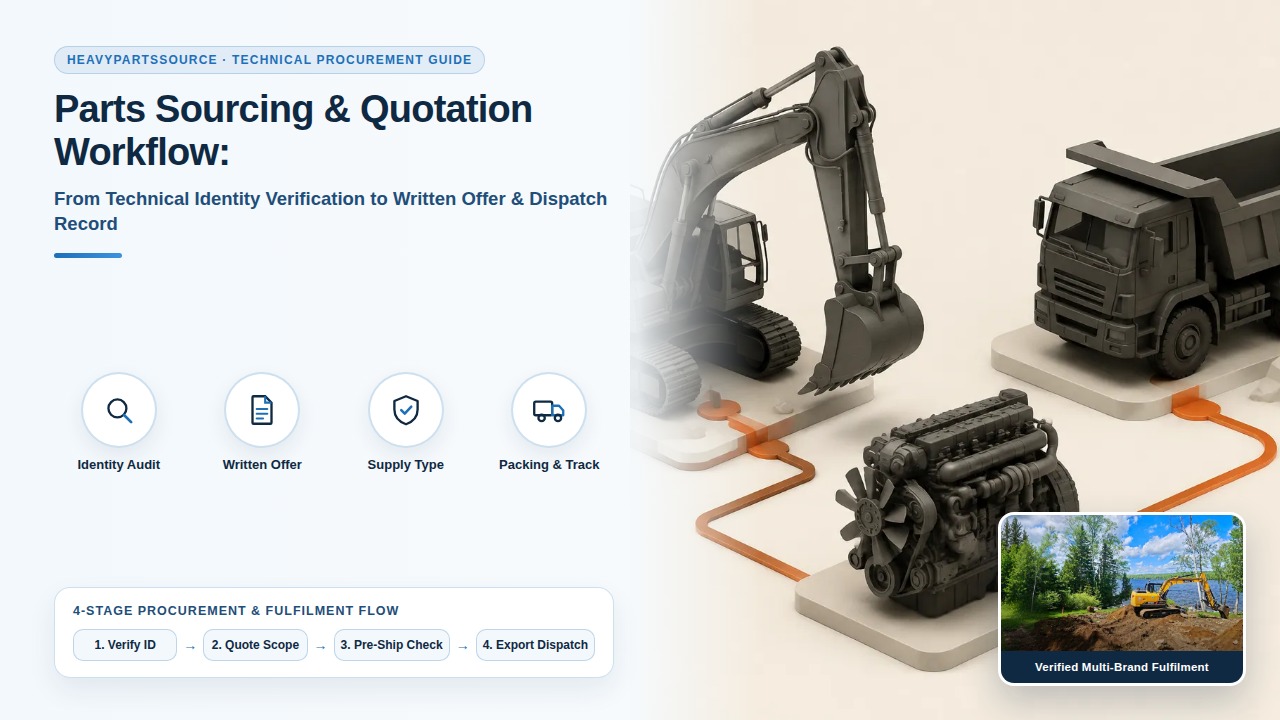
Accepting a blind price-only spare parts quote—issued against a bare catalog string without locking the host machine's 17-character serial number, disclosing the actual supply tier (Genuine OEM, Tier-1 OES, or Verified Aftermarket), measuring shaft splines and mounting flanges before crating, or defining Incoterms 2020 and customs HS codes—causes wrong part shipments, costly machine downtime, 18%–28% serial-break fitment returns, $1,800–$6,500 dead air-freight losses on non-returnable overseas orders, crushed gaskets inside unpartitioned wooden boxes, and airport dangerous-goods seizures (UN 3480 / UN 3164). Before releasing a purchase order, lock every heavy-equipment, diesel-engine, hydraulic, and commercial-truck inquiry to a 4-stage engineering sourcing and quotation workflow that verifies serial fitment, supply tier, caliper tolerances, and export crating before dispatch.
Our parts sourcing and quotation process executes four mandatory engineering verification stages from initial inquiry to final dispatch: (1) Stage 1 — EPC Serial-Break & Supersession Identity Audit (ISO 10261:2021 17-character machine PIN, ISO 3779 / 49 CFR § 565.15 17-character truck VIN, engine ESN + CPL / DH build plate, and Tier-1 sub-vendor nameplate cross-check under ISO 8000-115); (2) Stage 2 — Supply-Tier Allocation (Genuine Machine OEM vs. Tier-1 OES such as Bosch / Cummins / Rexroth / Kawasaki / Donaldson / Dana / ZF vs. Verified Aftermarket) and a Binding Written Offer (ISO 8000-110 semantic units PCS / SET / KIT / PAIR / ASSY, explicit supersession disclosure, lead time, and validity); (3) Stage 3 — Pre-Shipment Physical QC & Dimensional Inspection (ISO 2859-1 Level II sampling with Critical Defect AQL = 0.0 / Ac = 0, 100% caliper verification of DIN 5480 / SAE J744 splines, ISO 3019 pilot spigots, and ISO 6162 split-flange ports, plus line-numbered bag-and-tag photos); and (4) Stage 4 — Export Crating (FAO IPPC ISPM 15 56 °C / 30 min HT timber or engineered plywood), UN 3480 / UN 3164 Dangerous-Goods Segregation, WCO HS Chapters 84 / 87 Customs Classification, and Incoterms 2020 (EXW / FCA / FOB / CIF / DAP) Freight Execution.
Scroll horizontally to view all columns.
| Sourcing & quotation workflow stage | Governing engineering standard & catalog baseline | Mandatory technical verification gate | Output delivered to buyer before next stage | Dominant failure mode & prevention |
|---|---|---|---|---|
| Stage 1: EPC Serial-Break & Supersession Verification | ISO 10261:2021 (17-char PIN), ISO 3779 / 49 CFR § 565.15 (17-char VIN), ISO 8000-115 (Brand_Namespace : Part_Number), & OEM EPCs (Cat SIS 2.0, Komatsu KES, SANY GSP, Cummins QuickServe) | Cross-check requested part number against host machine serial break, engine ESN + CPL/DH, riveted sub-vendor plate (Rexroth R902..., Kawasaki K3V/K5V, Fast Gear, WABCO), and casting-vs-catalog rules | Line-numbered Technical Identity Audit (line-01, line-02) confirming exact current P/N or flagging open serial/dimension holds | Failure mode: Quoting unverified bare part numbers across mid-year OEM serial breaks or pricing a raw foundry casting mark (18%–28% wrong-part return rate). Prevention: Lock the 17-char PIN/VIN + sub-assembly serial plate before releasing any binding price. |
| Stage 2: OEM / Tier-1 OES / Aftermarket Supply-Tier Allocation | ISO 8000-110:2021 (master data syntax & semantic UOM PCS / SET / KIT / PAIR / ASSY) & Tier-1 OES cross-reference matrices (Bosch, Cummins, Rexroth, Kawasaki, Donaldson, Dana, ZF) | Allocate supply tier by operating pressure/clearance; separate Requested_Reference from Offered_Reference; lock assembly inclusions, unit price, validity (7–14 days), and lead time D_lead | Binding Written Quotation (Proforma Offer) with line-by-line manufacturer, tier, UOM, scope, weight/volume estimate, and Incoterms 2020 basis | Failure mode: Silent substitution of unverified low-grade hydraulic/fuel copies for OEM codes, or quoting 1 PCS when 1 SET (of 6) was needed. Prevention: Record alternatives in a separate Offered_Reference column and pair every quantity with an explicit ISO 8000-110 UOM. |
| Stage 3: Pre-Shipment Caliper & Nameplate QC Inspection | ISO 2859-1:1999 (ANSI/ASQ Z1.4 Level II AQL sampling, Critical AQL 0.0 / Ac = 0), ISO 3019-1/-2 (flanges), DIN 5480 / SAE J744 (splines), & ISO 6162-1/-2 (Code 61/62 ports) | 100% digital caliper, thread-gauge, and nameplate audit on precision assemblies (N_lot <= 8); ISO 2859-1 Level II lot sampling on consumables/wear iron; kit piece-count check | Pre-Dispatch QC Photo & Caliper Dossier (line-01-qc.jpg) tied to immutable Line_ID and Machine_ID before crate sealing | Failure mode: Discovering a DIN 5480 vs. SAE J744 spline mismatch, missing injector Trim code, or incomplete overhaul gasket kit only after international delivery. Prevention: Enforce mandatory caliper and tag photo sign-off at Critical AQL = 0.0 (Ac = 0) prior to packing. |
Stage 4: Export Crating & Incoterms 2020 Freight Execution | ICC Incoterms 2020 (EXW / FCA / FOB / CIF / DAP), FAO IPPC ISPM 15 (>= 56 °C / 30 min HT), IATA DGR (UN 3480 / UN 3164), & WCO HS Chapters 84 / 87 | Split urgent <= 70 kg air-express parcels from heavy ISPM 15 3-zone ocean crates; segregate UN 3480 batteries and discharge UN 3164 accumulators (0 bar N2); assign 6-digit HS codes | Commercial Invoice, Line-Keyed Packing List, ISPM 15 Crate Photos & B/L or Airway Bill (AWB) | Failure mode: Heavy cast-iron rollers crushing filters in an unpartitioned crate, customs quarantine of unstamped wood, or airport X-ray rejection of UN 3164 / UN 3480 items. Prevention: Use 3-zone ISPM 15 HT crates, discharge accumulators to 0 bar for air, and verify 6-digit HS 84/87 codes. |
Stage 1: How do we verify part identity, EPC serial breaks, and OEM supersessions before issuing a binding quote?
When you submit a single component inquiry or a multi-brand spare parts list via our quote request form or prefilled WhatsApp reference channel, our engineering desk does not simply run a text-string match against a static price file. Clicking a WhatsApp link generates a prefilled draft containing a unique HPS Reference ID; once you send that message or submit the web form and our team confirms actual receipt, your inquiry enters Stage 1 Technical Identity Audit (iso-10261-preview.txt, iso-8000-110-115-master-data-quality-bom.txt).
Under ISO 8000-115:2018, a bare numeric part reference is never globally unique across heavy equipment, diesel engines, and commercial trucks. Every requested line item is assigned an immutable Line_ID (line-01, line-02) and resolved into a verified 5-part engineering identity tuple:
ID_verified = ( Brand_Namespace , Verbatim_Catalog_PN , Supersession_or_Revision_Suffix , Host_PIN_or_VIN , SubAssembly_ESN_or_Tag )
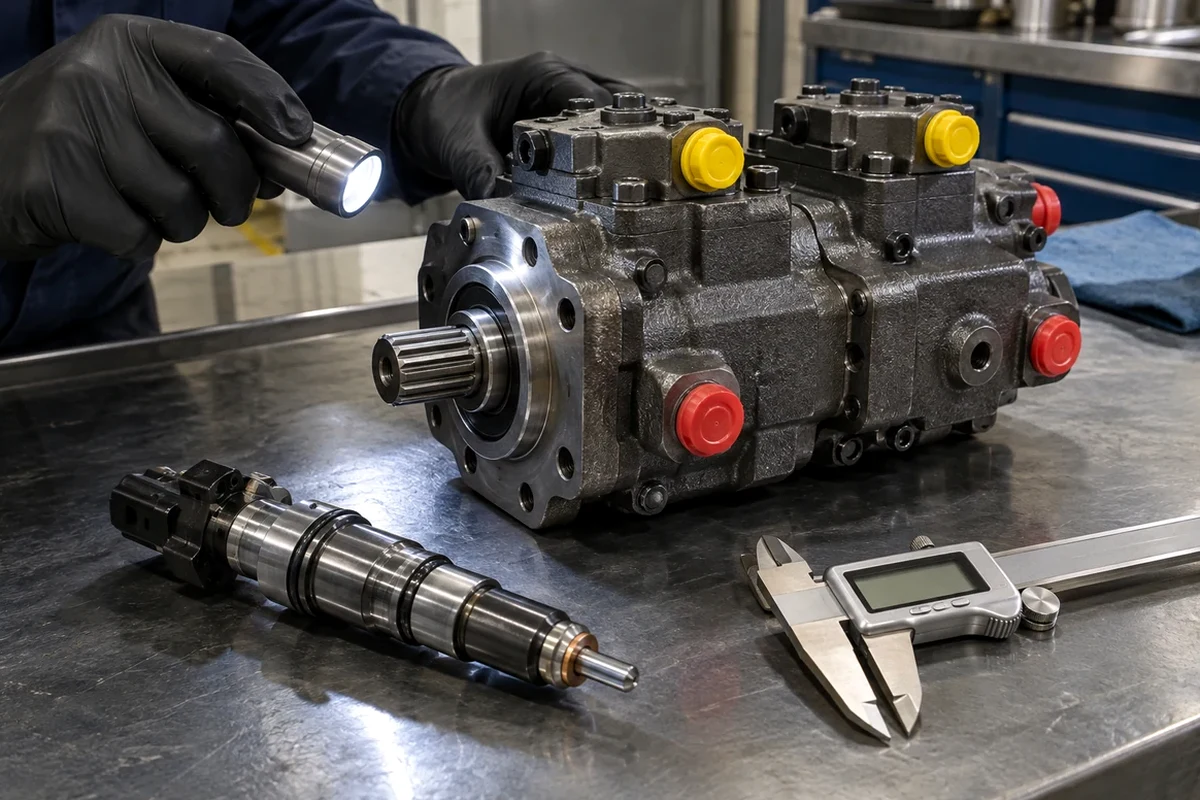
Stage 1 & Stage 2 engineering verification on the inspection bench: cross-checking the host machine catalog number against 10–25° raking-light inspection of the installed Tier-1 OES hydraulic pump casting, common-rail injector laser Trim code, and vernier caliper port/spline dimensions before issuing a written quotation.
Cross-Brand EPC Serial-Break, Supersession & Casting-Mark Audit Matrix
During Stage 1, our engineers verify your part numbers and 5-shot identification photos against six brand-specific Electronic Parts Catalog (EPC) rules (oem-cross-brand-part-number-syntax-normalization.txt, casting-vs-part-number.md):
Scroll horizontally to view all columns.
| Equipment or sub-system namespace | Primary EPC & serial-break anchor required in Stage 1 | What our engineering desk audits before pricing | Why bare part numbers or model names fail | Dominant failure mode & prevention |
|---|---|---|---|---|
1. Earthmoving Machinery (Cat, Komatsu, [SANY](/brands/sany), XCMG, Hitachi, Volvo CE) | 17-character ISO 10261:2021 PIN (or Cat 3-char Serial Prefix + Arrangement No.) + machine model ([SANY SY215C](/models/sany/sy215c), Komatsu PC200-8, Cat 320D) | Resolves mid-series serial breaks (e.g., PC200-8 S/N 300001–315645 vs. 315646-up), Komatsu 10th-digit revision counters (-0, -1, -2), and SANY trailing K seal-kit suffixes (60035553 cylinder vs. 60035553K seal kit) | Two excavators with the exact same boom decal (SY215C or PC200-8) frequently use different hydraulic cylinder rod diameters, main pumps, or wiring harnesses across serial breaks | Failure mode: Quoting an early-serial seal kit or main relief valve for a late-serial excavator (18%–28% field fitment mismatch). Prevention: Lock the 17-char ISO 10261 PIN and check our excavator part number lookup guide. |
2. Heavy-Duty Commercial Trucks ([SHACMAN](/brands/shacman), Sinotruk HOWO, FAW, Dongfeng) | 17-character ISO 3779 / 49 CFR § 565.15 VIN (Position 9 Modulo-11 check digit) + installed Engine, Transmission & Axle tags | Separates chassis OEM numbers (SHACMAN DZ9..., Sinotruk WG9... / AZ9...) from installed sub-assembly plates (Fast Gear 12JSD, ZF, Hande MAN or HC16/AC16 axle ratio Z_ring : Z_pinion, WABCO 10-digit valve tag) | Heavy truck builders configure the same cab/chassis ([SHACMAN X3000](/models/shacman/x3000) or HOWO A7/T7H) with dozens of engine, gearbox, and axle ratio combinations | Failure mode: Ordering a differential carrier or input shaft by truck VIN alone and receiving a 4.769 axle ratio when the tandem axle runs 5.262. Prevention: Verify the stamped gearbox and axle tags per our heavy-duty truck parts request guide. |
3. Diesel Engines (Cummins, [Weichai](/brands/weichai), Isuzu, Perkins, Caterpillar) | 8-digit Cummins ESN + 4-digit CPL, Weichai ESN + DH code ([Weichai WP12](/engines/weichai/wp12)), Isuzu 10-digit P/N (-0/-1 suffix), or Cat AR# | Audits piston bowl geometry (CPL), wet cylinder liner flange thickness, bearing undersize (STD vs. -0.25 / -0.50 / -0.75 mm), and common-rail injector 6–8 char IMA/Trim calibration codes | Ordering engine overhaul parts by displacement or engine family name ("6BT 5.9", "WP12", "4HK1") misses critical piston compression height and injector nozzle splits | Failure mode: Installing wrong-CPL pistons that strike the cylinder head or uncalibrated injectors that melt piston crowns. Prevention: Require the engine dataplate (ESN + CPL / DH / AR#) per our diesel engine parts ordering guide. |
4. Hydraulic Pumps, Motors & Control Valves (Bosch Rexroth, Kawasaki, Nabtesco, KYB, Danfoss) | Rexroth 10-digit Material No. (R902xxxxxx + full type code A11VO130...) or Kawasaki Model + 4-char Regulator Code (K3V112DT-1XER-9N24 + KR3G-9N24) | Verifies both the main pump nameplate and the separate bolt-on hydraulic regulator tag, plus shaft spline standard (DIN 5480 vs. SAE J744) and assembly scope (Complete ASSY vs. Rotary Group) | Host machine EPC numbers (e.g., SANY B220301000626) often map to multiple sub-vendor pump revisions or omit the pilot horsepower control curve | Failure mode: Shipping a replacement hydraulic pump whose pilot regulator curve or spline tooth profile does not match the excavator flywheel housing. Prevention: Audit both the main pump plate and the regulator tag before quoting. |
| 5. Raised Foundry Casting Marks vs. Machined Catalog Part Numbers | 10–25° raking-light photography of raised iron/aluminum casting numbers paired with caliper dimensions of machined bores, pilot spigots, and ports | Cross-references raw foundry blank identifiers (casting-vs-part-number.md) to the finished machined EPC assembly number | A single raw sand-cast iron housing is routinely machined into 3–6 different finished part numbers with different port threads (BSPP, Metric, UNF ORB, ISO 6162 Code 61/62) | Failure mode: Quoting or ordering directly from a raised foundry casting number and receiving an incompatible machining variant. Prevention: Flag every submitted number as EPC Catalog, Riveted Nameplate, or Foundry Casting Mark. |
Engineering Rule-of-Thumb (Stage 1 Mandatory 17-Character ISO 10261 PIN / ISO 3779 VIN & Component Serial-Tag Lock Before Binding Quotation): If an inquiry requests pricing on serial-sensitive hydraulic, engine, drivetrain, or electrical assemblies (hydraulic pumps, final drives, cylinder seal kits, pistons/liners, fuel injectors, ECM controllers, transmissions, or drive axles) without the parent machine's 17-character ISO 10261 PIN / ISO 3779 VIN and the installed component dataplate (Engine ESN + CPL/DH, Rexroth R902... / Kawasaki K3V... pump + regulator tag, or Fast/ZF/Axle ratio plate) → hold the line in Pending Technical Verification (or issue only a non-binding budget range conditioned on serial confirmation) rather than releasing a firm executable order quote, because quoting unverified bare part numbers across mid-production OEM serial breaks causes 18%–28% fitment return rates and $1,500–$6,000 in round-trip international freight and downtime losses.
Takeaway: Any missing revision suffix, unread serial plate, or unconfirmed kit inclusion stays explicitly flagged as an open verification item in Stage 1—never silently guessed.
Stage 2: How do we allocate supply tiers (Genuine OEM vs. Tier-1 OES vs. Verified Aftermarket) and structure a binding written quotation?
Once Stage 1 locks the exact technical identity and assembly scope of each line item, Stage 2 evaluates supply channels and builds your formal written quotation (Proforma Offer). Rather than forcing you into a single all-OEM or all-aftermarket price structure, our engineering desk allocates supply tiers based on operating pressure (MPa), internal running clearance (um), metallurgical heat-treatment requirements (HRC), and failure consequence (oem-cross-brand-part-number-syntax-normalization.txt, donaldson-f110024-eng.txt).
1. Supply-Tier Allocation Matrix (Genuine OEM vs. Tier-1 OES vs. Verified Aftermarket)
Scroll horizontally to view all columns.
| Supply tier designation in written quote | Manufacturing origin & packaging identity | Target component categories & physical operating thresholds | Typical unit cost vs. Genuine Machine OEM box | Dominant failure mode & prevention |
|---|---|---|---|---|
1. Genuine Machine OEM (CAT, Komatsu, [SANY](/brands/sany), Volvo, Hitachi, [SHACMAN](/brands/shacman), Sinotruk) | Produced by or for the host equipment manufacturer and supplied in sealed machine-brand packaging with OEM hologram/part label | Proprietary structural castings, machine-specific cab trim, brand-locked pre-programmed controllers (/categories/controllers) (ECM / VECU), and warranty-mandated assemblies | 100% (Reference baseline) | Failure mode: Paying 25%–45% machine-brand outer-box markup on standard Tier-1 hydraulic pumps, filters, or heavy steel wear parts, or receiving a blank unprogrammed ECU. Prevention: Use Genuine OEM where software/proprietary lock-in exists, and specify Pre-Programmed to Machine PIN/ESN on all controllers. |
2. Tier-1 OES / Original Equipment Supplier (Bosch, Cummins, Bosch Rexroth, Kawasaki KPM, Donaldson, Fleetguard, Dana, ZF, Fast Gear, WABCO, Denso) | Manufactured on the exact same Tier-1 factory assembly line that supplies the host OEM, delivered in the sub-vendor's own brand box (e.g., Rexroth R902..., Kawasaki K3V/K5V, Cummins, Donaldson) | High-pressure hydraulic pumps, main control valves, swing motors, and travel motors (P_sys = 31.4–38.0 MPa, clearance 5–12 um); HPCR fuel injectors/pumps (160–250 MPa, clearance 1–3 um); 2–4 um (Beta >= 200–1000) secondary fuel filters; heavy truck transmissions & brake valves | 65%–82% (18%–35% direct savings vs. machine-brand box at identical factory metallurgy and tolerance) | Failure mode: Ordering by host machine code alone when the Tier-1 OES part number (Rexroth R902... or WABCO 10-digit) is unrecorded, losing OES cross-reference access. Prevention: Transcribe the stamped Tier-1 OES nameplate in Stage 1 so Stage 2 can quote direct OES supply. |
3. Verified Aftermarket Replacement (ISO 9001 / IATF 16949 Audited Factories with Stage 3 QC) | Produced by vetted independent replacement manufacturers to verified OEM dimensional drawings and heat-treatment specs (HRC 52–58 surface induction hardening, HRC 32–40 core) | High-mass mechanical wear steel: undercarriage parts (track chains, shoes, bottom/top rollers, idlers, sprockets), GET (buckets, teeth, adapters, cutting edges), boom/arm pins & bushings, brake drums/linings, cab glass, and standard elastomer seal kits (NBR / PTFE / FKM) | 45%–68% (32%–55% savings vs. Genuine OEM with verified hardness and dimensional fit) | Failure mode: Using unverified ultra-cheap aftermarket parts inside high-pressure hydraulic rotary groups (34.3 MPa) or common-rail injectors (200 MPa), causing brass/steel swarf failure in < 200 hours. Prevention: Restrict aftermarket allocation to verified mechanical wear iron, seals, and structural hardware—never uncalibrated HPCR injectors or high-pressure pump rotary groups. |
Engineering Rule-of-Thumb (Stage 2 Supply-Tier Allocation: Separating Tier-1 OES Precision Hydraulic/Fuel Assemblies from Structural Wear Steel): If building a mixed-category quotation across hydraulics, engines, filtration, and undercarriage → allocate Tier-1 OES (Bosch Rexroth, Kawasaki, Bosch, Denso, Cummins, Donaldson, Fleetguard, Dana, ZF, Fast Gear, WABCO) or Genuine Machine OEM to any component operating at hydraulic pressures P_sys >= 31.4 MPa (5–12 um rotary-group clearance), common-rail injection pressures P_rail >= 160 MPa (1–3 um injector needle clearance), or fine filtration ratings <= 4 um (Beta >= 200 per ISO 19438), while allocating Verified Aftermarket Replacement (HRC 52–58 case-hardened alloy steel) to high-deadweight structural wear parts (buckets, teeth, cutting edges, track chains, rollers, idlers, sprockets, and pins/bushings), because Tier-1 OES captures exact OEM factory tolerances at 18%–35% lower cost while verified wear steel cuts heavy iron expenditure by 32%–55% without risking catastrophic hydraulic or engine contamination.
2. Mandatory Line-Item Fields on Every HeavyPartsSource Written Quotation (ISO 8000-110)
Every binding written quotation we issue maps 1-to-1 back to your original Line_ID (public/downloads/hps-quotation-review-template.csv) and explicitly locks eight commercial and engineering parameters:
- Immutable
Line_ID& Dual Reference Columns (Requested_Referencevs.Offered_Reference): If an OEM part number has been superseded or if we offer a Tier-1 OES cross-reference (for example, quotingKawasaki K3V112DT-1XER-9N24against requestedSANY B220301000626), our quotation records both numbers in separate columns. An alternative or supersession never silently overwrites your requested number and requires your written sign-off. - Explicit Supply Tier & Actual Manufacturer Name: Every line states
Genuine OEM,Tier-1 OES (with named manufacturer), orVerified Aftermarket Replacement. - Exact Assembly Scope &
ISO 8000-110Semantic Unit of Measure (UOM): Quantities are always paired withPCS,SET (e.g., 1 SET = 6 cylinder kits),PAIR (LH + RH),KIT (with listed seal/gasket inclusions), orASSY(for example, distinguishing a complete final drive assembly vs. bare travel motor or planetary gearbox). - Unit Price, Extended Price & Currency (
USD / EUR / CNY): Stated net of hidden crating surcharges. - Verified Lead Time (
D_lead) & Stock Allocation Window: DistinguishesIn-Stock Warehouse Dispatch (1–3 business days)fromFactory/Transfer Lead Time (5–14 business days). Stock availability is verified at the time of quotation; because fast-moving inventory turns daily, every written offer carries an explicit Quotation Validity Date (typically 7–14 calendar days). - Estimated Gross Weight (
kg), Crated Volume (CBM) & Modal Split: Enables transparent calculation of Air Express vs. Ocean LCL/FCL freight before you commit. Incoterms 2020Delivery Basis, Named Place & Payment Terms: Explicitly defines handover location (EXW,FCA,FOB,CIF,DAP) and payment milestones (T/T wire, L/C, or trade assurance).
Takeaway: A prepared parts list or an internal inquiry log is not an order; procurement and stock reservation lock only when you confirm the written quotation reference in writing and complete the agreed payment arrangement.
Stage 3: How do we execute pre-shipment physical QC and dimensional inspection (ISO 2859-1) before sealing export crates?
The most expensive failure in international spare parts sourcing occurs when a supplier ships a part in a sealed factory carton without opening and measuring the physical hardware inside—discovering 8,000 km later at a remote mine site that a warehouse picker pulled a 14-tooth spline instead of a 17-tooth spline or packed an incomplete gasket kit.
Before any order transitions from our staging floor to export crating, Stage 3 enforces our mandatory pre-dispatch quality checks governed by ISO 2859-1:1999 (Sampling procedures for inspection by attributes — Part 1: Sampling schemes indexed by acceptance quality limit (AQL) for lot-by-lot inspection, equivalent to ANSI/ASQ Z1.4) (iso-2859-1-aql-sampling-wco-hs-chapters-84-87.txt).
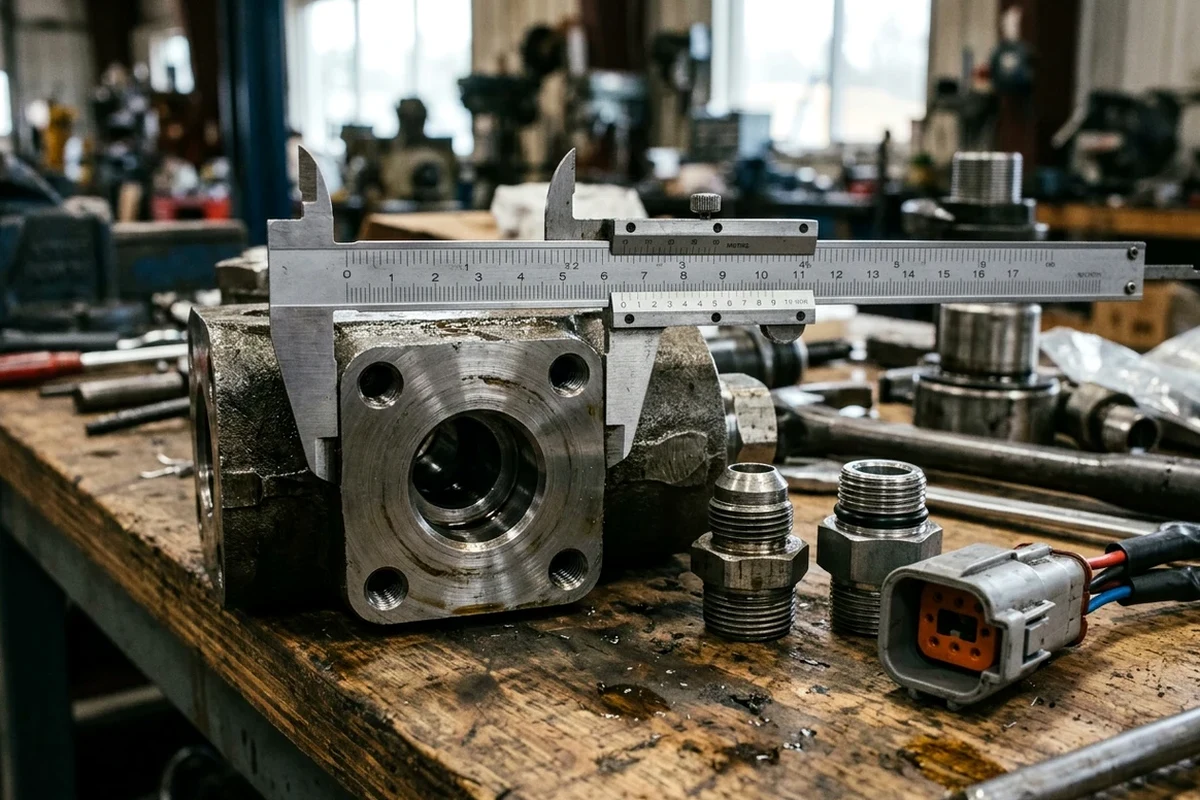
Stage 3 pre-shipment physical QC and dimensional inspection under ISO 2859-1: verifying mounting flange pilot diameters, ISO 6162 4-bolt split-flange port spacing, hydraulic adapter threads, and waterproof connector pinouts with calibrated vernier calipers before crate release.
Stage 3 Pre-Shipment ISO 2859-1 Physical QC & Dimensional Inspection Matrix
Scroll horizontally to view all columns.
Inspection gate & lot-size protocol (ISO 2859-1) | Target components & sampling rate | Physical instruments & dimensional tolerances verified | Acceptance / rejection threshold (AQL) | Dominant failure mode & prevention |
|---|---|---|---|---|
Gate 3A: 100% Piece-by-Piece Precision Assembly Audit (N_lot <= 8 units) | Hydraulic main pumps, swing/travel motors, final drives, main control valves, turbochargers, crankshafts, camshafts, HPCR fuel pumps/injectors, & ECM controllers | Digital vernier caliper (+-0.02 mm), outside micrometer (+-0.01 mm), thread pitch gauge, & spline count (Z). Verifies DIN 5480 / JIS B 1603 vs. SAE J744 spline OD, ISO 3019-1/-2 pilot spigot, ISO 6162 Code 61 (34.5 MPa) vs. Code 62 (41.4 MPa) port bolt spacing, and injector laser Trim / ECU flash codes | Critical Defect AQL = 0.0 (Ac = 0, Re = 1): Zero tolerance on any spline, pilot, port thread, or part-number mismatch | Failure mode: Shipping a hydraulic pump or travel motor whose shaft spline (e.g., 14T metric m=2.5, OD 37.50 mm vs. 14T SAE 12/24 DP, OD 31.75 mm) will not mate with the machine coupling. Prevention: Measure 100% of precision shafts, pilots, and ports with calipers before packing. |
Gate 3B: ISO 2859-1 General Inspection Level II Batch Sampling (N_lot >= 9 units) | Undercarriage track rollers, idlers, sprockets, track links/shoes, bucket teeth/pins, brake drums/linings, and spin-on filter cartons (Code Letters B–H, sample n = 3 to 50) | Steel tape & caliper check of track link pitch (190 / 203.2 / 216 mm), pin/bushing OD, bolt hole circle, filter mounting thread (1-14 UN, 1-1/8-16 UN, M30x2, M32x1.5) & gasket OD (donaldson-f110024-eng.txt), plus ultrasonic/portable hardness spot-check (HRC 52–58 on wear surfaces) | Critical AQL = 0.0 (Ac = 0, Re = 1) on fitment dimensions;Major AQL = 1.0 on surface finish/coating;Minor AQL = 2.5 on outer carton marks | Failure mode: Batch of aftermarket track links or filter elements having the wrong bolt hole spacing or metric-vs-inch thread pitch. Prevention: Pull ISO 2859-1 Level II random samples across every production batch and verify threads and bolt patterns against the Stage 1 drawing. |
Gate 3C: Overhaul & Seal Kit Bill-of-Materials (BOM) Piece-Count Audit | Diesel engine in-frame/out-of-frame overhaul kits, MLS cylinder head gasket sets, and hydraulic cylinder seal kits by size (Bore x Rod OD x Groove Width) | Flat-table layout count verifying all piston rings, wrist-pin snap rings, main/rod bearing halves (STD / undersize), front/rear crankshaft oil seals, and hydraulic rod U-cups, PTFE buffer rings, piston seals, and wiper rings | Ac = 0, Re = 1 on missing primary seals or wrong bearing undersize; MLS head gaskets locked onto rigid flat backer boards | Failure mode: Mechanic tearing down an engine or boom cylinder and discovering a missing rear main seal or bent multi-layer steel (MLS) head gasket. Prevention: Audit kit sub-counts against the OEM kit BOM and mount all MLS head gaskets onto rigid flat ply boards. |
| Gate 3D: Corrosion Preservation & Line-Keyed Bag-and-Tag Photo Record | 100% of outgoing line items (line-01 through line-N) across single-brand and consolidated multi-brand orders | Threaded steel/plastic dust plugs fitted into all hydraulic/fuel ports; machined journals coated with rust preventative and sealed in VCI (Volatile Corrosion Inhibitor) film; every bag/box labeled with Line_ID + Machine_ID + OEM_PN + Offered_PN + Qty/UOM | Mandatory Pre-Shipment QC Photo Set archived against the order record; any discrepancy halts dispatch for buyer sign-off | Failure mode: Unplugged hydraulic ports ingesting wood dust or salt-air moisture corroding ground valve spools during a 30-day ocean voyage. Prevention: Plug all fluid ports, VCI-wrap bare steel, and photograph every labeled line item prior to crating. |
Engineering Rule-of-Thumb (Stage 3 Mandatory Pre-Shipment Caliper & Nameplate Photo Check Before Sealing Export Crates): If an order contains any rotary hydraulic component, drivetrain assembly, hydraulic cylinder, or precision engine part → perform a 100% physical vernier caliper and raking-light nameplate inspection (ISO 2859-1 Critical Defect AQL = 0.0, Ac = 0, Re = 1) measuring the shaft spline tooth count Z and major diameter (+-0.05 mm), mounting flange pilot diameter and bolt-circle pitch (+-0.10 mm), and high-pressure port threads / ISO 6162 split-flange dimensions while recording timestamped QC photographs (line-XX-qc.jpg) before sealing the export crate, because catching a dimensional or revision discrepancy on the warehouse inspection bench costs $0 in freight and < 24 hours to swap from local stock, whereas discovering it after international air or ocean transit costs 2x–4x the part value in dead freight, customs duties, and machine downtime.
Takeaway: If our Stage 3 QC inspection uncovers any discrepancy in part suffix, packaging count, or caliper dimension, we halt packing on that line and present the physical photo evidence to you—never substituting or shipping a non-conforming item without written approval.
Stage 4: How do we execute export crating (ISPM 15), dangerous-goods segregation (UN 3480 / UN 3164), customs HS classification, and Incoterms 2020 freight?
Once Stage 3 QC sign-off is complete, Stage 4 engineers the physical export packaging, dangerous-goods compliance, customs tariff documentation, and modal freight handover (incoterms-2020-trade-gov.txt, ispm-15-ippc-wood-packaging-export-crating.txt, iata-lithium-battery-guidance-un3480.txt, iso-2859-1-aql-sampling-wco-hs-chapters-84-87.txt).
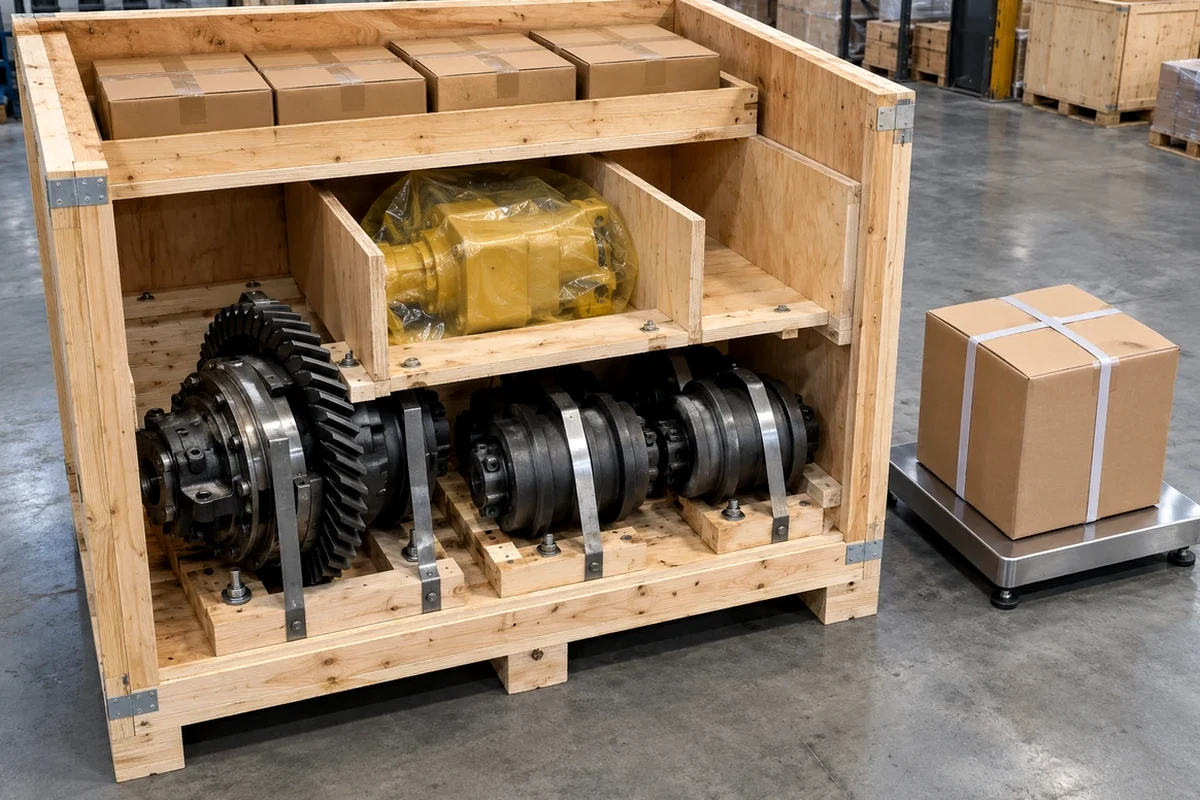
Stage 4 export crating and modal split execution: bolting high-mass differential and undercarriage castings to the bottom skid deck (Zone 1), isolating VCI-wrapped hydraulic pumps behind internal wooden partitions (Zone 2), staging crush-sensitive filter cartons on the upper shelf (Zone 3), and splitting urgent machine-down stoppers onto a separate air-express parcel on the floor scale.
Stage 4 Export Crating (ISPM 15), Incoterms 2020, UN 3480 / UN 3164 DG & WCO HS Classification Matrix
Scroll horizontally to view all columns.
| Export execution layer | Governing international regulation | Mandatory engineering & compliance specification | How it is recorded on your shipment dossier | Dominant failure mode & prevention |
|---|---|---|---|---|
1. Incoterms 2020 Delivery & Risk-Transfer Terms | ICC Incoterms 2020 (EXW, FCA, FOB, CIF, CIP, DAP, DDP) | EXW: Buyer handles pickup & export customs.FCA [Named Warehouse/Terminal]: HPS clears export customs & loads buyer's forwarder.FOB [Named Port]: HPS delivers on board vessel.CIF / CIP & DAP: HPS manages main air/sea freight to destination port or jobsite (excludes destination import duty/tax unless DDP) | Stated verbatim with the named geographic port/place on the Proforma Invoice, Commercial Invoice, and Bill of Lading / AWB | Failure mode: Booking EXW across multiple domestic factories when the buyer lacks a local export customs broker, stranding cargo at origin. Prevention: Use FCA [Consolidation Warehouse] or FOB [Port] when using your own forwarder, or CIF / DAP when HeavyPartsSource manages freight (see shipping). |
2. Phytosanitary Wood Crating & 3-Zone Heavy-Over-Light Load Securement (ISPM 15) | FAO IPPC ISPM 15 (Regulation of Wood Packaging Material in International Trade) | Solid wood crates/skids (> 6 mm thick) use debarked timber heat-treated to >= 56 °C (132.8 °F) core temperature for >= 30 min (HT) with visible IPPC wheat-ear stamps on two opposite sides, OR 100% engineered plywood/OSB crates (exempt from ISPM 15). Enforces Zone 1 (Base) bolted iron, Zone 2 (Middle) partitioned cores, Zone 3 (Top) light cartons (CG <= 40% height) | Crate external dimensions (L x W x H cm), gross/net weight (kg), ISPM 15 HT certificate/stamp photo, and crate ID recorded on Packing List | Failure mode: Destination customs (US CBP, EU, Australia, Chile/Peru) quarantining or ordering re-export of an unstamped raw-timber crate ($1,500–$4,500 port fines), or loose rollers crushing filters in transit. Prevention: Mandate ISPM 15 HT or engineered plywood crates with bolted 3-zone internal partitions. |
3. Dangerous Goods Segregation (UN 3480 Lithium Batteries, UN 2794 Wet Batteries, UN 3164 Accumulators & Class 3 Liquids) | IATA DGR (62nd Ed. / ICAO TI) & IMDG Code (PI 965 for UN 3480; PI 208 / SP A114 & IMDG SP 283 for UN 3164) | UN 3480 Lithium-Ion Batteries (Class 9): State of Charge <= 30% SoC, short-circuit protected, Cargo Aircraft Only (CAO) or separate DG sea booking.UN 3164 Hydraulic Accumulators (Class 2.2 N_2 gas): Ship uncharged (0 bar N2, certified gas-free) for air cargo, or isolate on a signed DG declaration (>= 5x burst pressure).Class 3 Liquids/Aerosols: Strip liquid sealants/ether from air overhaul kits | Explicit Non-DG, 0 bar Gas-Free Certificate, or separate Shipper's Declaration for Dangerous Goods (DGD) & SDS | Failure mode: Packing one standalone UN 3480 lithium diagnostic/backup battery, a pre-charged UN 3164 nitrogen breaker accumulator, or a 50 mL flammable gasket sealant tube inside a general air pallet—causing airport X-ray security to impound the entire shipment. Prevention: Segregate UN 3480 / UN 2794 batteries, strip liquid chemicals from air kits, and ship air-freight accumulators at 0 bar N2. |
4. Customs Tariff Classification (WCO Harmonized System Chapters 84 & 87) | WCO Harmonized System (HS) 6-digit international headings + destination 8/10-digit tariff schedule (US HTS, EU TARIC) | Assigns exact functional HS headings per line:• 8409.99: Diesel engine internal parts (pistons, liners, valves, bearings, gaskets)• 8413.50 / 8413.60 / 8413.91: Axial-piston (8413.50), gear/vane (8413.60) hydraulic pumps & rotary group parts (8413.91)• 8412.21 / 8412.29: Hydraulic cylinders (8412.21) & swing/travel motors (8412.29)• 8421.23 / 8421.31: Fuel/lube (8421.23) & air (8421.31) filters• 8481.20: Hydraulic/pneumatic control valves• 8431.41 / 8431.49: Excavator buckets/GET (8431.41) & undercarriage rollers/chains (8431.49)• 8708.30 / 8708.40 / 8708.50: Heavy-truck brakes (8708.30), gearboxes (8708.40), & drive axles (8708.50) | 6-digit HS code, material composition (forged steel / cast iron / elastomer), and principal machine function printed on every Commercial Invoice line | Failure mode: Declaring an entire 30-line mixed crate under one generic catch-all code (e.g., classifying excavator engine or hydraulic parts under 8708 automotive parts), triggering customs inspection holds, tariff reclassification penalties, or overpaid import duties. Prevention: Classify every Commercial Invoice line under its exact functional Chapter 84 (machinery/engine/hydraulics) or Chapter 87 (commercial vehicle chassis) 6-digit HS heading. |
Engineering Rule-of-Thumb (Stage 4 Modal Freight Split: Urgent Air-Express <= 70 kg Machine-Down Parts vs. Heavy ISPM 15 Ocean-LCL Crates & UN 3480 / UN 3164 Segregation): If a quotation combines urgent machine-down components with heavy structural assemblies or regulated items → route urgent high-value stoppers with individual piece weight W_piece <= 70 kg and chargeable air weight W_charge_air = max(W_gross_kg, L_cm * W_cm * H_cm / 6000) <= 85 kg (such as ECM controllers, wire harnesses, fuel injectors, seal kits, pilot valves, and bare hydraulic rotary groups) via Priority-A International Air Express (DHL / FedEx / Air Cargo, 3–6 days door-to-door) to cap machine-down standby losses, while routing heavy iron and overhaul batches (W_total >= 150 kg or V_total >= 1.0 CBM, such as complete final drives, track chains, rollers, cylinders, and crankcases) via Priority-B Ocean LCL/FCL packed in ISPM 15 HT-stamped (>= 56 deg C / 30 min) or engineered plywood crates, and strictly isolate any UN 3480 lithium-ion battery (<= 30% SoC, Cargo Aircraft Only), UN 3164 pressurized accumulator (unless bled to 0 bar N2), or Class 3 liquid sealant from general air cargo so a single restricted item never grounds urgent repair parts.
Takeaway: Every shipment leaves with a line-keyed Commercial Invoice and Packing List matching your original Line_IDs, enabling fast receiving checks and transparent claims handling under our warranty and returns policy.
How do you calculate total landed cost (C_total,landed) and compare downtime-adjusted sourcing options across air vs. ocean freight?
Comparing two supplier quotes by unit ex-works price (C_FOB) alone is a classic procurement trap. A low unit price on an unverified part that takes 28 days by sea while an excavator sits idle—or a blind quote that carries a 25% probability of a serial-break fitment return—costs far more than a verified Tier-1 OES unit dispatched via air express.
1. Quantitative Landed Unit Cost & Downtime-Adjusted Sourcing Selection Formula (C_total,landed)
To evaluate competing supply tiers (Genuine OEM vs. Tier-1 OES vs. Verified Aftermarket) and freight modes (Air Express vs. Ocean LCL) on an apples-to-apples engineering basis, calculate the Downtime-Adjusted Total Landed Cost C_total,landed ($):
C_total,landed = C_FOB + C_freight + C_duty + ( D_lead * C_downtime,day )
where:
-
C_FOB= Verified ex-warehouse /FCA/FOBpart price includingISPM 15export crating ($). -
C_freight= Modal international transport cost ($), governed by Air Express chargeable weightW_charge_air = max(W_gross_kg, L_cm * W_cm * H_cm / 6000)or Ocean LCL freight tonsM_charge_lcl = max(V_cbm, W_gross_kg / 1000). -
C_duty= Destination customs tariff and brokerage entry fee under the part's 6-digitWCO HSheading ($), calculated asC_duty = (C_FOB + C_freight_CIF) * r_tariff + C_broker. -
D_lead= Total door-to-door lead time from order confirmation to site delivery (days, including warehouse QC, transit, and customs release). -
C_downtime,day= Net daily machine-down standby and lost-production cost ($/day). For planned preventive maintenance (PM) or stock replenishment,C_downtime,day = $0/day(because the machine continues working while the crate sails). For an unplanned machine-down breakdown (AOG / Line-Down) on a 20-to-35-ton excavator or heavy dump truck (10 h/shiftat$120–$250/hnet contribution),C_downtime,day = $1,200–$2,500/day. -
1-Line Worked Example (Sourcing a
62 kgKawasaki K3V112DTHydraulic Main PumpHS 8413.50for a Downed[SANY SY215C](/models/sany/sy215c)Excavator withC_downtime,day = $1,500/dayvs. Planned Overhaul Stock withC_downtime,day = $0/day):Machine-Down Air Express (Tier-1 OES, D_lead = 5 days): C_total,landed = $3,100 (FOB) + $620 (Air 62 kg) + $286 (5% Duty + $100 Broker) + (5 days * $1,500/day) = $4,006 + $7,500 = $11,506 (vs. $46,729 if shipped by 29-day Sea LCL while machine sits idle: $2,850 + $180 + $252 + [29 * $1,500] = $46,782 -> Air Express saves $35,276 in net downtime!).Planned Stock Replenishment (C_downtime,day = $0/day, D_lead = 29 days Sea LCL): C_total,landed = $2,850 (FOB) + $180 (Sea LCL) + $252 (Duty + Broker) + (29 * $0) = $3,282 landed (saving $724 vs. Air Express when ordered ahead of scheduled overhaul).
2. Expected Blind-Quote Wrong-Part Air-Freight Return & Rework Cost Equation (E[C_blind])
When a buyer orders from an unverified "low-price" supplier that skips Stage 1 serial-break verification (P_err = 0.22 probability of wrong revision) and skips Stage 3 caliper QC, the true expected cost E[C_blind] includes the dead round-trip freight, non-recoverable import duties, and extra downtime days D_rework spent waiting for a replacement:
E[C_blind] = C_total,landed + P_err * ( C_part_unrecovered + 2 * C_freight + C_duty + D_rework * C_downtime,day )
- Worked Example (
$2,600Unverified Blind-Quoted Pump CarryingP_err = 0.22Serial/Spline Error Risk on a Downed Excavator): Even if the blind supplier quotes$2,600($500cheaper on paper than verified Tier-1 OES at$3,100), a22%chance of receiving the wrong regulator curve or spline adds0.22 * ($650 restocking/scrap loss + $1,240 two-way air freight + $260 wasted duty + [8 extra days * $1,500/day]) = 0.22 * $14,150 = $3,113in expected rework—making the "cheaper" blind quote$2,613more expensive per order than Stage 1–4 verified sourcing.
3. 5-Year Blind-Quote Wrong-Part Air Freight Loss, Uninspected Crate Damage & 4-Stage Verified Sourcing TCO Ledger
Scroll horizontally to view all columns.
| 5-Year Fleet Sourcing Cost Dimension | Blind Part-Number Quotes & Uninspected Dispatch | HeavyPartsSource 4-Stage Verified Sourcing Workflow | 5-Year Financial & Operational Impact (15-Machine Fleet) | Dominant Failure Mode & Prevention |
|---|---|---|---|---|
1. Serial-Break Wrong-Part Returns & Dead Air Freight (Stage 1 Audit) | 18%–28% fitment mismatch rate on bare P/N quotes; buyer eats $400–$1,800 dead international air freight and 15%–25% restocking fees per wrong shipment | < 0.5% fitment discrepancy rate (17-char ISO 10261 PIN / ISO 3779 VIN + Engine ESN/CPL + Sub-Vendor Tag locked before pricing) | Saves $24,000–$52,000 over 5 years in wasted two-way air freight, duplicate customs duties, and unreturnable wrong-revision parts | Failure mode: Ordering by generic model name (PC200-8, SY215C, X3000) across mid-series OEM serial breaks or pricing a raw foundry casting mark. Prevention: Enforce Stage 1 PIN/VIN + ESN and sub-vendor plate verification on every line. |
2. Precision Tier-1 OES vs. Machine-Box Markup & Cheap Copy Failures (Stage 2 Allocation) | Either overpaying 25%–45% for machine-brand outer boxes on all parts OR suffering $8,000–$18,000 hydraulic/engine swarf failures from unverified cheap copies | Strategic Tier-1 OES (Rexroth, Kawasaki, Bosch, Cummins, Donaldson, ZF, WABCO) on precision cores + Verified Aftermarket (HRC 52–58) on heavy wear steel | Reduces annual spare parts spend by 18%–32% ($45,000–$95,000 over 5 years) while maintaining zero hydraulic/fuel contamination failures | Failure mode: Silent substitution of low-grade copies for high-pressure hydraulic pumps (34.3 MPa) or HPCR injectors (200 MPa). Prevention: Declare exact manufacturer and supply tier per line in the Stage 2 written offer. |
3. Pre-Shipment Caliper QC vs. Jobsite Teardown Surprises (Stage 3 ISO 2859-1 QC) | Boxes forwarded unopened from sub-suppliers; wrong spline counts (14T vs. 17T), missing kit O-rings, or bent MLS head gaskets discovered mid-repair | 100% digital caliper & tag check on precision cores (Critical AQL 0.0 / Ac = 0) + ISO 2859-1 Level II batch sampling + timestamped line-XX-qc.jpg photo dossier | Eliminates 8–14 days of stalled bay teardown downtime per incident ($12,000–$35,000 saved per avoided bay hold) | Failure mode: Discovering a DIN 5480 vs. SAE J744 spline mismatch or missing crankshaft seal while the machine is torn down in the workshop. Prevention: Measure splines, pilots, ports, and kit piece counts on our QC bench before crating. |
4. Uninspected Crate Crush Damage, ISPM 15 Quarantine & UN 3480 / UN 3164 Air Holds (Stage 4 Execution) | Loose heavy iron crushing filters in thin boxes; unstamped wood fined $1,500–$4,500 at destination customs; UN 3164 / UN 3480 items grounding air cargo | 3-Zone ISPM 15 HT (56 °C / 30 min) or plywood crates + 0 bar N2 accumulator discharge + UN 3480 separation + line-level WCO HS 84/87 invoicing | Saves $15,000–$38,000 over 5 years in avoided transit damage, port demurrage fines, and customs reclassification delays | Failure mode: Heavy rollers crushing spin-on filters inside an unpartitioned crate or one charged UN 3164 accumulator halting an urgent air shipment. Prevention: Enforce 3-zone heavy-over-light ISPM 15 crating and modal DG split in Stage 4. |
Takeaway: A rigorous 4-stage sourcing and quotation process lowers 5-year fleet total cost of ownership by eliminating wrong-revision shipments, matching supply tiers to physical stress limits, catching dimensional errors before export, and matching freight mode to machine downtime cost.
Download CSV templates & copy the 4-Stage Sourcing & Quotation Verification Worksheet
Use our standardized engineering templates to submit your inquiry and audit incoming quotations line by line:
- Download the blank parts request & Stage 1 identification template (CSV, English): Lock one item per row with an immutable
Line_ID, plain-text (@) part number, reference brand, parent17-char PIN/VIN + Engine ESN, quantity, semanticISO 8000-110unit (PCS / SET / KIT / PAIR / ASSY), target supply tier, and photo filenames. - Download the Stage 2–4 quotation review & reconciliation checklist (CSV, English): Audit every offered line against your original
Line_ID—verifying the offered manufacturer, supply tier (Genuine OEM / Tier-1 OES / Verified Aftermarket), assembly scope, unit price, lead timeD_lead,Incoterms 2020basis,WCO HScode, and Stage 3 QC photo sign-off before authorizing shipment.
End-to-End Stage 1 to Stage 4 Line-Item Reconciliation Example
Scroll horizontally to view all columns.
| Workflow gate | Engineering verification record (line-01 & line-02) | Commercial & physical status |
|---|---|---|
| Stage 1: Identity & EPC Serial-Break Audit | line-01 requests SANY B220301000626 (1 ASSY main hydraulic pump) for [SANY SY215C](/models/sany/sy215c) (PIN: SY0215CB93688xxxx). Raking-light photo line-01-pump-tag.jpg confirms installed Kawasaki K3V112DT-1XER-9N24 with regulator KR3G-9N24. line-02 requests 12 PCS bottom track rollers (SANY 60277731). | Both identities locked against parent machine PIN and component nameplate; zero open serial ambiguities. |
| Stage 2: Supply-Tier Allocation & Written Offer | line-01 quoted as Tier-1 OES (Kawasaki KPM, Complete Pump + Regulator ASSY) in Offered_Reference column ($3,100 FOB, 2-day QC lead time). line-02 quoted as Verified Aftermarket (HRC 55 forged alloy steel, 12 PCS) ($1,680 FOB). Quote validity locked for 10 days. | Buyer reviews and signs off on Tier-1 OES cross-reference for line-01 and Verified Aftermarket for line-02 in writing. |
Stage 3: Pre-Shipment ISO 2859-1 Caliper & Tag QC | Gate 3A (100% check on line-01): Caliper confirms 14-tooth spline (OD 37.50 mm, JIS B 1603 / DIN 5480), ISO 3019-2 pilot spigot, and KR3G-9N24 tag (line-01-qc.jpg). Gate 3B (ISO 2859-1 Level II on line-02): Sample n = 3 rollers verified for flange width, bolt hole circle, and HRC 55 hardness (Critical AQL = 0.0, Ac = 0). | All ports plugged, machined surfaces VCI-wrapped, and QC photo dossier approved by buyer prior to crate sealing. |
Stage 4: Modal Split, ISPM 15 Crating & Incoterms 2020 Dispatch | Because the excavator is down (C_downtime,day = $1,500/day), line-01 (62 kg, HS 8413.50) dispatches immediately via Priority-A Air Express (CIP / DAP). line-02 (480 kg, HS 8431.49) bolts to the base skid of an ISPM 15 HT-stamped crate via Priority-B Ocean LCL (CIF). | Commercial Invoice, line-keyed Packing List, ISPM 15 certificate, Airway Bill (line-01), and Ocean B/L (line-02) archived against order record. |
Takeaway: Always reconcile incoming quotes line-by-line against your original Line_ID and keep any proposed Tier-1 OES or aftermarket cross-reference in a dedicated Offered_Reference column so your maintenance records retain full traceability.
Frequently asked questions about our parts sourcing and quotation process
Why does HeavyPartsSource require my machine's 17-character PIN/VIN and engine or pump nameplate before issuing a binding quote?
Across heavy equipment (Caterpillar, Komatsu, SANY, XCMG, Hitachi, Volvo), commercial trucks (SHACMAN, Sinotruk HOWO), and diesel engines (Cummins, Weichai, Isuzu), manufacturers introduce mid-production engineering updates (serial breaks) without changing the exterior model decal (iso-10261-preview.txt, komatsu-serial-lookup.md). Quoting a bare part number or model name without locking the 17-character ISO 10261 PIN / ISO 3779 VIN and the installed component dataplate (Engine ESN + CPL/DH, Bosch Rexroth R902..., or Kawasaki K3V/K5V regulator code) results in an 18%–28% field fitment return rate—or prices a raw foundry casting mark instead of a machined catalog assembly (casting-vs-part-number.md). Locking these identifiers in Stage 1 guarantees that the quoted component matches your exact factory build configuration.
How do you decide whether to quote Genuine OEM, Tier-1 OES (Bosch / Cummins / Rexroth / Kawasaki / Donaldson / Dana / ZF), or Verified Aftermarket?
In Stage 2, we allocate supply tiers by physical operating stress and micron clearance (oem-cross-brand-part-number-syntax-normalization.txt), while always respecting your explicit tier preference. For high-pressure hydraulic pumps, motors, and control valves (31.4–38.0 MPa, 5–12 um clearance), common-rail fuel injection assemblies (160–250 MPa, 1–3 um clearance), 2–4 um (Beta >= 200–1000) secondary fuel filters, and heavy-truck transmissions or pneumatic brake valves, we prioritize Tier-1 OES (Bosch Rexroth, Kawasaki, Bosch, Denso, Cummins, Donaldson, Fleetguard, Dana, ZF, Fast Gear, WABCO) or Genuine Machine OEM, because Tier-1 OES delivers the exact assembly-line component in the sub-vendor's box at 18%–35% lower cost than machine-brand packaging. Conversely, for high-mass structural wear steel (undercarriage track chains, rollers, idlers, sprockets, buckets, teeth, cutting edges, and pins/bushings), we offer Verified Aftermarket Replacement (HRC 52–58 heat-treated alloy steel verified under Stage 3 QC), saving 32%–55% without compromising service life.
What happens during Stage 3 pre-shipment QC inspection (ISO 2859-1), and do I receive photos before my order ships?
Yes. Before any export crate is sealed, every order undergoes Stage 3 physical inspection at our warehouse (iso-2859-1-aql-sampling-wco-hs-chapters-84-87.txt, quality checks). On precision assemblies (N_lot <= 8), our technicians perform a 100% piece-by-piece check using calibrated digital vernier calipers, micrometers, and thread gauges to verify shaft spline tooth count Z and major OD (DIN 5480 / JIS B 1603 vs. SAE J744), mounting flange pilot diameter (ISO 3019-1/-2), port threads (ISO 6162 Code 61 vs. Code 62), and riveted nameplates. On multi-unit consumable and undercarriage batches (N_lot >= 9), we pull ISO 2859-1 General Inspection Level II samples enforced at Critical Defect AQL = 0.0 (Ac = 0, Re = 1) for fitment dimensions, Major AQL = 1.0, and Minor AQL = 2.5. Every item is plugged, VCI-wrapped, labeled with Line_ID + Machine_ID + OEM_PN + Offered_PN, and photographed (line-XX-qc.jpg) so you can approve the physical hardware before dispatch.
How do you handle Incoterms 2020, ISPM 15 wood crating, and dangerous goods (UN 3480 batteries / UN 3164 hydraulic accumulators)?
In Stage 4, every written quote and Commercial Invoice specifies the exact Incoterms 2020 rule and named geographic place (FCA [Named Warehouse] or FOB [Port] when handing over to your freight forwarder; CIF / CIP or DAP when HeavyPartsSource manages international air or ocean transport) (incoterms-2020-trade-gov.txt). All solid-wood export crates use debarked timber heat-treated to >= 56 °C core temperature for >= 30 minutes (HT) and stamped with the FAO IPPC ISPM 15 wheat-ear mark (or use ISPM 15-exempt engineered plywood crates) with 3-zone heavy-over-light internal dividers (ispm-15-ippc-wood-packaging-export-crating.txt). Regulated items—including UN 3480 lithium-ion batteries (Class 9, <= 30% SoC, Cargo Aircraft Only), UN 2794 wet batteries, UN 3164 nitrogen-charged hydraulic accumulators (Class 2.2), and Class 3 liquid sealants/aerosols—are strictly segregated from general air cargo; for urgent air orders, we discharge UN 3164 hydraulic accumulators to 0 bar N2 (certified gas-free) for local nitrogen charging at your site (iata-lithium-battery-guidance-un3480.txt).
What to send us
Scroll horizontally to view all columns.
| Item | Why we need it | Example format |
|---|---|---|
1. Line-Numbered Parts Request (Line_ID + Verbatim Part Number + Source Type) | Locks immutable line-01, line-02 tracking (ISO 8000-110 / 115) and distinguishes EPC catalog codes from riveted tags or raised casting marks | Completed CSV request template or worksheet below submitted via our quote request page |
2. Host Machine 17-Char PIN / VIN & Installed Sub-Assembly Serial Plate | Resolves Stage 1 OEM serial breaks (ISO 10261 PIN / ISO 3779 VIN) and engine/pump/drivetrain configurations (Cummins ESN+CPL, Weichai DH, Rexroth R902..., Kawasaki K3V..., Fast/ZF/Axle ratio) | SANY SY215C | PIN: SY0215CB93688xxxx | Engine: Isuzu 4HK1 ESN 648xxx + line-01-pin-plate.jpg |
3. Target Supply Tier (Genuine OEM vs. Tier-1 OES vs. Verified Aftermarket) & Scope (Qty + UOM) | Guides Stage 2 supply-tier allocation (Rexroth / Kawasaki / Bosch / Cummins / Donaldson / Dana / ZF vs. wear steel) and locks semantic ISO 8000-110 units (PCS / SET / KIT / PAIR / ASSY) | line-01: 1 ASSY Main Pump w/ Regulator (Tier-1 OES Kawasaki); line-02: 1 SET of 6 Piston-Liner Kits |
4. Supporting 10–25° Raking-Light Nameplate & Caliper Photos | Enables Stage 1 casting-vs-catalog resolution and establishes the baseline for Stage 3 ISO 2859-1 caliper QC (splines, pilot OD, port threads, bore x rod) | line-01-pump-tag.jpg, line-01-spline-caliper.jpg (camera flash OFF, oblique LED light per our part photo guide) |
5. Destination Port/Address, Preferred Incoterms 2020 & Modal Split (Air vs. Sea LCL/FCL) | Determines Stage 4 FCA / FOB / CIF / DAP freight costing, splits <= 70 kg machine-down air stoppers from ISPM 15 ocean crates, and flags UN 3480 / UN 3164 (0 bar) handling | Priority-A Air Express (DAP Lima) for line-01; Priority-B Ocean LCL (CIF Callao, ISPM 15 HT crate) for lines 02–15 |
A preliminary part-number hit in our catalog search or a general model listing does not by itself confirm serial-break compatibility, assembly scope, or live warehouse stock. When your parts list and identification photos are ready, submit your request for Stage 1 verification and a written quotation. You can also explore our heavy equipment parts hub (including SANY and the SANY SY215C model guide), heavy-duty truck parts hub (including SHACMAN and the SHACMAN X3000 model reference), and diesel engine parts directory (including Weichai and the Weichai WP12 engine reference), or review our parts sourcing service, part identification service, multi-brand consolidation service, pre-dispatch quality checks, shipping terms, and warranty and returns policy.
Takeaway: Locking the 17-character machine PIN/VIN and sub-assembly serial tag in Stage 1, separating Tier-1 OES precision cores from Verified Aftermarket wear steel in Stage 2, enforcing ISO 2859-1 caliper and photo QC in Stage 3, and splitting urgent air stoppers from ISPM 15 3-zone ocean crates in Stage 4 transforms international heavy-parts purchasing into a predictable, zero-surprise engineering workflow.
Method and sources
This 4-stage parts sourcing, quotation, pre-shipment QC, and export dispatch guide was compiled from international machinery identification, master-data quality, statistical sampling inspection, phytosanitary crating, dangerous-goods transport, customs tariff, and commercial trade standards alongside OEM catalog systems, reviewed October 2026:
- ISO 10261:2021(E) (Earth-moving machinery — Product identification numbering system), US 49 CFR § 565.15 / ISO 3779 (Vehicle identification number (VIN)), ISO 8000-110:2021 (Master data: Syntax, semantic encoding, and conformance to data specification), & ISO 8000-115:2018 (Exchange of quality identifiers) (
iso-10261-preview.txt,49-cfr-565-15-vin-content-structure-check-digit.txt,iso-8000-110-115-master-data-quality-bom.txt): 17-character machine PIN and truck VIN structures, immutable line-item tracking (Line_ID), composite part identifiers (Brand_Namespace : Part_Number), and semantic Units of Measure (PCS,SET,KIT,PAIR,ASSY). - Cross-Brand OEM EPC Serial-Break, Supersession & Tier-1 OES Allocation Reference (
oem-cross-brand-part-number-syntax-normalization.txt,casting-vs-part-number.md,cat-serial-prefix-sis.md,komatsu-serial-lookup.md,cummins-dataplate-esn-cpl-guide.txt,kawasaki-k3v-k5v-pump-catalog.txt,rexroth-axial-piston-commissioning-manual.txt,donaldson-f110024-eng.txt,eurotruck-wabco-knorr-bremse-valve-id.txt): EPC numbering, revision suffixes, casting-vs-catalog rules, and OEM vs. Tier-1 OES (Bosch,Cummins,Bosch Rexroth R902...,Kawasaki K3V/K5V,Donaldson,Fleetguard,Dana,ZF,Fast Gear,WABCO) vs. Verified Aftermarket supply-tier criteria. - ISO 2859-1:1999 / ANSI/ASQ Z1.4 (Sampling procedures for inspection by attributes — Part 1: Sampling schemes indexed by acceptance quality limit (AQL) for lot-by-lot inspection), ISO 3019-1/-2, DIN 5480 / JIS B 1603 / SAE J744, & ISO 6162-1/-2 (
iso-2859-1-aql-sampling-wco-hs-chapters-84-87.txt,iso-3019-preview.txt,din-5480-eassistant.md,iso-6162-sae-j518-flanges.md): Stage 3 pre-shipment 100% precision assembly caliper inspection (N_lot <= 8) and General Inspection Level II batch sampling (Critical Defect AQL = 0.0 / Ac = 0, Re = 1;Major AQL = 1.0;Minor AQL = 2.5) across shaft splines, mounting pilots, and 4-bolt split-flange ports. - ICC Incoterms 2020 Official Rules, FAO IPPC ISPM 15 (Regulation of Wood Packaging Material in International Trade), IATA Dangerous Goods Regulations (
62nd Ed. / ICAO TI — UN 3480 PI 965 & UN 3164 PI 208 / SP A114), IMDG Code (SP 283), & WCO Harmonized System (HS) Chapters 84 and 87 (incoterms-2020-trade-gov.txt,ispm-15-ippc-wood-packaging-export-crating.txt,iata-lithium-battery-guidance-un3480.txt,iata-dgr-imdg-un3164-un2794-dg-part-segregation.txt,iso-2859-1-aql-sampling-wco-hs-chapters-84-87.txt): export handover terms (EXW,FCA,FOB,CIF,CIP,DAP),>= 56 °C / 30 min HTsolid-wood crating vs. exempt plywood, dangerous-goods separation (UN 3480 <= 30% SoC CAO,UN 3164 0 bar N2uncharged air option), and 6-digit customs tariff headings (8409.99,8413.50/60/91,8412.21/29,8421.23/31,8431.41/49,8481.20,8708.30/40/50).